By Fatima Saka
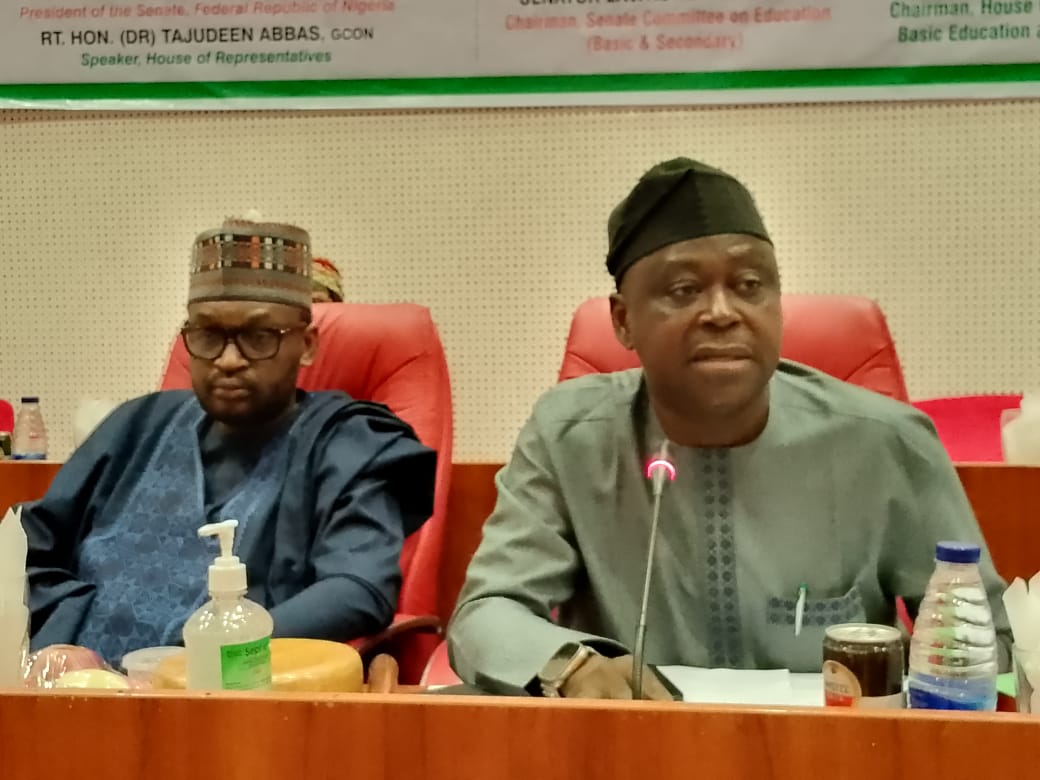
The Joint Committees of the Senate and House of Representatives on Education have expressed divergent views over the proposed removal of the five per cent counterpart funding requirement for states seeking federal intervention funds for senior secondary education, as lawmakers deliberate on measures to strengthen the administration and financing of public schools across Nigeria.
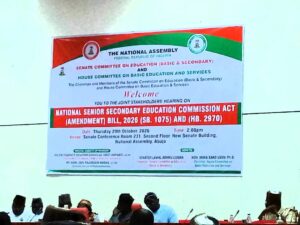
The disagreement emerged on Thursday during a joint stakeholders’ hearing on the National Senior Secondary Education Commission (Amendment) Bill, 2026, comprising Senate Bill 1075 and House Bill 2970, at the National Assembly, Abuja.
The hearing was hosted by the Chairman of the Senate Committee on Education (Basic and Secondary), Senator Lawal Adamu Usman, and the Chairman of the House Committee on Basic Education and Services, Hon. Mark Bako Useni, PhD.
While proponents of the proposed amendment argued that retaining the five per cent counterpart funding requirement could prevent financially constrained states from accessing federal education support, some lawmakers insisted that states must demonstrate commitment to education financing, particularly following increased revenue accruing to state governments from the removal of fuel subsidy.
A representative of the bill’s proponents explained that the proposed removal was intended to ensure that no state, including the Federal Capital Territory, would be excluded from accessing intervention funds because of its inability to provide counterpart contributions.
He said the Federal Government remained concerned about Nigerian children’s access to quality education and should not allow the five per cent requirement to become an obstacle to states benefiting from the intervention programme.
However, a lawmaker expressed reservations about the proposal, arguing that state governments should be able to contribute to education development, especially with the additional resources available to them following the removal of fuel subsidy.
He recalled that during a previous retreat, lawmakers had contacted some state governors over their failure to provide counterpart funding, prompting some of them to fulfil their obligations and access available intervention funds.
The lawmaker maintained that states should demonstrate genuine commitment to education rather than depend entirely on federal intervention.
Responding to concerns about possible diversion of intervention funds, the bill’s proponents explained that the proposed framework would introduce a performance-based funding model to ensure transparency and accountability.
Under the arrangement, states would first conduct needs assessments of their public schools and submit action plans detailing identified gaps and proposed interventions to the commission.
The commission would subsequently review the plans, agree on the required funding with state education authorities and sign performance agreements specifying projects and expected outcomes.
The funds, according to the explanation, would be released in instalments rather than as a single payment.
The first tranche would be released to enable implementation, while subsequent payments would depend on monitoring, verification and confirmation that the funds had been utilised in accordance with agreed objectives.
The proposed arrangement would also involve auditors and monitoring teams to verify projects and prevent the diversion of education funds to unrelated expenditure.
Another major issue raised at the hearing was the scope of direct Federal Government intervention in public secondary schools.
A lawmaker questioned provisions of the proposed legislation which appeared to restrict direct intervention to selected categories of schools, including Federal Unity Colleges and schools operated by the military and police.
He argued that the commission’s intervention should cover public secondary schools across the country rather than exclude state-owned institutions.
The lawmaker called for a review of the provisions to ensure that public schools at all levels could benefit from federal support.
In response, the proponents acknowledged the concern and indicated that the relevant provisions would be considered for amendment to broaden the scope of direct intervention.
Earlier, the Federal Capital Territory Secondary Education Board expressed support for strengthening the National Senior Secondary Education Commission, describing it as necessary for improving the administration, coordination, financing and governance of public senior secondary schools.
The board said a properly strengthened commission could provide an effective national framework for addressing critical challenges in senior secondary education, particularly through targeted interventions in infrastructure, teaching and learning resources, laboratory facilities and teacher development.
It also called for a clear delineation of responsibilities between the commission at the federal level and state education authorities to avoid duplication of functions.
The board recommended transparent criteria for allocating intervention funds, with funding decisions based on students’ population, the number of schools and existing infrastructure deficits.
It further called for timely release of approved funds, periodic reviews of intervention priorities across states and the FCT, professional representation and competence in the commission’s governance structure, as well as effective monitoring and accountability mechanisms without creating unnecessary administrative bottlenecks.
The board reaffirmed its support for the strengthening of the commission as an institution responsible for providing coordinated oversight of public senior secondary education.
In closing the technical session, the joint committees assured stakeholders that their written submissions and recommendations would be considered in the legislative process.
READ ALSO: Nigeria’s Rising Neonatal Deaths Expose Gaps in Preventive Healthcare — FG
NTDs: Nigeria’s 2030 Elimination Target Threatened by Funding Gaps, Drug Shortages
A representative of the committees said the National Assembly was making laws in the interest of Nigerians and not for the legislature or the executive, assuring participants that their contributions would help improve the quality of the proposed legislation.
The joint hearing was organised by the Senate Committee on Education (Basic and Secondary) and the House Committee on Basic Education and Services.
About The Author