Solar Panel
By Fatima Saka
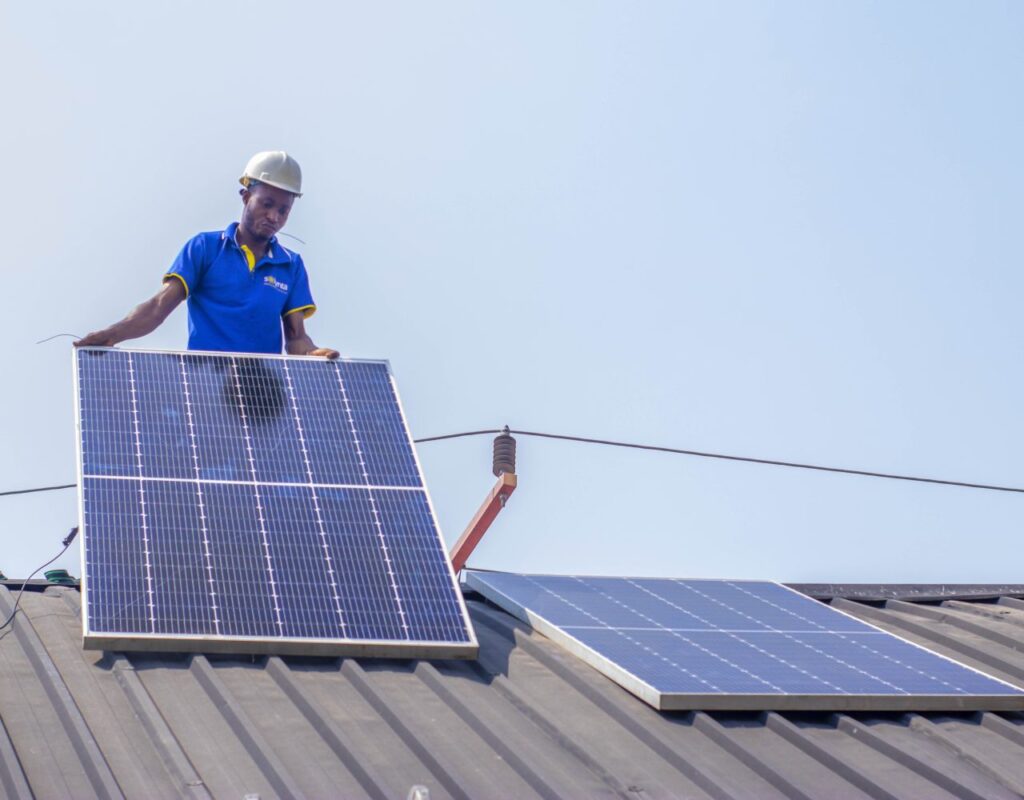
The Solar Power Nigeria Campaign has applauded the Federal Government for prioritising local manufacturing capacity before restricting solar panel imports, saying the approach would protect Nigerians from rising solar equipment costs while strengthening the country’s renewable energy industry.
The campaign, in partnership with the Global Initiative for Food Security and Ecosystem Preservation (GIFSEP), commended the Minister of Innovation, Science and Technology, Dr Kingsley Tochukwu Udeh, SAN, for supporting a gradual transition to domestic production rather than imposing an import ban before local manufacturers could meet national demand.
In a statement issued on Friday, Dr Michael Terungwa David, Co-Convener of the Solar Power Nigeria Campaign and Executive Director of GIFSEP, said developing local manufacturing capacity before restricting imports was necessary to protect energy access, create jobs and promote Nigeria’s energy self-sufficiency.
David said the approach would enable households, businesses and public institutions to continue accessing affordable solar products while local manufacturers developed the capacity to meet the country’s growing demand.
The minister had reportedly stated during a recent media briefing that Nigeria could not ban solar panel imports without first establishing sufficient domestic manufacturing capacity.
As part of efforts to achieve this, Udeh disclosed that the Federal Government was engaging major solar manufacturers in Turkey to attract investment and establish production facilities in Nigeria, with memoranda of understanding expected to be signed soon.
The campaign also welcomed plans to strengthen quality control mechanisms to prevent substandard solar panels and components from entering the Nigerian market, stressing that both locally manufactured and imported products must meet acceptable standards.
It further highlighted the Barefoot Renewable Energy College, commissioned in September, as a key initiative for training artisans in solar manufacturing and installation.
According to GIFSEP, developing a skilled workforce would improve installation standards, strengthen local production and potentially reduce the cost of solar products and services.
The campaign also acknowledged the Renewed Hope Solarisation Project, being implemented through the Energy Commission of Nigeria, to transition federal institutions, including academic institutions, from dependence on the national grid to solar power.
It noted that the government’s approach was particularly important given Nigeria’s electricity challenges, with the national grid supplying approximately 4,000 to 5,000 megawatts to a population of more than 200 million people.
Millions of households and businesses continue to rely on expensive petrol and diesel generators, making solar energy an important alternative for improving electricity access.
The campaign warned that banning solar panel imports before local manufacturers could meet market demand could increase prices and make solar energy less accessible to households and businesses already struggling with electricity costs.
It said the government’s current direction aligned with recommendations made by renewable energy stakeholders during engagements organised earlier in 2026.
At a media training on renewable energy reporting organised by GIFSEP and its partners in April, stakeholders warned that an outright import ban could worsen energy poverty if domestic manufacturers were unable to meet demand.
They consequently advocated a phased transition over three to five years to allow local manufacturers to expand production while Nigerians continued to access imported solar products.
Similarly, participants at the Kano Solar Dialogue 2026, co-organised by GIFSEP and the Centre for Renewable Energy and Sustainability Transition at Bayero University Kano in July, called for a National Renewable Energy Industrialisation Roadmap.
The proposed roadmap identified incentives for local manufacturers, affordable financing, technical training, stronger quality standards and gradual import substitution as essential measures for developing Nigeria’s solar industry.
Reacting to the development, David said the government’s decision to prioritise manufacturing capacity before restricting imports was the right approach to protecting consumers and supporting local industry.
“We commend the Honourable Minister for listening to stakeholders and choosing a path that puts Nigerians first. Building manufacturing capacity before closing the door to imports is the right sequence,” he said.
He added that the focus on quality standards and technical training would address persistent challenges in the solar sector, particularly the circulation of substandard products and poor installation practices.
To ensure the policy delivers tangible benefits, the campaign urged the Federal Government to publish a clear, time-bound roadmap for expanding local manufacturing and gradually substituting imports in consultation with industry operators and civil society organisations.
It also called for incentives and affordable financing for manufacturers, installers and households, alongside stronger enforcement of quality standards at ports and in local markets in collaboration with the Standards Organisation of Nigeria.
The campaign further recommended expanding the Barefoot Renewable Energy College and similar training programmes across the six geopolitical zones, with deliberate inclusion of women and young people.
READ ALSO: NBTI Seeks Global Investment to Turn 298 Nigerian Innovations into Businesses
It urged the government to extend the Renewed Hope Solarisation Project beyond federal institutions to primary healthcare centres, schools and rural communities.
The Solar Power Nigeria Campaign and GIFSEP reaffirmed their readiness to work with the Ministry of Innovation, Science and Technology, the Energy Commission of Nigeria and other stakeholders through research, public engagement and dialogue to support affordable solar energy access and the growth of Nigeria’s domestic manufacturing industry.
About The Author