
By Fatima Saka
The proposed nationwide ban on single-use plastics could lead to widespread job losses, business closures and higher consumer prices if implemented abruptly, the House of Representatives Ad-Hoc Committee on the Preparedness for the Single-Use Plastic Ban in Nigeria has warned.
The committee, chaired by Hon. Terseer Ugbor, Deputy Chairman, House Committee on Environment, called for a phased and evidence-based transition, supported by fiscal incentives and measures to protect businesses and workers affected by the policy.
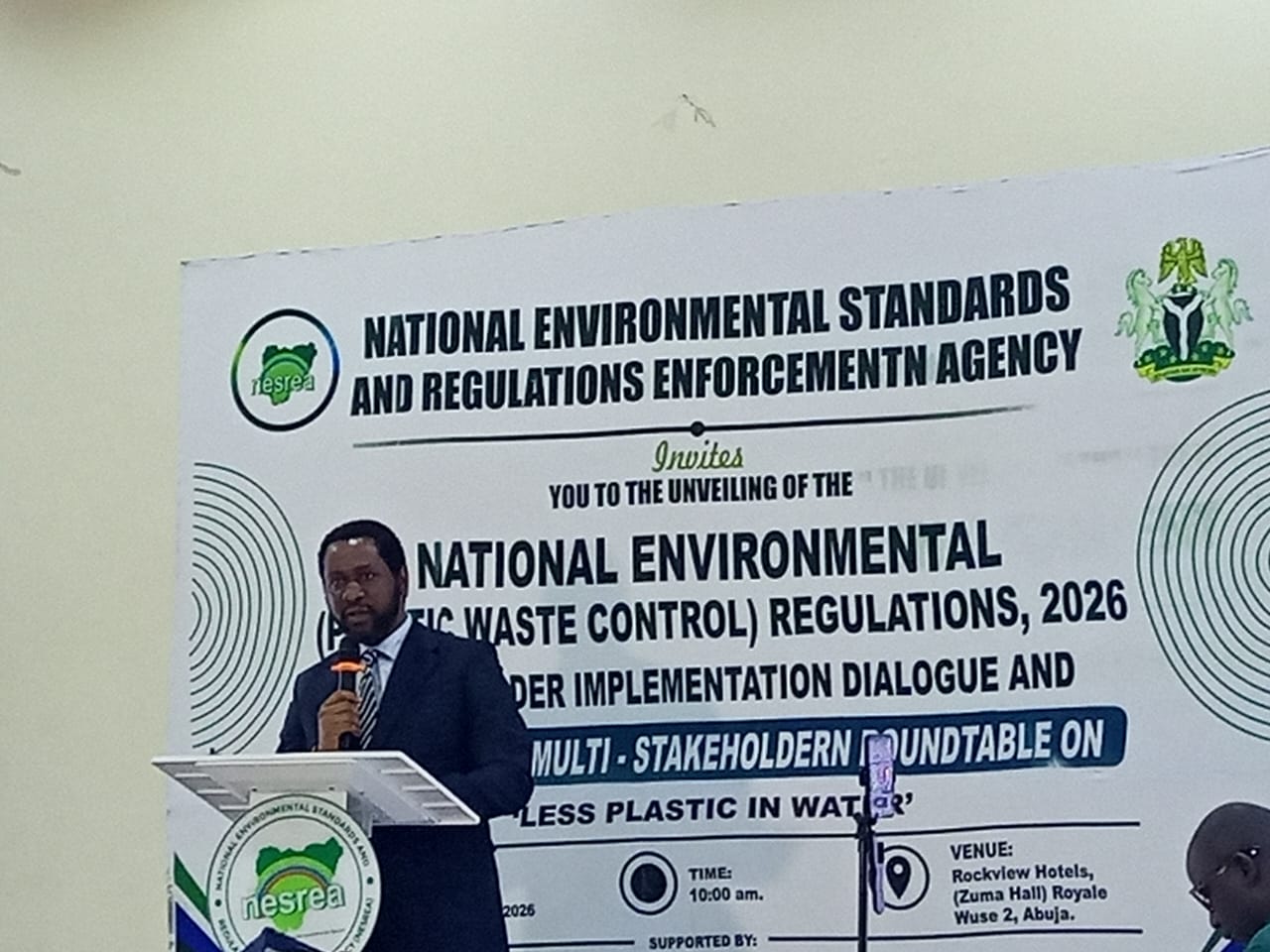
Ugbor made the position known on Thursday in Abuja at the unveiling of the National Environmental (Plastic Waste Control) Regulations, 2026, Stakeholders Implementation Dialogue and inaugural Multi-Stakeholder Roundtable on Less Plastic in Water, organised by the National Environmental Standards and Regulation Enforcement Agency (NESREA) in collaboration with relevant stakeholders.
The committee recommended the introduction of a Green Tax and stronger Extended Producer Responsibility (EPR) obligations for plastic producers and importers, while proposing consideration of an immediate ban on lightweight plastics below 40 microns.
It said Nigeria generates close to 2.5 million tonnes of plastic waste annually, with less than 10 per cent formally recycled, contributing to blocked drainage systems and the leakage of plastic waste into marine ecosystems.
The committee warned that an immediate ban could disproportionately affect small and medium-sized enterprises that lack the financial capacity to acquire machinery and transition to alternative packaging materials.
It therefore proposed a phased legislative and regulatory schedule, harmonisation of federal and state plastic regulations, stronger enforcement, recycling incentives and retooling support for affected businesses and workers.
The committee said revenue generated through green taxation and EPR could be channelled into recycling infrastructure and the development of a nationwide circular economy.
The Federal Ministry of Environment said it was implementing the Federal Executive Council’s directive on the phase-out of PET bottles, Styrofoam bags and straws within government ministries, while supporting staged implementation, mandatory impact assessments, a clear EPR framework and ring-fenced funding for affected workers and SMEs.
The Federal Ministry of Industry, Trade and Investment called for the proposed blanket ban to be suspended, advocating a Plastic Waste Management Bill focused on collection and recycling.
It also proposed refill-and-reuse systems, research into bio-polymers, incentives for eco-packaging machinery and tax credits for businesses that meet recycling targets.
NESREA warned that a sudden blanket ban could affect access to clean drinking water and result in significant job losses, advocating a phased transition towards full circularity by 2030.
The Manufacturers Association of Nigeria proposed a gradual phase-out over 14 years, while the Food and Beverage Recycling Alliance recommended a one-to-two-year ban on Styrofoam and lightweight nylons below 40 microns, followed by expanded EPR obligations for PET bottles and water sachets.
The Minister of Environment, Balarabe Abbas Lawal, represented by the Permanent Secretary, Salihu Aminu Usman, called for an integrated approach that balances environmental protection with economic development.
He described the transition to a circular plastic economy as an environmental, public health, employment and governance project, stressing that plastic waste could become raw material for new industries through efficient collection, processing and recycling.
READ ALSO: FG Vows to Protect Nigerian Investments in Angola, Prioritises Auto Parts Market
Standards Key to Preventing Satellite Failures – Space Engineer Says
The committee maintained that Nigeria’s plastic pollution crisis requires urgent action but stressed that the transition must protect jobs, businesses and industrial livelihoods.
It said a successful single-use plastic ban should therefore be anchored on a clear roadmap combining phased regulation, green fiscal incentives, industrial support and effective enforcement.
About The Author