
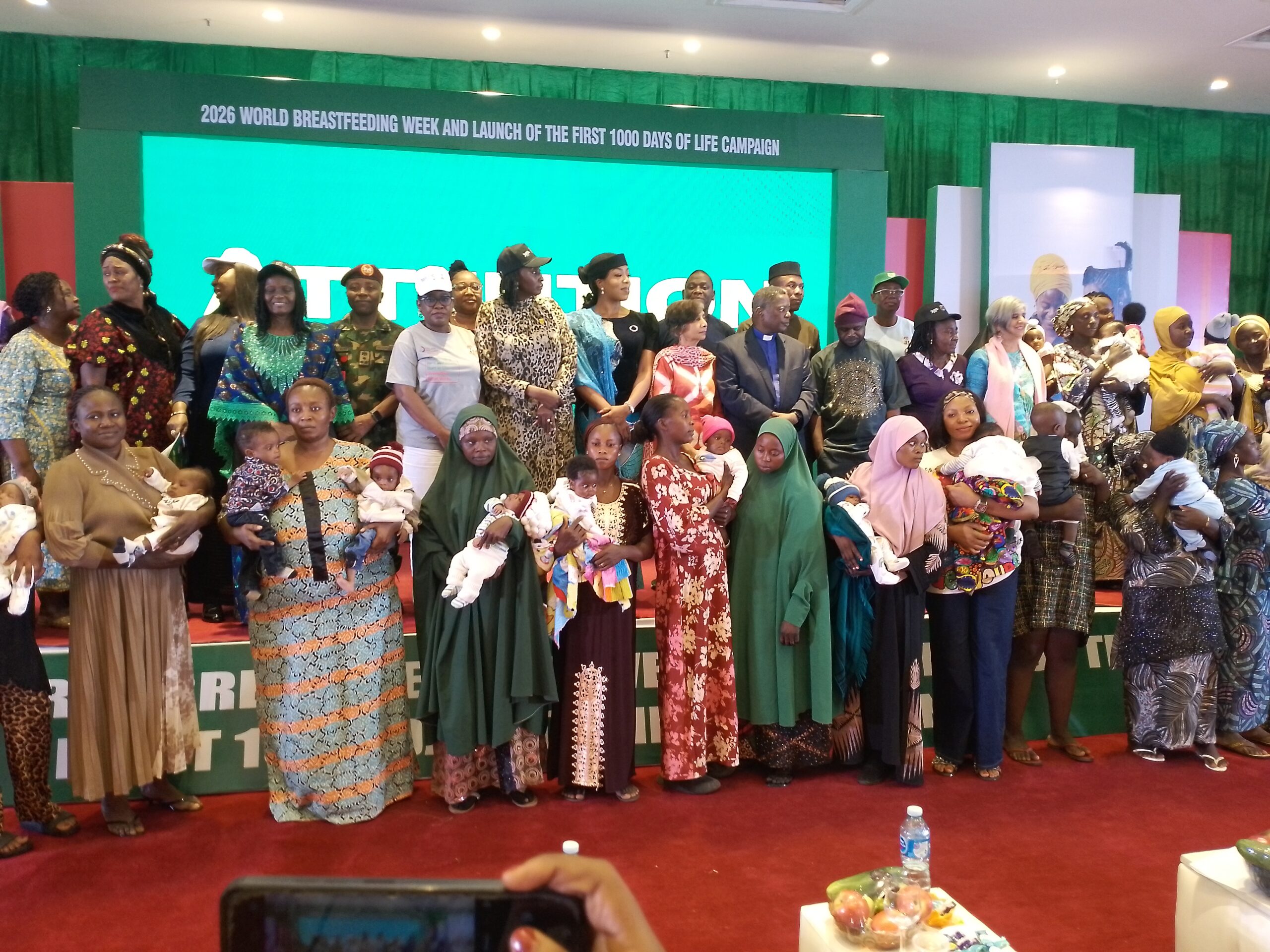
Advocates for maternity protection and community support
By Fatima Saka
Abuja – The Federal Government has expressed concern over Nigeria’s persistently low exclusive breastfeeding rate, revealing that only 29 per cent of infants are exclusively breastfed for the first six months, despite widespread awareness of its benefits.
The Permanent Secretary, Federal Ministry of Health and Social Welfare, Daju S. Kachollom, disclosed this at the 2026 World Breastfeeding Week commemoration and the launch of the First 1,000 Days of Life Nutrition Social and Behaviour Change Campaign on Monday in Abuja.
Kachollom said although about 95 per cent of Nigerian mothers breastfeed, only 36 per cent initiate breastfeeding within the first hour after birth, while just 23 per cent continue up to 24 months.
She warned that poor nutrition within the first 1,000 days of life—from conception to a child’s second birthday—can result in irreversible consequences such as stunting, weak immunity, impaired cognitive development, and reduced economic productivity.
“Nigeria is currently facing a triple burden of malnutrition, including undernutrition, micronutrient deficiencies and rising overweight cases. Breastfeeding remains one of the most effective interventions for improving child survival and development,” she said.
The Permanent Secretary identified barriers such as cultural practices, inadequate counselling, limited workplace support, and aggressive marketing of breast milk substitutes as major challenges affecting optimal breastfeeding practices.
She reaffirmed government’s commitment to scaling up breastfeeding interventions through strengthened policies, expansion of baby-friendly hospital initiatives, enforcement of regulations, and promotion of breastfeeding-friendly workplaces. She also commended the 21 states that have implemented six months paid maternity leave, urging others to follow.
In her welcome address, Director of Nutrition, Mrs. Olufunmilola Adegbite, described breastfeeding as a critical investment in national development, noting that while 95.6 per cent of children are breastfed at some point, only about 35.5 per cent begin within the first hour of birth.
Adegbite added that malnutrition remains a major public health concern, with stunting affecting about 40 per cent of children, while underweight and wasting also persist across the country.
Ms. Wafaa fadil Saeed Abdelatef, representative of the United Nations Children’s Fund (UNICEF) emphasised that breastfeeding is not only a maternal responsibility but a collective societal duty requiring enabling policies and supportive environments.
The UNICEF representative, who acknowledged “all the women with their beautiful children,” said the event celebrates mothers and their vital role in child development, stressing that breastfeeding is “the first vaccine” that protects children against illness, malnutrition and preventable deaths.
She noted that despite over 90 per cent of women breastfeeding, only about one-third of newborns receive breast milk within the first hour, while exclusive breastfeeding remains at 29 per cent due to structural and societal barriers.
“We cannot place the burden solely on mothers. Without supportive environments, at home, in workplaces, and through government policies, even the most determined mothers will struggle,” she said.
The UNICEF representative further underscored the importance of the First 1,000 Days campaign, describing it as a strategic intervention to promote maternal nutrition, early initiation of breastfeeding, exclusive breastfeeding, and appropriate complementary feeding.
“The campaign is about creating an environment where healthy choices become easy choices, where fathers, families, communities, employers and policymakers all support breastfeeding,” she added.
Also speaking, Dr. Pavel Ursu, represented, a representative of the World Health Organization (WHO) called for strengthened policies, increased funding, and expanded community-based interventions to improve breastfeeding outcomes in Nigeria.
The WHO representative highlighted evidence showing that improved breastfeeding counselling and baby-friendly health facilities can significantly boost exclusive breastfeeding rates, urging stakeholders to prioritise six key actions, including legislation, health system strengthening, family and community support, and sustained financing.
According to WHO, early initiation of breastfeeding within the first hour, exclusive breastfeeding for six months, and continued breastfeeding up to two years and beyond remain critical to improving child survival and development outcomes.
Other stakeholders, including representatives of civil society organisations, Executive Secretary of CS-SUNN, Mr. Sunday Okoronkwo, was represented by the Programme Manager, Mr. Ridwan Awosanya.
Delivering a goodwill message on the theme, “Breastfeeding for a Sustainable Start in Life: Strengthen What Works,” Okoronkwo described breastfeeding as a vital intervention for maternal and child health and a cornerstone for national development.
He emphasised that breastfeeding extends beyond basic nutrition, playing a critical role in human capital development, building resilient communities, and driving sustained national prosperity.
Others development partners, and the Nigerian Legion, also called for stronger collaboration, improved funding, and community engagement to enhance breastfeeding practices nationwide.
READ ALSO: NiDCOM Confirms Release of Nigerian Girls Detained in Mauritius
FG Advocates for Stronger Public Diplomacy, Repositions Policy
They stressed that breastfeeding is fundamental to human capital development, national productivity, and long-term economic growth.
The 2026 World Breastfeeding Week, themed “Breastfeeding for a Sustainable Start in Life: Strengthening What Works,” highlights the need to scale up proven interventions and ensure that every child receives optimal nutrition for a healthy start in life.
About The Author