By Fatima Saka
The Federal Government has renewed its commitment to reducing maternal and newborn deaths, with a strong emphasis on improving the quality, equity, and timeliness of healthcare delivery across Nigeria.
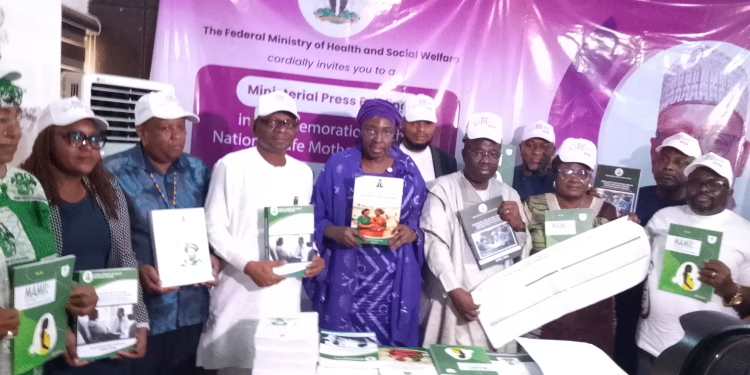
Speaking at the commemoration of Safe Motherhood Day 2026, the Coordinating Minister of Health and Social Welfare, Muhammad Ali Pate, said this year’s theme, “Closing the Gap: From Coverage to Quality Care for Every Mother,” reflects an urgent national priority to move beyond expanding access to ensuring effective and life-saving maternal care.
Represented by the Permanent Secretary of the ministry, Daju Kachollom, the minister acknowledged that while Nigeria has made progress in expanding maternal health services, significant gaps remain—particularly in the quality and timeliness of care for vulnerable populations.
A major pillar of the government’s strategy is the Maternal and Neonatal Mortality Reduction Innovation Initiative (MAMII), now operational in 32 states. The initiative deploys data-driven interventions to tackle the leading causes of maternal and neonatal deaths, while strengthening referral systems, emergency obstetric care, and overall service delivery.
To address financial barriers, the National Health Insurance Authority (NHIA) is scaling up access to Comprehensive Emergency Obstetric and Newborn Care services. Since the programme’s rollout, over 32,000 women and 1,700 newborns have benefitted, with more than 250 health facilities participating nationwide.
The government also highlighted improvements in emergency response through the National Emergency Medical Services and Ambulance System (NEMSAS) and the Rapid Emergency Services and Maternal Transport (RESMAT) programme. Currently active in 136 of the 172 MAMII local government areas, the initiative is supported by 612 ambulances across 340 LGAs.
According to the minister, nearly 79,000 people have been transported under the scheme, with pregnant women accounting for about 60 per cent—an indication of its impact in reducing delays in accessing skilled care.
Further gains include a 20 per cent increase in antenatal care attendance in MAMII-supported areas, as well as the identification and linkage of over 166,000 previously unregistered pregnant women to health services across eight states.
In strengthening service delivery, the government has distributed over 111,000 “mama kits” and essential maternal and newborn health commodities to primary healthcare centres, reaching an estimated 1.2 million women and newborns nationwide.
On workforce expansion, more than 2,000 skilled birth attendants and 3,000 community health workers have been recruited to improve access to quality care, particularly at the grassroots level.
The minister also announced the rollout of key policy tools, including the Obstetrics Clinical and Newborn Service Protocol, revised Antenatal Care Guidelines, Life-Saving Skills training packages, and the MAMII Comprehensive Guide. These instruments are designed to standardise care, strengthen health worker capacity, and improve coordination across the health system.
Describing the reforms as a shift toward a more coordinated and systems-based approach, Pate stressed that achieving safe motherhood requires strong and functional healthcare systems.
“Every maternal death is preventable and unacceptable,” he said, calling on state governments, healthcare workers, and development partners to translate commitments into measurable actions.
In her remarks, the Permanent Secretary reiterated that access alone does not guarantee improved outcomes, noting that timely, skilled, and compassionate care remains critical to reducing maternal and newborn mortality.
She highlighted ongoing efforts to expand the empanelment of healthcare facilities capable of delivering Comprehensive Emergency Obstetric and Newborn Care, alongside reforms to strengthen the community health workforce and expand insurance coverage.
Also speaking, the Nigeria Country Representative of the World Health Organization, Pavel Ursu, commended the Federal Ministry of Health and Social Welfare for sustained reforms and improved coordination in the health sector.
Represented by Dr. Martin Joseph, the WHO official emphasised that access to healthcare must be matched with quality and respectful services to prevent maternal deaths.
He noted that ongoing reforms and enhanced collaboration among stakeholders are already contributing to improved health system performance, while reaffirming WHO’s commitment to supporting Nigeria in strengthening its health workforce and service delivery.
READ ALSO: 2027: Lawal Musa Daura. Most Qualified Candidate for Katsina State Governor
Consensus Candidacy Ignites Political Momentum of APC Rallies Behind Adeola for Ogun Governorship
The event also featured the launch of key policy and technical documents, including the National Antenatal Care Guidelines, the National Clinical Service Protocol for Obstetric and Neonatal Care, and the revised Life-Saving Skills training package for frontline health workers.
Stakeholders at the event stressed that translating these policies into practice will be critical to closing existing gaps and ensuring that no woman dies from preventable pregnancy-related causes in Nigeria.
About The Author