Lagos, Nigeria — The Minister of State for Health and Social Welfare, Dr. Iziaq Adekunle Salako, on Tuesday called for increased private sector investment to bridge Nigeria’s widening healthcare financing gap, stressing that sustainable growth in the sector depends on strategic public-private collaboration.
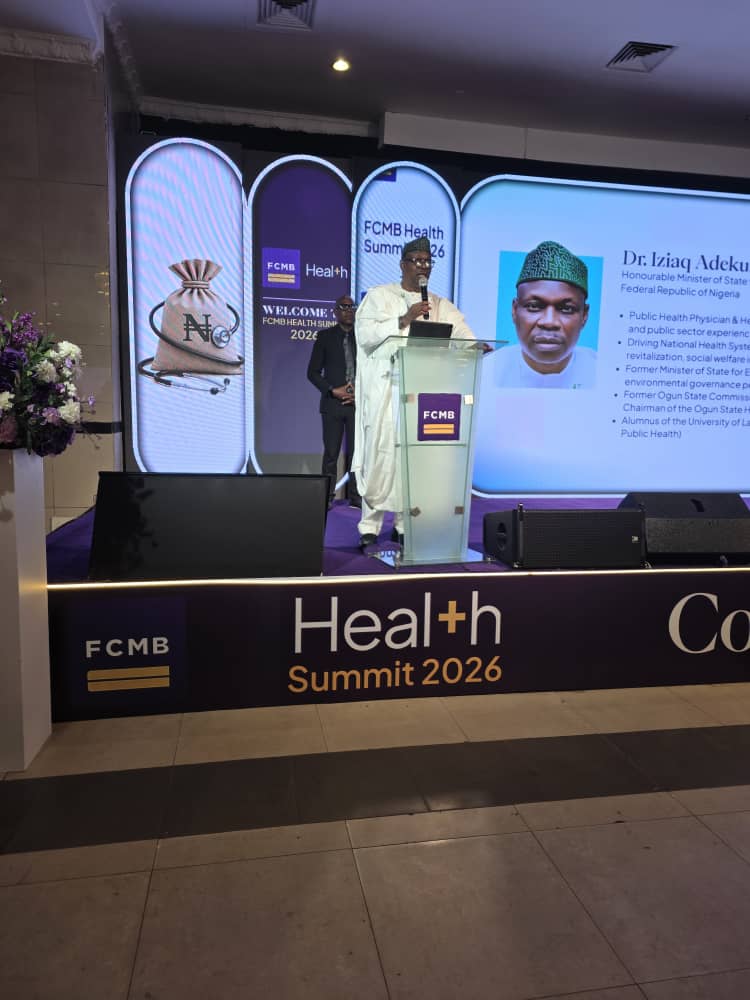
Speaking at the opening ceremony of the FCMB Healthcare Summit 2026 held at the Civic Centre, Lagos, Salako identified limited capital as one of the most critical constraints facing Nigeria’s health system, despite ongoing policy reforms by the Federal Government.
The summit, themed “Financing Growth, Unlocking Opportunity, Building the Future of Healthcare,” brought together key stakeholders including hospital owners, investors, regulators, and financial institutions to explore solutions for strengthening healthcare delivery through innovative financing.
Salako noted that while government policies provide direction, the scale of infrastructure and service delivery required for Nigeria’s population of over 240 million cannot be achieved without robust private sector participation.
He highlighted the role of the Basic Healthcare Provision Fund (BHCPF), established under the National Health Act 2014, describing it as a cornerstone of healthcare financing. According to him, the fund has disbursed a cumulative ₦339 billion over the past 12 years, with ₦235 billion released within the last three years under the current administration.
“The most recent tranche of ₦32.9 billion is supporting over 8,300 primary healthcare centres, with plans to expand coverage to about 13,000 facilities nationwide,” Salako said.
The minister also disclosed that the Federal Government is proposing an increase in the statutory allocation to the BHCPF from one percent to two percent of the Consolidated Revenue Fund, signaling stronger commitment to healthcare funding while encouraging private co-financing.
On health insurance coverage, Salako referenced the National Health Insurance Authority (NHIA) Act 2022, which makes health insurance mandatory for Nigerians. He revealed that enrollment has grown to over 22 million people, marking a 35 percent increase since 2023.
Despite this progress, he expressed concern that out-of-pocket spending still accounts for 71 percent of healthcare expenditure in Nigeria, far above the global benchmark of 15 to 20 percent.
“That gap is unacceptable and represents the financing challenge we must urgently address,” he said.
Salako further outlined key reforms under the Health Sector Renewal Investment Initiative launched in 2023, including expansion of primary healthcare infrastructure, establishment of cancer centres, and implementation of a sector-wide strategic blueprint for 2024–2027.
He also emphasized the importance of the Presidential Initiative for Unlocking the Healthcare Value Chain (PVAC), aimed at reducing Nigeria’s dependence on imported medical products. The initiative targets 70 percent local production of medicines, diagnostics, and devices by 2030.
In addition, the minister cited several financial interventions supporting the sector, including the Central Bank of Nigeria’s ₦100 billion Healthcare Sector Intervention Facility, a €50 million Bank of Industry partnership with EIB Global, and a $200 million African Development Bank facility to boost long-term financing for healthcare enterprises.
Salako described the launch of FCMB’s Dedicated Healthcare Fund as a significant step toward aligning commercial financing with government policy frameworks.
He urged investors to adopt stronger governance structures, leverage blended financing models, and prioritize investments in primary care, diagnostics, and local pharmaceutical manufacturing.
“Government cannot build Nigeria’s healthcare future on public financing alone, and the private sector cannot succeed without policy certainty and risk-sharing mechanisms,” he said.
Salako further urged stakeholders to translate discussions from the summit into actionable investments that will strengthen the healthcare system and improve access to quality services nationwide.
He then formally declared the FCMB Healthcare Summit 2026 open.If you’d like, I can tighten the lead further, add more policy context, or adapt it to your publication style (e.g., Distinct News tone).
About The Author