
By Fatima Saka
The Federal Government has reaffirmed its commitment to expanding access to quality eye care services, with a target to deliver five million free pairs of spectacles and 25,000 cataract surgeries nationwide by 2027.
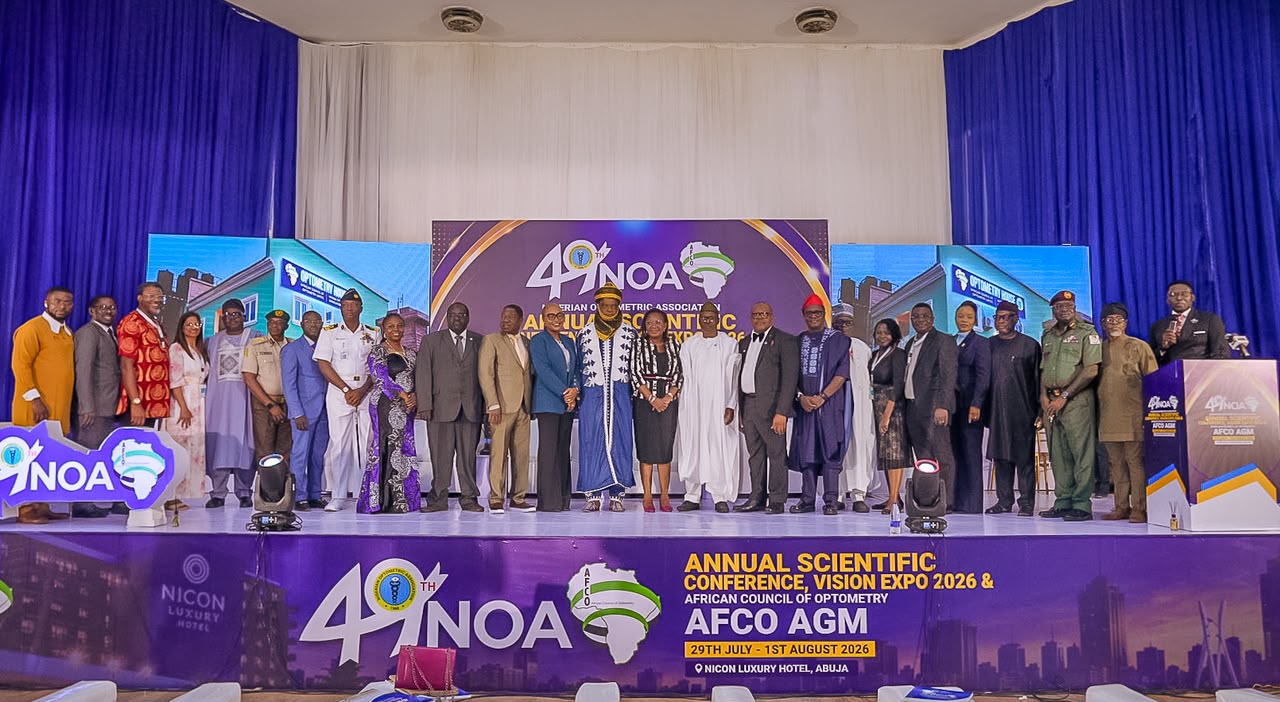
Minister of State for Health and Social Welfare, Dr. Iziaq Adekunle Salako, disclosed this on Thursday in Abuja while delivering his opening address at the 49th Annual National Scientific Conference of the Nigerian Optometric Association (NOA) and the African Council of Optometry (AFCO) Annual General Meeting.
Speaking on the conference theme, “Optometrists in a Changing Africa: From Diversity to Unity,” Salako emphasized the need for collaboration across the continent to strengthen healthcare systems and address growing public health challenges.
He noted that eye health had long been neglected in broader health discussions despite its significant impact on productivity, independence, and quality of life, stressing that the administration of President Bola Ahmed Tinubu has made eye care a national priority.
According to him, the government is implementing the National Eye Health Strategic Development Plan (2024–2028), aimed at integrating eye care services across primary, secondary, and tertiary healthcare levels to ensure early detection and effective management of eye diseases.
Salako highlighted key interventions, including the launch of the Nigeria Glaucoma Guidelines and Toolkit to standardize diagnosis and treatment nationwide, as well as the training of ophthalmologists across all 36 states and the Federal Capital Territory.
He further revealed that under the Effective Spectacle Coverage Initiative, Jigi-Bola 2.0, over 2,220 primary healthcare workers across 16 states have been trained to conduct vision screening and referrals.
Describing Jigi-Bola 2.0 as a flagship mobile eye care programme, the minister said nearly two million Nigerians have been screened, while over 1.3 million people have received free reading glasses, with about 66 per cent getting their first-ever pair.
“The initiative is now being expanded under the Renewed Hope Health Connect to reach more vulnerable populations and significantly reduce avoidable blindness in Nigeria,” he said.
Salako also underscored the economic value of investing in eye care, citing studies showing that every one dollar invested in eye health yields between 28 and 36 dollars in returns through improved productivity, reduced healthcare costs, and enhanced quality of life.
He noted that mobile clinics deployed under the Jigi-Bola programme have helped eliminate barriers such as distance and cost, bringing essential eye care services closer to underserved communities.
The minister described optometrists as critical frontline professionals in bridging the gap between primary screening and advanced care, commending their dedication, research contributions, and service in underserved areas.
He assured that the ministry would continue to collaborate with the Nigerian Optometric Association to deepen integration of grassroots eye care initiatives into the national health system.
Salako also lauded the NOA for bringing the headquarters of the African Council of Optometry to Nigeria and producing the President-elect of the continental body.
He urged practitioners to continue advancing the profession, mentoring younger colleagues, and partnering with government to achieve universal eye health coverage.
READ ALSO: Highland Montessori Graduates Class of 2026, Calls for Support for Vulnerable Children
FG Targets 5 Million Nigerians with Expanded Jigi-Bola Eye Care Initiative
Declaring the conference open, the minister called for increased investment in eye care systems, research, and access to quality services, stressing that improved vision health is essential for social inclusion, education, and national development.
“And so, with peace and plenty, Nigeria shall be blessed,” he concluded.
About The Author