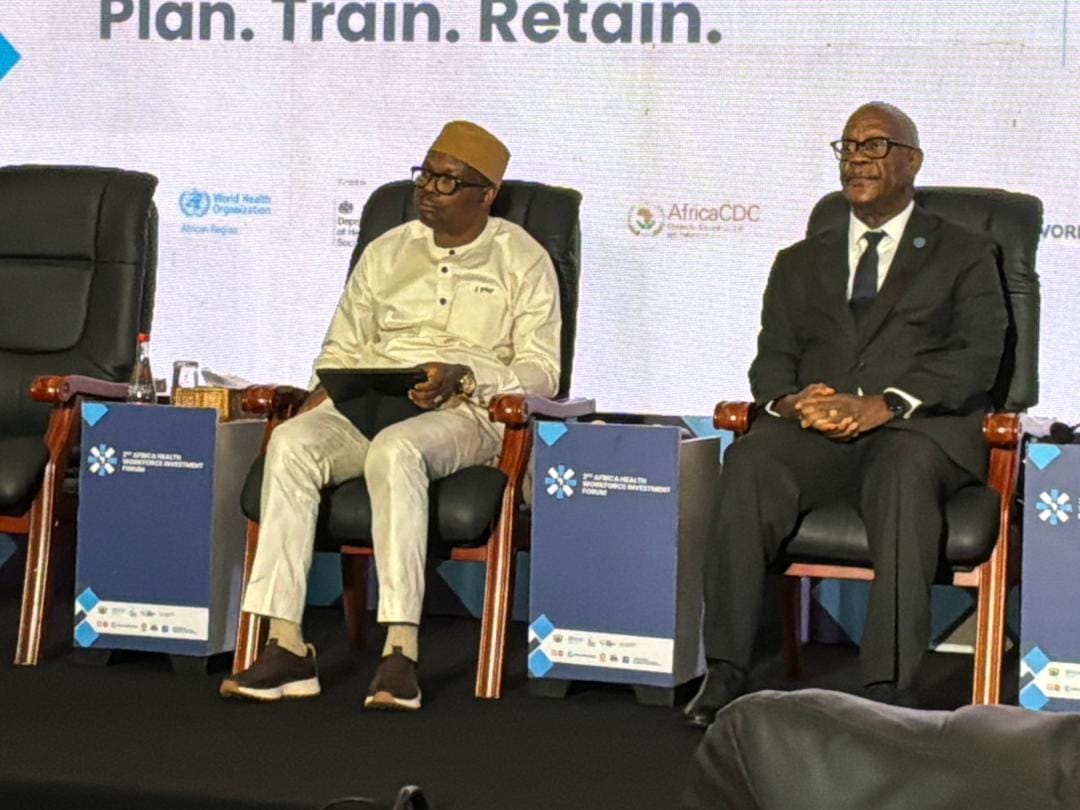
Accra, Ghana — Nigeria’s Minister of State for Health and Social Welfare, Dr. Iziaq Adekunle Salako, has raised alarm over Africa’s widening health workforce gap, warning that the continent could face a shortfall of 6.1 million health workers by 2030 without urgent and sustained investment.
Speaking at the 2nd Africa Health Workforce Investment Forum held at the Marriott Hotel Accra, Salako described inadequate financing for health personnel as a major barrier to achieving Universal Health Coverage (UHC).
He noted that although Africa’s health worker density improved from 11 per 10,000 people in 2013 to 27 per 10,000 in 2024, the growth remains insufficient to meet rising healthcare demands across the continent.
The minister highlighted a paradox within the sector, revealing that despite shortages, about 27 percent of skilled health professionals remain unemployed due to mismatches between training, job creation, and labour market needs.
Salako further pointed to a shifting financing landscape, noting that Official Development Assistance for health has declined by an estimated 70 percent between 2021 and 2025, even as public health emergencies surged by 41 percent between 2022 and 2024. Africa, he added, continues to bear approximately 25 percent of the global disease burden.
To address unemployment among qualified health workers, he said Africa requires a 43 percent increase in employment investment. However, domestic funding remains weak, with only Rwanda, Botswana and Cabo Verde meeting the 15 percent health budget target under the Abuja Declaration.
Focusing on Nigeria, Salako reaffirmed the country’s commitment to the Africa Health Workforce Investment Charter, noting that the government is implementing reforms to strengthen the sector.
He disclosed that in August 2024, the Federal Government approved a National Policy on Health Workforce Migration aligned with the World Health Organization Global Code of Practice. The policy addresses ethical recruitment, diaspora engagement, retention incentives, and rural deployment, while tackling the growing migration of health workers.
Under the administration of Bola Ahmed Tinubu, Nigeria has also launched a Health Sector Renewal Investment Initiative targeting approximately 900 million dollars in investments between 2024 and 2026. The programme focuses on strengthening primary healthcare infrastructure, expanding training capacity, and deploying community health workers nationwide.
Salako added that Nigeria has completed its National Health Workforce Country Profile and established a National Health Workforce Registry with technical support from the World Health Organization. A Health Labour Market Analysis is also underway to guide future investments.
He said the government has increased training quotas in health institutions and retrained over 70,000 frontline health workers, with a target of 120,000 under the primary healthcare workforce strengthening initiative.
The minister called for a new global compact on health workforce mobility, urging structured agreements that ensure mutual benefits between countries. He criticised the current system where low-income countries bear the cost of training health workers, only for high-income nations to benefit from their migration.
Salako proposed bilateral and multilateral arrangements that include compensation for source countries, joint training programmes, and managed migration pathways that allow professionals to gain experience abroad and return with enhanced skills.
READ ALSO: WHO, Norway Deepen Partnership to Boost Nigeria’s Health Systems, Tackle Immunisation Gaps
Lagos Launches Ferry Safety Mentorship Programme to Boost Water Transport Safety, Blue Economy
He also urged African countries to adopt a standard reporting system, recommending that each nation track and publish its graduate-to-employment ratio annually as part of an Africa Health Workforce Scorecard.
The forum continues through May 8, with stakeholders expected to deliberate on strategies to strengthen health systems and workforce sustainability across the continent.
About The Author