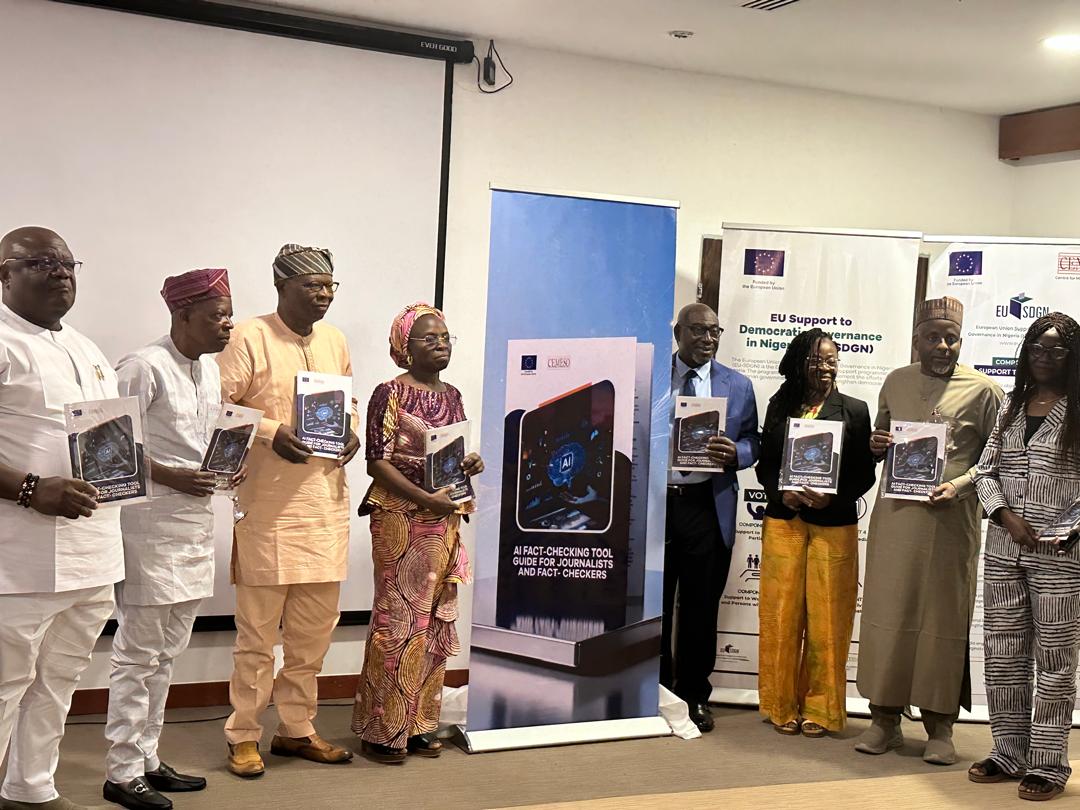
……AI Fact-Checking Tool Guide for Journalists and Fact-Checkers launched to strengthen verification capacity and combat misinformation in digital space

By Fatima Saka
Abuja, Nigeria — Media experts and stakeholders have raised alarm over the escalating threat of artificial intelligence (AI)-driven misinformation and disinformation to Nigeria’s electoral integrity, warning that the 2027 general elections could witness the most sophisticated wave of information warfare in the country’s democratic history.
The concern dominated discussions at a Technical Summit on Elevating Fact-Checking Capabilities of Journalists held on Tuesday in Abuja, organised by the Centre for Media and Society (CEMESO).
The Executive Director of CEMESO, Mr. Akin Akingbulu, said Nigeria’s information ecosystem is facing unprecedented pressure from coordinated disinformation networks, foreign interference, and AI-enabled manipulation.
He warned that artificial intelligence has fundamentally changed the scale and speed of deception in the digital space.
“Artificial intelligence has industrialised disinformation. We are now seeing the rapid production of deepfake videos, manipulated audio, and fabricated political narratives that spread faster than verification systems can respond,” Akingbulu said.
He described the convergence of AI manipulation, weak regulatory safeguards, and exclusion of vulnerable groups from political discourse as a “democratic emergency.”
According to him, Nigeria’s linguistic diversity is also being exploited.
“Most global AI detection systems are designed for English. This leaves Hausa, Yoruba, Igbo, and Pidgin highly exposed, yet these are the languages most targeted in disinformation campaigns,” he added.
Akingbulu further linked misinformation to declining electoral participation, noting that voter turnout dropped to 27 percent in 2023.
“When fear-based narratives and manipulated content dominate the information space, citizens disengage. Disinformation is no longer just about falsehood—it is about suppressing participation,” he said.
The Executive Director of the International Press Centre (IPC), Mr. Lanre Arogundade, also warned that deepfakes and AI-generated content are increasingly undermining public trust and democratic discourse.
He said journalism must evolve to meet the speed and sophistication of emerging threats.
“Deepfakes and AI-manipulated content are now capable of rewriting reality. They are produced with technical precision, and they require equally advanced verification systems to counter them,” Arogundade stated.
He stressed that fact-checking can no longer be treated as a peripheral newsroom function.
“Fact-checking must become real-time, embedded, and technology-driven. It is no longer optional; it is essential to democratic survival,” he said.
Arogundade disclosed that the Nigerian Fact-checkers Coalition has significantly expanded its monitoring capacity, moving from verifying over 150 election-related claims in 2023 to continuous real-time verification across electoral cycles.
Delivering a goodwill message on behalf of the Director-General of the National Broadcasting Commission (NBC), Mrs. Stella Erhunmnsee, Director of Broadcast Policy and Research, said misinformation now poses a direct threat to national stability and democratic legitimacy.
She commended CEMESO, IPC, and development partners for strengthening media resilience.
“The integrity of the information ecosystem is as critical as the integrity of the electoral process itself. Once trust collapses, democracy is weakened,” she said.
Erhunmnsee stressed that fact-checking must become a professional standard in journalism practice.
“Accuracy without verification is no longer enough. Fact-checking must move from being optional to being a core professional obligation in every newsroom,” she noted.
She described the unveiling of the AI Fact-Checking Tool Guide as a major milestone in strengthening proactive journalism.
> “This guide represents a shift from reactive reporting to proactive verification. It equips journalists to detect manipulation before it spreads,” she said.
However, she cautioned that technology alone cannot solve the problem.
“No tool can replace ethical journalism. The effectiveness of these innovations depends on discipline, responsibility, and professional judgment,” she added.
Stakeholders at the summit called for stronger coordination among regulators, media organisations, civil society, technology platforms, and development partners.
They also emphasised the need to institutionalise fact-checking within newsroom operations, especially in broadcast media, where verification systems remain inconsistent.
CEMESO also announced ongoing capacity-building efforts, including training for over 100 journalists in Ekiti State, alongside additional workshops planned in Abuja.
Looking ahead, participants proposed the establishment of campus-based fact-checking hubs to train young journalists and build grassroots resilience against misinformation.
READ ALSO: CDS Orders Troops to Intensify Anti-Terror Operations in Southern Kaduna
Troops Repel ISWAP Attack in Magumeri, Neutralise Scores, Recover Arms
They further stressed that combating disinformation requires inclusive strategies that empower women, youths, and rural communities—groups identified as both highly vulnerable to false information and least equipped to counter it.
The summit ended with a renewed commitment to coordinated action ahead of the upcoming off-cycle elections in Ekiti and Osun States, which stakeholders described as critical testing grounds for Nigeria’s preparedness ahead of 2027.
About The Author