By Fatima Saka
Nigeria has called for urgent reform of the United Nations Security Council and stronger multilateral cooperation to restore confidence in international institutions and make global governance more representative and effective.
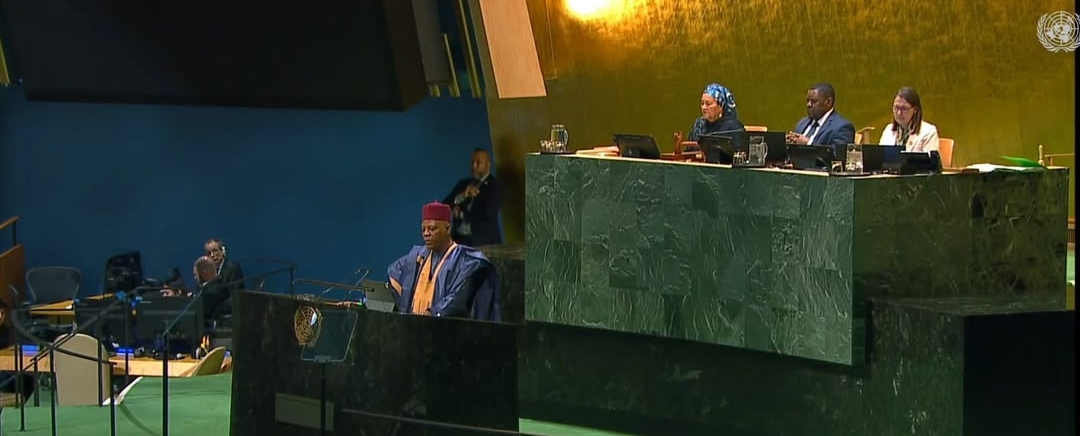
The call was made in Nigeria’s national statement delivered by Vice President Kashim Shettima, GCON, on behalf of President Bola Ahmed Tinubu, GCFR, during the General Debate of the 81st United Nations General Assembly (UNGA) on Thursday, September 24, 2026.
The statement, contained in a press release signed by Oluwafemi Adeniyi, Spokesperson, Ministry of Foreign Affairs, Abuja, on Friday, September 25, 2026, reaffirmed Nigeria’s commitment to the UN Charter, international law, diplomacy, dialogue and collective responsibility in addressing global challenges.
With the theme, “Restoring Trust, Managing Transformation: A United Nations That Delivers for All,” the General Assembly provided the platform for Nigeria to restate its position on strengthening international institutions and restoring trust in the multilateral system.
A major focus of Nigeria’s intervention was the long-standing demand for greater African representation on the UN Security Council.
Nigeria reiterated Africa’s position, as contained in the Ezulwini Consensus and Sirte Declaration, seeking at least two permanent and five non-permanent seats for Africa on the Council.
The country argued that reform was necessary to reflect current global realities and ensure meaningful African participation in decisions affecting international peace and security.
Nigeria also highlighted its contributions to international peacekeeping and regional stability, recalling its roles in Liberia, Sierra Leone, Darfur, Mali and The Gambia.
It reaffirmed its commitment to promoting peace, security and democratic governance through the Economic Community of West African States (ECOWAS), the African Union and partnerships in the Gulf of Guinea.
On economic development, Nigeria linked its foreign policy priorities to ongoing domestic economic reforms, including macroeconomic management, stronger institutions, private-sector development and strategic public investment.
The country called for greater technology transfer, capacity building and climate finance to enable developing countries pursue economic growth while meeting their climate commitments.
Nigeria also reaffirmed its commitment to the Energy Transition Plan and the Paris Agreement, including its target of achieving net-zero emissions by 2060.
On emerging technologies, Nigeria highlighted investments in digital infrastructure, broadband connectivity, innovation ecosystems, research institutions and technology entrepreneurship.
It called for responsible deployment of artificial intelligence to support healthcare, education, agriculture, governance and economic productivity.
The country further advocated reforms to the international financial architecture, including wider access to concessional financing and sustainable debt frameworks to support Africa’s economic transformation.
It expressed support for private capital, blended finance, South-South cooperation and strategic partnerships, while identifying the African Continental Free Trade Area (AfCFTA) as a key instrument for expanding intra-African trade, strengthening regional value chains and accelerating industrialisation.
On global security, Nigeria called for stronger international cooperation against terrorism, organised crime, cyberattacks and illicit financial flows.
Drawing from its experience in confronting Boko Haram, ISWAP and other armed groups, Nigeria stressed the need for intelligence sharing, institutional capacity building, disruption of terrorism financing and measures to prevent illicit weapons from fuelling conflicts.
It, however, emphasised that sustainable security requires more than military action, pointing to education, economic opportunities, accountable governance and protection of the rights and dignity of communities as essential components of lasting peace.
Nigeria also called for urgent diplomatic efforts to resolve conflicts in Sudan and other war-affected countries, urging parties to protect civilians, facilitate humanitarian access and respect international humanitarian and human rights law.
The country advocated greater emphasis on dialogue, reconciliation, peacebuilding and conflict prevention, noting that military victories alone cannot guarantee lasting peace.
Highlighting Africa’s potential as a major driver of future global growth, Nigeria pointed to the continent’s youthful population, natural resources, expanding markets, resilience and innovation as key assets.
It urged the international community to recognise developing countries as essential partners in shaping global solutions and achieving shared prosperity.
In its closing message, Nigeria pledged continued support for cooperation over confrontation, dialogue over division, hope over fear and partnership over isolation.
It urged UN Member States to fulfil their obligations to one another and confront current global challenges with justice, wisdom and compassion.
READ ALSO: NELFUND Student Loan: New Beneficiary Guidelines Ahead 2026/2027 Application
Flood Disaster: Umeh Visits Family of Six-Year-Old Boy Swept Away in Anambra
Nigeria maintained that a reformed, inclusive and effective United Nations is essential to achieving a peaceful, just and sustainable world for future generations.
Available next action: Create a downloadable DOCX file here in this chat containing the editable prose above
About The Author