By Fatima Saka
The Senate has intensified scrutiny of the ₦2.268 trillion 2026 budget proposal submitted by the Nigerian Army, demanding transparency, proper utilisation of funds, and clear justification for the massive increase as troops continue to battle insurgency across the country.
The Army is seeking ₦2,268,415,497,222 for the 2026 fiscal year — significantly higher than the ₦1.504 trillion proposed by the Ministry of Finance — creating a funding gap of over ₦764 billion. The proposal comes amid a declared state of emergency and sustained military operations against banditry in the North-West and insurgency in the North-East.
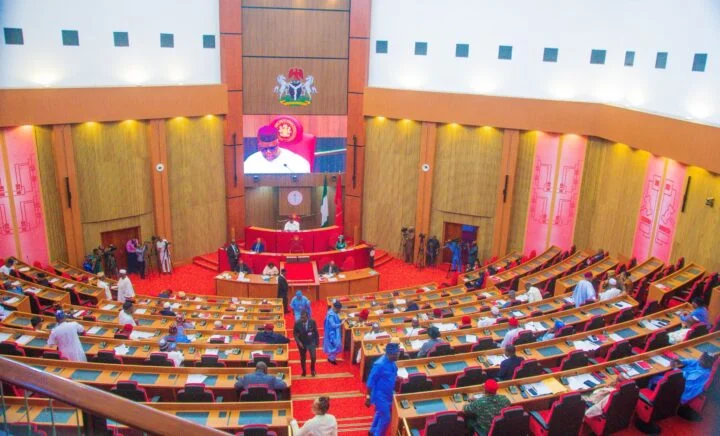
Chairman of the Senate Committee on Army, Abdulaziz Musa Yar’Adua, presented the figures before the Senate Committee on Appropriation chaired by Solomon Adeola on Friday. He argued that the financial request reflects the operational realities facing troops and urged lawmakers to carefully examine the Army’s original projections rather than rely solely on a possible supplementary budget.
Yar’Adua stressed that adequate funding, if properly structured and released on time, would significantly strengthen efforts to end insurgency and restore stability nationwide.
A breakdown of the proposal shows that the Army’s capital expenditure request stands at ₦902.58 billion, compared to the ₦167.77 billion allocated — a shortfall of about ₦734.81 billion. The increase, according to the committee chairman, is driven largely by plans to recruit about 28,000 additional soldiers and procure modern equipment to enhance combat effectiveness.
Lawmakers observed that while personnel deployment under the 2025 budget achieved 94.47 per cent performance, overhead releases stood at just 24.79 per cent, limiting operational capacity. For 2026, the Army is requesting ₦111.26 billion for overhead costs against the ₦81.91 billion allocated, leaving a deficit of ₦29.35 billion.
The committees unanimously resolved that the 2026 allocation must be reviewed upward to reflect the security emergency declared by President Bola Ahmed Tinubu, Commander-in-Chief of the Armed Forces.
They recommended that the Federal Government consider front-loading at least 30 per cent of capital releases to enable immediate procurement of critical equipment and swift troop deployment. Senators also proposed placing the Army and other security agencies on first-line charge to ensure timely and uninterrupted funding.
However, the Appropriation Committee raised concerns over discrepancies in personnel cost figures and questioned the interpretation of a 70 per cent performance benchmark contained in the budget documents. Lawmakers demanded a detailed and itemised breakdown of the proposed ₦734 billion capital increase before granting approval.
Adeola Bags ICCON Fellowship for Contributions to Public Health Chemistry
Adeola Bags ICCON Fellowship for Contributions to Public Health Chemistry
Beyond funding for equipment and recruitment, senators emphasised the need to address troop welfare, including field allowances and feeding arrangements, noting that morale remains a crucial factor in sustaining frontline operations.
The Senate pledged closer oversight and collaboration between committees to ensure that any additional allocation is transparently managed and effectively deployed, warning that without accountability and timely releases, increased funding alone may not translate into improved security outcomes.
About The Author