By Fatima Saka
A good heart, genuine humility and integrity are qualities that cannot always be acquired through wealth, education, professional accomplishments or political influence. They are values that, in many instances, are nurtured through upbringing, personal convictions and the choices an individual makes throughout life.
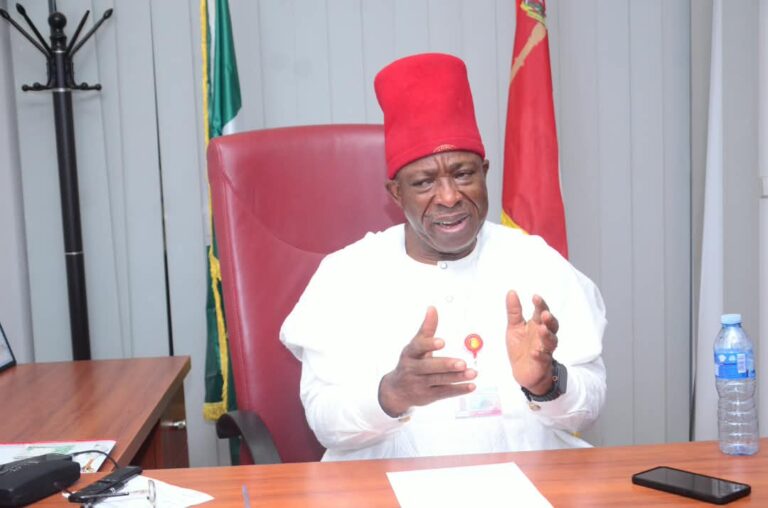
For Distinguished, Senator Mukhail Adetokunbo Abiru, popularly known as Tokunbo Abiru and fondly called Baba Adinni by some of his distinguished colleagues in the Red Chamber, (Senate) National Assembly of Nigeria, these qualities form an important part of the public image associated with his personality.
Indeed, being a person of good character is more than a mere gift; it is a reflection of values that manifest in one’s conduct, relationships, decisions and treatment of others. Humility, integrity, discipline and compassion become meaningful when they extend beyond personal interests to positively influence other lives.
The Yoruba title Baba Adinni, an honorary religious and chiefly title associated with contributions to Islam and community development, adds another dimension to Abiru’s public identity.
Beyond the title, political recognition and professional accomplishments lies a more compelling story: that of a man whose journey through family upbringing, banking, public administration and legislative service offers an opportunity to examine the importance of mentorship, sound values and investing in the development of others.
His story raises an important question about the meaning of success: What is the value of attaining great heights if the knowledge, experience and opportunities acquired cannot be used to help others discover and fulfil their own potential?
The Making of a Man: The Influence of Upbringing and Values
The character of an individual is often shaped long before professional success or public recognition arrives. Family upbringing, parental guidance, personal discipline and the environment in which a child grows can have a lasting influence on the decisions that define adulthood.
For Abiru, his late father, Mudashiru Akanbi Abiru, a respected lawyer, jurist and former senator of the Second Republic, was one of the major influences in his formative years.
In a previously published interview with THISDAY, the senator recalled growing up in Surulere, Lagos, and described his father as a disciplined and religious man who placed considerable importance on family values and personal responsibility.
He also spoke about his father’s approach to parenting, which he described in another interview with PUNCH as involving “tough love”. The experience, according to his account, taught him the importance of focus, hard work and the understanding that success does not come through shortcuts.
Such childhood lessons offer an important perspective on the man behind the public office. They illustrate how parental guidance and values absorbed during formative years can influence an individual’s attitude towards responsibility, professional conduct and relationships with others.
The Yoruba saying, “Tí wọ́n bá bí ọmọ, tí wọ́n tọ́ ọmọ dàgbà,” aptly captures this philosophy: giving birth to a child is one thing, but raising that child with discipline, proper guidance and good character is another.
It is a wisdom that places responsibility on parents not merely to bring children into the world, but to nurture individuals capable of making responsible decisions and contributing positively to society.
From Professional Experience to Public Responsibility
Senator Abiru’s journey demonstrates how discipline, preparation and professional experience can open new pathways to public service.
An Economics graduate of Lagos State University, he built a career spanning more than three decades in the banking and financial sector. He is a Fellow of the Institute of Chartered Accountants of Nigeria and an Honorary Fellow of the Chartered Institute of Bankers of Nigeria. He also attended Lagos Business School and Harvard Business School.
His professional journey included service at Guaranty Trust Bank and First Bank of Nigeria, where he rose to become Executive Director, Corporate Banking.
He subsequently became Group Managing Director and Chief Executive Officer of Skye Bank during a challenging period in the Nigerian financial sector. Following the restructuring of the bank and the emergence of Polaris Bank, he became its pioneer Managing Director and Chief Executive Officer.
Before entering elective politics, Abiru also served as Lagos State Commissioner for Finance between 2011 and 2013 under the administration of former Governor Babatunde Fashola.
These experiences placed him at the intersection of banking, financial administration and public policy, providing a foundation for his eventual transition into the National Assembly.
In December 2020, he won the Lagos East Senatorial District by-election following the death of Senator Bayo Osinowo. He secured another mandate in 2023 and currently serves in the 10th National Assembly as Chairman of the Senate Committee on Banking, Insurance and Other Financial Institutions.
His movement from the corporate boardroom to the Senate chamber represents a transition from managing financial institutions to participating in decisions that shape the country’s economic and regulatory environment.
It also demonstrates how professional experience, when brought into public service, can contribute to broader conversations about governance, institutional development and economic opportunities.
Mentorship: Helping Others Discover Their Potential
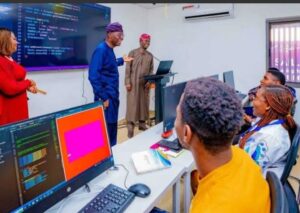
One of the important ways to examine a leader’s influence is to look beyond personal achievements and consider the opportunities created for people within his sphere of responsibility.
For Abiru, human capacity development, particularly among young people, provides an important dimension of his public service.
Through the Senator Abiru Innovation Lab, popularly known as SAIL, and the SAIL Empowerment Foundation, he has supported initiatives designed to expand access to technology, education, entrepreneurship and skills development.
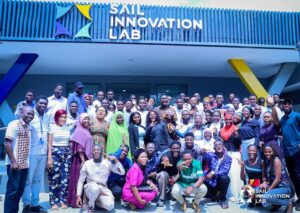
Established in 2021 in partnership with Co-Creation Hub, SAIL was conceived as a platform for equipping young people, students, artisans and entrepreneurs with relevant skills for a changing economy.
Its programmes include digital technology training, business acceleration, STEM education, teacher development and capacity-building opportunities for artisans and creative entrepreneurs.
The thinking behind such initiatives is important. In an increasingly competitive world, access to education alone may not be sufficient to guarantee economic independence. Young people also need practical skills, exposure, mentorship and opportunities to apply what they have learnt.
The Lagos East Teachers’ Fellowship is another dimension of this human development approach. It recognises that teachers are central to the future of education and that improving learning outcomes requires continuous investment in those responsible for shaping the minds of younger generations.
The programme has continued to expand beyond its original geographical reach.
In September 2026, the MTN Foundation and SAIL Innovation Lab announced that 5,000 public-school teachers had participated in the second cohort of the MTN-SAIL Teachers’ Fellowship, with 500 selected for intensive training and graduation.
The programme also introduced formal artificial intelligence-assisted teaching into its curriculum, with Microsoft contributing to the training component.
The foundation’s co-founder, Mrs Feyisola Abiru, disclosed that the fellowship had trained more than 10,000 public-school teachers across the 36 states and the Federal Capital Territory since its launch in 2022.
The significance of this intervention extends beyond the teachers who receive the training. A teacher equipped with improved teaching methods, digital knowledge and modern educational tools can transfer those skills to successive generations of students.
It is an example of the multiplier effect of mentorship and capacity development: investing in one individual can influence hundreds of others.
Similarly, the SAIL STEM initiatives provide students with practical exposure to science, technology, engineering and mathematics, encouraging them to explore fields that are increasingly important to the global economy.
These interventions demonstrate the importance of creating opportunities that allow young people to develop their abilities rather than depend entirely on immediate assistance.
Building People, Not Just Programmes
Beyond technology and education, the SAIL Empowerment Foundation, founded by Abiru and his wife, Feyisola, has extended its activities to entrepreneurship, sports development, bursaries and other community development interventions.
Its stated mission includes empowering at least one young person in every household, beginning in Lagos, with an ambition to extend its impact across Nigeria.
Among its programmes is Bursary 600, designed to support students financially, while other interventions seek to improve access to skills, knowledge and economic opportunities.
The importance of these programmes is best understood through the different challenges they seek to address.
For a student struggling to meet educational expenses, financial assistance can help sustain an academic journey. For an unemployed graduate, digital skills training may create access to a new career path. For an aspiring entrepreneur, business support can provide an opportunity to move from an idea to a viable enterprise.
The foundation’s official impact information also documents interventions in technology training, STEM education, teacher development, entrepreneurship and job placement.
In December 2025, Abiru launched 48 cooperative societies across Lagos East with a start-up grant of ₦480 million.
The cooperatives, drawn from market women associations, farmers’ groups and artisans across the district’s 16 local government areas and local council development areas, were designed to support productivity and sustainable livelihoods.
The intervention brought another dimension to his human development activities by extending support beyond students and technology trainees to traders, farmers, artisans and community-based economic groups.
The same event also featured the distribution of food packs to 12,000 households as part of an annual support programme for vulnerable residents.
In this sense, human development is not simply about distributing resources; it is about creating conditions in which people can become more capable, independent and productive.
In September 2026, Fola Adeola, co-founder of Guaranty Trust Bank, commended Abiru and his wife for their investment in young Nigerians through the SAIL Empowerment Foundation.
During a visit to the SAIL Innovation Lab in Ikorodu, Adeola described the initiative as a worthy legacy built on service, selflessness and commitment to humanity.
Such recognition brings attention to an important dimension of leadership: the responsibility to use acquired experience, resources and influence to create opportunities for people beyond one’s immediate circle.
Legislative Leadership: Turning Professional Experience into National Reforms
Beyond his investment in mentorship, education and human capacity development, Abiru’s legislative contributions provide another dimension to his public service journey.
Drawing on his extensive experience in the banking and financial sector, he has sponsored and advanced legislative proposals aimed at strengthening Nigeria’s financial institutions, improving regulatory frameworks and expanding economic opportunities.
One of his notable legislative contributions was the Copyright Act reform process. The National Assembly’s bill tracker lists a Copyright Act repeal and re-enactment bill sponsored by him in 2021. The Copyright Act, 2022, was subsequently signed into law by former President Muhammadu Buhari on March 17, 2023.
The legislation modernised Nigeria’s copyright framework, addressing the protection of creative works, digital challenges, enforcement and the rights of authors and other creators.
Another major legislative contribution is the Nigerian Insurance Industry Reform Act (NIIRA) 2025, which originated from the Nigerian Insurance Reform Bill, sponsored by Abiru on March 14, 2024.
The legislation, advanced under his leadership as Chairman of the Senate Committee on Banking, Insurance and Other Financial Institutions, received presidential assent from President Bola Tinubu on August 5, 2025.
The Act repealed and consolidated several outdated insurance laws into a unified regulatory framework. Its provisions address capital requirements, insurance supervision, policyholder protection, compulsory insurance and claims settlement.
The reform represents an important intervention in Nigeria’s insurance industry, with implications for consumer protection, investor confidence and the sector’s contribution to economic development.
Other legislative proposals he has sponsored or advanced include the NDIC Act Amendment Bill (2023), National Insurance Commission Act Bill (2024), Franchise Regulation Bill (2022) and CBN Amendment Bill (2024).
His legislative interests have also extended to MSME financing through proposals such as the Factoring, Assignments and Receivables Financing Bill, as well as export financing through the NEXIM Act Amendment Bill.
Other areas include constitutional alterations, flood management, public education technology integration and the review of obsolete statutory provisions.
These interventions reflect an aspect of leadership that is sometimes overlooked: the ability to translate professional knowledge and experience into policies and laws that can strengthen institutions and create opportunities for others.
For a banker who transitioned into public service, the legislative journey demonstrates how expertise acquired in one field can be deployed to address broader national challenges.
Motions and Petitions: Giving Voice to Constituency Concerns
Beyond sponsoring bills and participating in legislative reforms, Abiru has used motions and public petitions to bring issues affecting communities and individual Nigerians before the Senate.
His legislative interventions have addressed critical infrastructure, environmental challenges, financial regulation and economic opportunities for Nigerian businesses.
Among the issues he has raised are the rehabilitation of the Ikorodu–Shagamu and Ikorodu–Epe roads, two important routes serving communities and supporting commercial activities.
He has also presented interventions concerning the flooding disaster associated with the Oyan River Dam, drawing attention to the consequences of flooding and the need for appropriate responses.
His motions have equally addressed emerging economic and regulatory issues, including cryptocurrency regulation and Nigeria’s preparedness to maximise opportunities under the African Continental Free Trade Area.
His presentation of public petitions also illustrates another aspect of constituency representation: providing a legislative platform for individuals and groups seeking attention to grievances.
Among the petitions presented were matters involving the Magodo Residents Association and the dismissal of a naval seaman.
Such interventions reflect the petition process as an avenue through which citizens can bring complaints and matters of public interest before the legislature for consideration.
Ultimately, representation extends beyond making laws. It also involves identifying challenges affecting constituents, bringing them to the attention of relevant authorities and using available legislative mechanisms to seek responses.
Protecting Nigerians: The CBEX Investigation and Financial Accountability
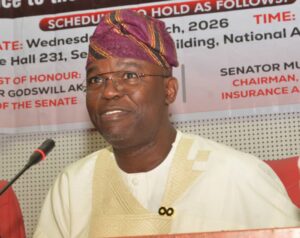
Abiru’s legislative engagement with emerging financial technologies predates the collapse of the Crypto Bullion Exchange (CBEX), reflecting his involvement in debates about the risks, regulation and opportunities associated with digital finance.
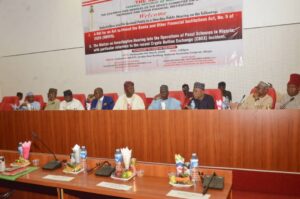
In February 2021, during the Ninth Senate, he co-sponsored a motion with Senator Istifanus Gyang on the Central Bank of Nigeria’s decision to stop financial institutions from facilitating cryptocurrency transactions.
The motion sought explanations from relevant financial regulators on the implications of the directive and the need for an appropriate regulatory approach to digital assets.
His involvement in the subject gained further prominence on July 9, 2025, when he co-sponsored a motion with Senator Osita Izunaso, representing Imo West, seeking a comprehensive investigation into the collapse of CBEX and the growing proliferation of fraudulent digital investment schemes.
The motion followed reports that Nigerians had lost more than ₦1.3 trillion to the collapsed platform, which attracted investors with promises of unusually high returns on digital asset investments.
During the debate, Abiru highlighted the dangers of regulatory gaps in the digital investment space, drawing parallels with previous schemes such as MMM Nigeria and MBA Forex.
He raised concerns about how fraudulent operators exploit social media influence, inadequate financial literacy and promises of unrealistic returns to attract unsuspecting investors.
Following the adoption of the motion, the Senate mandated a joint investigation involving its committees on Banking, Insurance and Other Financial Institutions; Capital Market and Institutions; Anti-Corruption and Financial Crimes; and ICT and Cybersecurity.
The subsequent public hearing in March 2026, chaired by Abiru, provided an opportunity for relevant agencies, including the Economic and Financial Crimes Commission, to present information on the scheme and efforts to trace funds and identify victims.
During the hearing, the EFCC disclosed that its blockchain analysis had traced more than $46 million in stablecoin transactions to wallets linked to CBEX. The agency also reported identifying more than 1,200 victims in Lagos and prosecuting Nigerian promoters of the platform.
The hearing also examined proposed amendments to the Banks and Other Financial Institutions Act, with lawmakers considering ways to address regulatory gaps exploited by unlicensed digital financial operators.
The legislative engagement extended to discussions on the regulation of virtual assets and digital financial service providers in June 2026, when Abiru supported the need to harmonise proposed regulatory provisions with existing financial laws, including BOFIA and the Investments and Securities Act.
His involvement in these issues illustrates the intersection between professional experience and legislative responsibility, particularly at a time when digital financial services are expanding rapidly and exposing consumers to new forms of financial risk.
For ordinary Nigerians, the implications go beyond financial regulation. They concern the protection of savings, the security of investments and the confidence citizens need to participate in a changing financial economy.
It is also an example of how legislative oversight can bring public grievances to the attention of institutions, demand explanations from regulators and stimulate conversations about reforms needed to protect citizens.
The Influence of Good Decisions and Professional Mentorship
Behind many successful careers are people whose advice, guidance and examples have influenced important decisions at critical moments.
Abiru has acknowledged the importance of mentorship in his own journey. In previously published interviews, he identified respected personalities in the banking and business community, including Chief Olusegun Osunkeye, Fola Adeola, Mohammed Hayatu-Deen and Wale Edun, among individuals he admires.
His reflections on mentorship offer an opportunity to examine how the experiences of accomplished professionals can influence the choices of others.
In a demanding professional environment, the right guidance can help individuals avoid costly mistakes, recognise opportunities, develop confidence and make decisions that shape their future.
The same principle applies to leadership and public service. Experience becomes more valuable when it is accompanied by the willingness to learn, listen to others and consider the long-term consequences of decisions.
Abiru’s experience in banking and financial administration provides a practical connection between professional knowledge and legislative responsibilities.
His work on insurance reforms, financial regulation and the investigation of digital investment schemes demonstrates how technical knowledge can become relevant to public policy and institutional oversight.
Ultimately, the influence of good decisions is not limited to personal advancement. When decisions are informed by knowledge, integrity and a sense of responsibility, their benefits can extend to institutions and the wider society.
Baba Adinni: The Responsibility Behind the Title
The title Baba Adinni carries religious and cultural significance in Yoruba society. It is an honorary designation associated with contributions to Islam, community development and service to society.
For Abiru, the title is part of a public identity that also includes his professional background, political responsibilities and reputation among admirers for discipline and upright conduct.
However, titles and honours acquire deeper meaning when they are reflected in the responsibilities an individual accepts and the values demonstrated through everyday actions.
A person’s character is not established by the titles attached to his name alone, but by the consistency between the principles he professes and the decisions he makes.
This is particularly important for people in positions of influence, whose actions can shape the conduct, expectations and opportunities of others.
For a senator with a long professional history and growing involvement in human development initiatives, the challenge is to ensure that the values associated with his public identity continue to find expression in meaningful service.
A Legacy Measured by Lives Influenced
The story of Tokunbo Abiru ultimately extends beyond the conventional account of a successful banker who became a politician. It offers a broader opportunity to consider the relationship between character, mentorship, professional experience and the responsibility to develop others.
His father’s influence provides a window into the values that shaped his formative years. His banking career demonstrates the importance of professional discipline and experience. His transition into public service illustrates how those experiences can be applied to governance.
His legislative contributions provide examples of efforts to strengthen institutions and address emerging economic challenges, while the SAIL Innovation Lab and SAIL Empowerment Foundation demonstrate his investment in education, skills, entrepreneurship and human capacity development.
From teachers acquiring new digital skills to young people exploring technology, students receiving educational support and cooperative groups accessing start-up grants, these initiatives provide different examples of how opportunities can be extended to people beyond the immediate circle of political influence.
Yet, the most enduring measure of such efforts will be found in the lives of the people who benefit from them, the knowledge they pass on, the businesses they build and the decisions they make with the opportunities available to them.
For young people seeking direction, teachers looking to improve their professional capacity and entrepreneurs searching for opportunities, mentorship and access to knowledge can make a significant difference.
Perhaps this is one of the most important lessons that can be drawn from Abiru’s journey: success becomes more meaningful when it creates room for others to grow.
READ ALSO: Atani Monarch to Recognise Ohuabunwa Family at 20th Coronation Anniversary
Ogundipe tasks universities on research-driven solutions, innovation for Africa’s development
Beyond the Senate chamber, banking achievements and the recognition attached to Baba Adinni, the greater question of legacy remains how much of one’s knowledge, values and opportunities can be transferred to the next generation.
For, in the final analysis, a leader’s influence is not measured only by how far he rises, but also by how many others he helps to rise.
About The Author