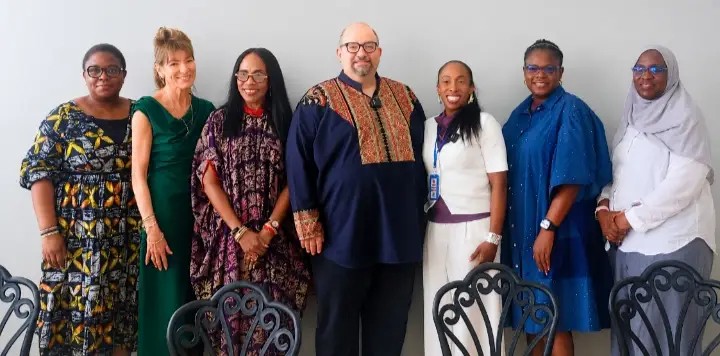
From left: Oluwatosin Oladipo, Project Lead, National Inclusion Conference, Sharon Gray, Director of Wholehearted Learning, previous headteacher of 22 years and member of Youth Justice Board, Bolanle Adewale, Executive Director, The Learning Place Centre, President, International Forum of Inclusion Practitioners, Daniel Sobels, Angelina Ikeako, Ex National Executive Director, National Inclusion Conference, CEO Goldenlinks Educational Consultant, Olusola Imoru, Communication Lead, Golden Educational Consultants, Doyinsola Jawando-Adebomehin, Centre Coordinator TLP Centre and Directress, TLP, at the media briefing on Monday in Lekki.
Stakeholders in Nigeria’s education sector have called for strengthened support systems for neurodiverse learners as part of efforts to advance inclusive education and uphold the government’s “leave-no-child-behind” policy.
Speaking at a news conference in Lagos, Chief Executive Officer of Goldenlinks Educational Consultant, Angelina Ikeako, said the two-day conference, scheduled to begin on May 29, would focus on promoting excellence in inclusive education nationwide.
With the theme, “Embedding Inclusive Excellence: Supporting Neurodiverse Learning in Every Class,” Ikeako noted that the event would convene educators, policymakers, school proprietors, parents, caregivers and other key stakeholders.
She described the conference as a platform for transformation and advocacy, aimed at ensuring that every child receives the necessary support and accommodations to succeed academically.
Ikeako expressed concern that many neurodiverse learners remain excluded from meaningful education despite being enrolled in schools, largely due to inadequate learning adjustments.
“It is easy to assume that because children are in school they are being educated, but without the right accommodation and interventions, many neurodiverse learners are simply in school for compliance rather than meaningful learning,” she said.
She further emphasised that inclusion should go beyond conditions such as autism and dyslexia to also address mental health, social and economic challenges, as well as the needs of gifted learners requiring specialised support.
According to Ikeako, inclusive education impacts about 20 per cent of the population globally and is critical to achieving equitable access to education and broader economic participation.
Also speaking, President of the International Forum of Inclusion Practitioners, Daniel Sobel, said the conference would highlight innovative inclusion practices from Nigeria and across the world.
“We are trying to say publicly that inclusion is a top priority in Nigeria. This conference celebrates and supports the vision that no child should be left behind,” he said.
Sobel stressed the need for a coordinated national approach to strengthen knowledge, reduce stigma and improve understanding of learning differences.
He noted that many children continue to face discrimination due to a lack of awareness about neurodiversity, calling for systemic reforms in the education sector.
In her remarks, Executive Director of the Learning Place Centre, Bolanle Adewale, described inclusive education as a fundamental human right supported by international conventions.
She advocated for the adoption of evidence-based teaching strategies such as Universal Design for Learning and differentiated instruction, noting that these approaches benefit both neurodiverse and neurotypical learners.
“Every child can learn. What matters is the environment, structures and support systems provided to help each child to thrive,” she said.
Adewale added that building the capacity of educators remains essential to creating inclusive classrooms where all learners feel valued and supported.
Meanwhile, Project Lead of the National Inclusion Conference, Oluwatosin Oladipo, urged the government to strengthen policies, funding and teacher training to support inclusive education.
She highlighted the need for specialised teaching skills, continuous professional development and access to appropriate learning tools for educators and caregivers.
READ ALSO: NAWOJ Hails Ruth Abubakar’s PDP Ticket as Boost for Women’s Political Inclusion
FG Declares Two-Day Public Holiday for Eid-ul-Adha, Urges National Reflection
“Government needs to believe in inclusion and support it through policies, funding and capacity building,” she said.
Oladipo added that sustained investment in teacher training and caregiver support would be key to building an inclusive education system capable of meeting the needs of all learners.
About The Author