
By Fatima Saka
The Nigeria Government and Development partners has taken a significant step to improve its ability to detect and respond to disease outbreaks with the launch of a €4.2 million European Union-supported programme aimed at strengthening public health institutions across the country.
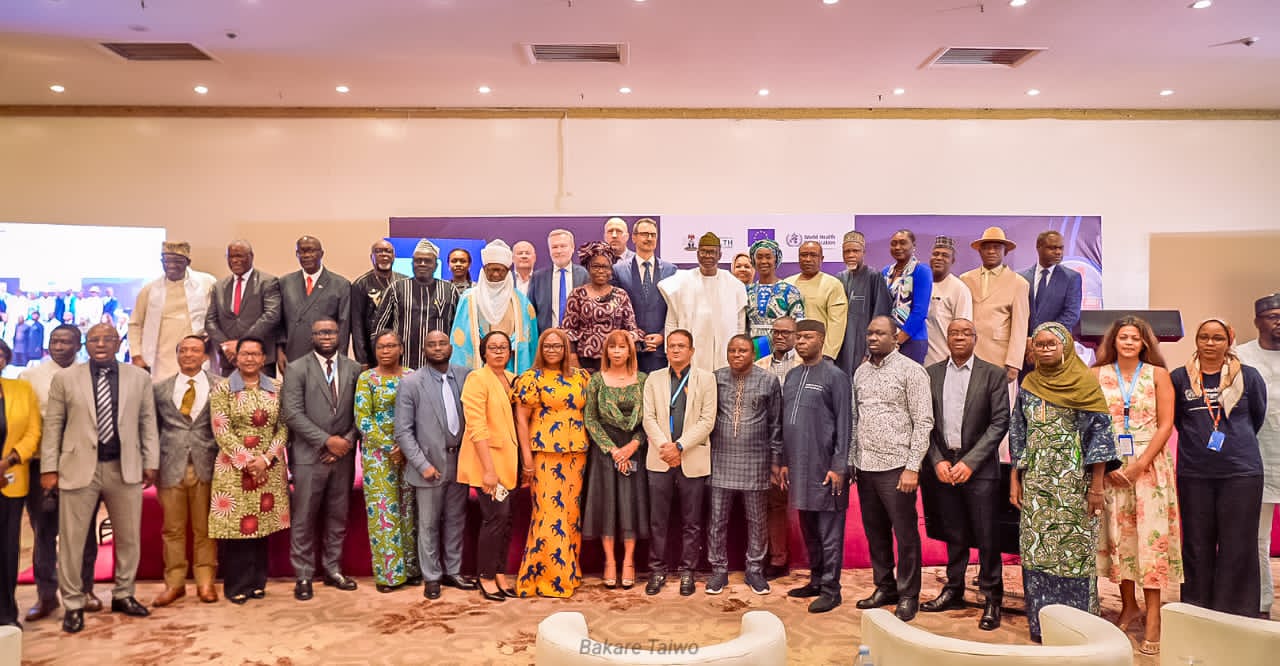
The launch, which was held in Abuja on Monday, brought together key government officials, development partners, and public health stakeholders to mark the commencement of the strategic initiative.
The initiative, known as the EU Support to Public Health Institutes in Nigeria (EU SPIN), will be implemented by the World Health Organization in partnership with the Federal Ministry of Health and Social Welfare over a four-year period. Funded by the European Union, the programme is designed to enhance early outbreak detection, improve real-time data sharing, and reduce the impact of health emergencies nationwide.
Nigeria continues to grapple with a dual burden of infectious disease outbreaks and rising noncommunicable diseases. According to the WHO, noncommunicable diseases now account for 27 per cent of deaths in the country, while malaria contributes nearly 30 per cent of global malaria fatalities. Recurrent outbreaks of cholera, diphtheria, Lassa fever, meningitis, and Mpox also remain major public health concerns.
To address persistent gaps in outbreak response, the EU SPIN programme will focus on strengthening coordination among public health institutions, improving workforce capacity, and deploying digital tools for faster and more accurate decision-making. It also aims to integrate public health functions more closely with primary healthcare systems and local communities, while targeting at least 75 per cent of the workforce for digital skills training.
Speaking at the launch, Minister of State for Health and Social Welfare, Iziaq Adekunle Salako, underscored the urgency of strengthening Nigeria’s health systems in the face of rising disease burdens.
He noted that the initiative aligns with the Federal Government’s broader health sector reforms under the Renewed Hope Agenda, particularly efforts aimed at achieving universal health coverage and improving emergency preparedness.
Salako emphasised that beyond infrastructure, the programme would invest in people and systems, ensuring that health workers are better trained, institutions are more responsive, and vulnerable populations receive timely care.
He added that the government remains committed to equitable access to quality healthcare and will continue to work with global partners to build a resilient system capable of withstanding future health shocks.
Also speaking, the European Union Ambassador to Nigeria, Gautier Mignon, highlighted the EU’s long-standing partnership with Nigeria in strengthening governance and social sectors, including health.
He explained that the EU SPIN programme reflects a strategic investment in Nigeria’s public health infrastructure, with a strong focus on digital transformation and institutional capacity building.
Mignon stressed that effective outbreak preparedness depends on strong institutions that can coordinate efficiently and respond rapidly. He noted that the EU’s support is not only financial but also technical, aimed at fostering innovation, data-driven decision-making, and sustainable systems that will endure beyond the programme’s lifespan.
In his remarks, the WHO Representative in Nigeria, Pavel Ursu, emphasised the importance of collaboration and coordination in managing public health threats. He stated that the programme would strengthen linkages between national, state, and local health institutions, ensuring a more unified and effective response to outbreaks.
Ursu further noted that the integration of digital tools and real-time data systems would significantly improve surveillance, early warning mechanisms, and response strategies.
He added that WHO’s technical expertise would support Nigeria in implementing global best practices while adapting them to local realities, ultimately helping to save lives and protect communities.
READ ALSO: Nigeria Warns Citizens in South Africa Over Plans Crackdown on Undocumented Migrants
Binani Air’s First Lagos Flight Signals Expansion Drive in Nigeria’s Aviation Sector
By 2028, the programme is expected to enhance inter-agency coordination, clarify institutional roles, and ensure more reliable public health data across federal, state, and local levels. Progress will be monitored through national systems, with periodic reviews involving government and development partners.
Public health workers are expected to benefit from improved tools, clearer coordination frameworks, and enhanced capacity, ultimately leading to better health outcomes, particularly for women, children, the elderly, persons with disabilities, and other vulnerable groups.
About The Author