By Fatima Saka
The Chief of Army Staff (COAS), Lt.-Gen. Waidi Shaibu, has warned that the effectiveness of the Nigerian Army’s newly established divisions, formations and units will depend on the strength of the logistics and sustainment systems put in place to support them.
Shaibu said expanding the Army’s structure without a corresponding increase in combat service support capabilities could undermine the operational effectiveness of the new formations.
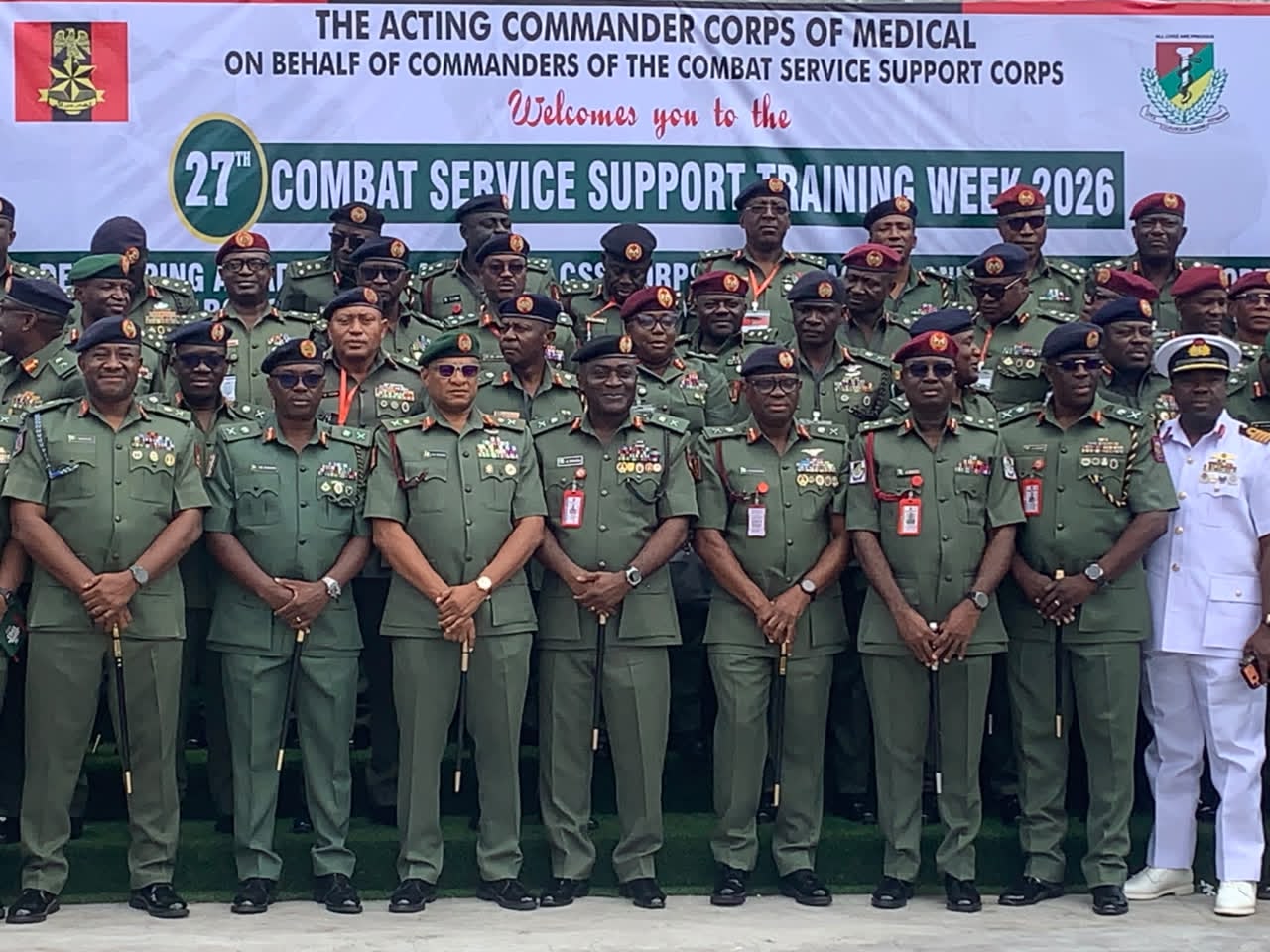
The COAS stated this at the opening of the 27th Combat Service Support Training Week, holding from Aug. 17 to Aug. 21 at the Nigerian Army Ordnance Corps, Abalti Barracks, Ojuelegba, Lagos State.
Represented by the Chief of Logistics, Nigerian Army, Maj.-Gen. Adebayo Adeyinka, Shaibu said the new formations would improve force disposition, operational reach and responsiveness to Nigeria’s evolving security challenges.
“New formations without corresponding logistics capability will merely increase structure without producing the required operational effect,” he said.
He noted that the expansion would require innovative approaches to supply chain management, transportation, equipment recovery and maintenance, medical support, infrastructure development, ammunition management, fuel distribution and forward logistics support.
According to him, greater use of technology, improved forecasting, data-driven planning and resilient supply networks would also be required to sustain military operations in difficult and contested environments.
Shaibu described the theme of the training, “Developing an Adaptable and Agile Combat Service Support Corps for Proactive and Sustainable Support to the Nigerian Army in the Discharge of its Responsibilities within a Joint and Multi-Agency Environment,” as timely and aligned with the operational readiness pillar of his command philosophy.
He said the annual training had remained an important professional platform for the Combat Service Support Corps to assess readiness, interrogate emerging sustainment challenges, draw lessons from operations and develop practical solutions to enhance the effectiveness of the Nigerian Army.
The COAS stressed that modern combat operations were sustained not by fighting forces alone but by the efficiency of the logistics and support architecture behind them.
He said operational tempo, force sustainment and mission success depended on the timely provision of ammunition, fuel, mobility, medical support, maintenance, engineering services, infrastructure and other essential resources.
Shaibu urged participants to critically examine the sustainment demands of the expanded Nigerian Army and develop practical recommendations for supporting the newly established divisions from inception to full operational capability.
He said particular attention should be given to scaling and distributing logistics assets, maintenance facilities, medical services, transport resources and supply systems to ensure the new formations become sustainable fighting organisations.
The COAS described logistics as one of the decisive determinants of operational success, noting that sound strategy and superior tactics would achieve little if troops could not be sustained at the point of need.
He said Nigeria’s evolving security environment, characterised by terrorism, insurgency, banditry, difficult terrain, extended lines of communication and increasingly sophisticated threats, required a Combat Service Support system that was agile, anticipatory and capable of supporting prolonged operations across multiple theatres simultaneously.
Shaibu said he expected the training to generate clear and implementable recommendations to strengthen the Army’s logistics architecture, improve equipment availability, reduce response time and enhance the resilience of supply chains.
He assured participants of his continued support for initiatives aimed at strengthening the Nigerian Army’s logistics and sustainment capability.
“As we expand our force structure, we must simultaneously expand the institutional systems that sustain it,” he said.
He added that deliberate investment in infrastructure, logistics platforms, maintenance capacity, technology, manpower development and efficient resource management was necessary to achieve enduring readiness and successfully operationalise the newly established formations.
Shaibu also commended President Bola Tinubu for his strategic direction and continued support for the Nigerian Army, particularly the recent approval for the
expansion of the force.
READ ALSO:
NiDCOM Boss to LASU Graduates: Be Useful, Visible Nigerian
NEMA DG Zubaida Umar Receives Responsive Humanitarian Leadership Award
He said the approval underscored the President’s determination to strengthen the Army’s capacity to confront Nigeria’s evolving security challenges.
The COAS further reaffirmed the loyalty of officers and soldiers of the Nigerian Army to the Constitution of the Federal Republic of Nigeria and their determination to discharge their responsibilities with professionalism and dedication.
About The Author