The South-West Association of the Deaf (SWAD) has called on governments across the six South-West states to prioritise inclusive education and create more employment opportunities for persons with hearing disabilities.
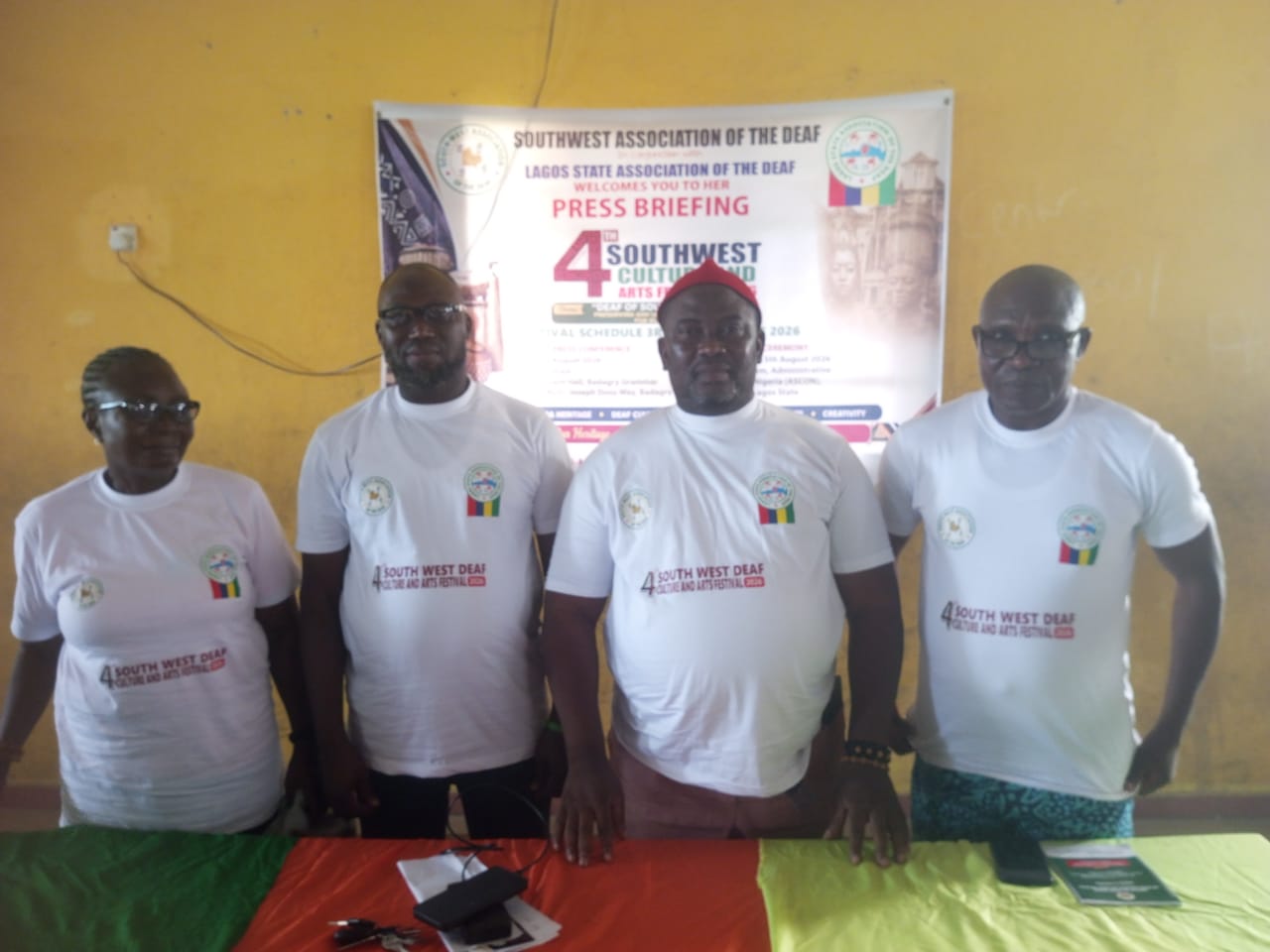
The appeal was made on Thursday by the Chairman of SWAD, Dr. Taiwo Akangbe, during a press briefing to mark the commencement of the 4th South-West Culture and Arts Festival in Badagry, Lagos State.
Akangbe expressed concern that the needs of the deaf community are often overlooked, stressing that their inability to hear should not be mistaken for a lack of intelligence or capability.
He noted that members of the deaf community possess knowledge and skills but are limited by communication barriers and insufficient government support.
“The government should give us serious consideration. We are not lacking in knowledge or wisdom, but our inability to hear has limited our access to communication and opportunities,” he said.
He emphasised the importance of inclusive education, calling for improved learning materials, more accessible books, and the recruitment of qualified teachers trained to support deaf students.
According to him, understanding is fundamental to learning, and many deaf students struggle due to poorly adapted educational content.
Akangbe also urged that parents of deaf children be actively involved in policies and programmes, noting that effective support systems must include families.
He further appealed to South-West governments to include members of the deaf community in policy-making and social activities to ensure full inclusion.
Speaking on the festival, Akangbe said the theme, “The Deaf of Southwest Nigeria: Preserving and Leveraging Yoruba Culture for Global Impacts,” reflects the community’s commitment to cultural preservation and advocacy.
He explained that the event brings together deaf participants from across the region to celebrate cultural heritage, showcase talents, and promote unity.
Activities lined up for the festival include cultural displays, artistic performances, educational sessions, sporting events, and networking opportunities aimed at strengthening the community and preserving Yoruba traditions.
Also speaking, a former Chairman and Coordinator of SWAD, Mr. Omotola Ezekiel, stressed the urgent need for employment opportunities beyond teaching roles.
“We need assistance in employment. Not only teaching jobs, but other sectors where deaf graduates can contribute meaningfully,” he said.
In her remarks, Dr. Agatha Olaninyi, a deaf advocate from Osun State, called on the government to document and preserve Yoruba sign language as part of the region’s cultural heritage.
She explained that sign language is central to the identity of the deaf community, adding that much of what is currently used in Nigeria is borrowed from other countries.
READ ALSO: Experts to Tackle Rising Flood Risks, Push Climate Resilience at Orodata X Spaces
EDEN Urges Universities to Lead Climate Action Beyond Classrooms
“We want the government to preserve and document Yoruba sign language. Language is a key part of culture, and for the deaf community, it defines who we are,” she said.
The stakeholders collectively urged authorities to take deliberate steps toward inclusion, ensuring that deaf persons are fully integrated into educational systems, the workforce, and cultural development initiatives.
About The Author