The Association of Waste Managers of Nigeria (AWAMN) has called for an urgent transition to a circular economy model that converts plastic waste into affordable housing materials, as part of efforts to address Nigeria’s growing waste burden and housing deficit.
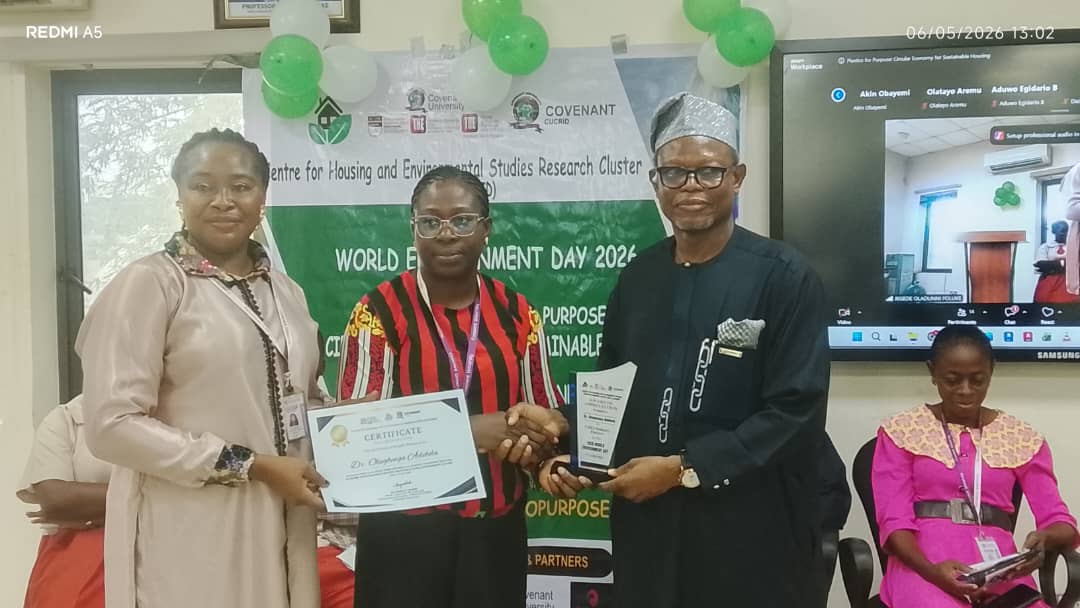
The National President of AWAMN, Dr Olugbenga Adebola, made the call during a presentation at the Centre for Housing and Environmental Studies, Covenant University, Ota, to commemorate the 2026 World Environment Day.
Adebola emphasised that Nigeria could simultaneously solve its environmental and housing challenges by transforming plastic waste into valuable construction resources and clean energy.
He described waste as an untapped economic asset rather than a nuisance, stressing that improper waste handling remains the core problem.
“Waste is not waste until it is wasted. We do not have a waste problem; we have a resource misplaced in the wrong place and in the wrong hands,” he said.
Adebola urged Nigerians to adopt waste segregation at source, noting that effective sorting would enhance recycling and resource recovery across the value chain.
He explained that waste could be categorised into recyclables, combustibles and compostables, with materials such as plastics, paper, glass, aluminium and textiles having significant reuse potential.
The AWAMN president identified plastic pollution as a major environmental threat, particularly in urban centres like Lagos, where indiscriminate disposal frequently blocks drainage systems and contributes to flooding.
He called for a shift toward cities where waste is efficiently collected and processed directly from households and businesses, preventing environmental degradation.
According to him, efficient waste management also serves as preventive healthcare by reducing diseases such as malaria, cholera and food poisoning.
“Effective and efficient waste management is free healthcare service because it prevents diseases before they occur,” he said.
Adebola disclosed that Nigeria generates over 60,000 tonnes of waste daily, with plastics forming a significant proportion, adding that Lagos alone produces thousands of tonnes each day.
Highlighting innovative solutions, he showcased prototype housing units constructed from recycled plastic, describing them as durable, cost-effective and environmentally sustainable.
He explained that recycled plastics could be processed into building materials using thermoplastic technology or cement-based composite systems, with some materials containing up to 70 per cent recycled plastic mixed with sand.
Adebola noted that scaling such solutions could significantly reduce Nigeria’s housing deficit while curbing environmental pollution.
He, however, expressed concern over weak implementation of existing environmental policies, including the National Environmental Policy on Solid Waste Management, the Extended Producer Responsibility framework and the Nigerian Circular Economy Roadmap launched in 2024.
“Nigeria has many good policies, but implementation remains a challenge,” he said.
The AWAMN president called for stronger enforcement mechanisms, updated building regulations and incentives to encourage the use of recycled materials in construction.
He also urged increased investment in recycling infrastructure, noting that plastic recycling remains capital-intensive due to logistics and transportation challenges.
Adebola advocated government incentives for recycling companies and developers, as well as policies mandating the use of recycled materials in selected public housing and infrastructure projects.
He encouraged private developers to collaborate with waste collectors and recyclers to integrate recycled materials into roofing, pavements and building components.
The AWAMN president further disclosed a partnership with the Nigerian Armed Forces Resettlement Centre to train retiring military personnel in waste management and recycling, promoting environmental entrepreneurship.
He also called on universities and research institutions to intensify studies on the safety, durability and performance of recycled construction materials, stressing the need to bridge the gap between research and real-world application.
Adebola emphasised that adopting circular economy principles could generate millions of jobs across waste collection, recycling, manufacturing and construction sectors.
He expressed optimism that Nigeria could become a leading African model for integrating waste management with affordable housing.
“The time to transition from conventional housing to modular sustainable housing is now. Let us turn plastic waste into plastic purpose,” he said.
The News Agency of Nigeria (NAN) reports that the highlight of the event was the presentation of an award to Adebola in recognition of his environmental stewardship.
About The Author