…Unveil Vote4Climate 2027 Campaign, Urge Issue-Based Politics
By Fatima Saka
Abuja, Nigeria — Environmental experts on Friday warned that Nigeria’s worsening climate crisis, weak policy frameworks, and unsustainable exploitation of natural resources are deepening food insecurity, fueling insecurity, and threatening the country’s long-term stability.
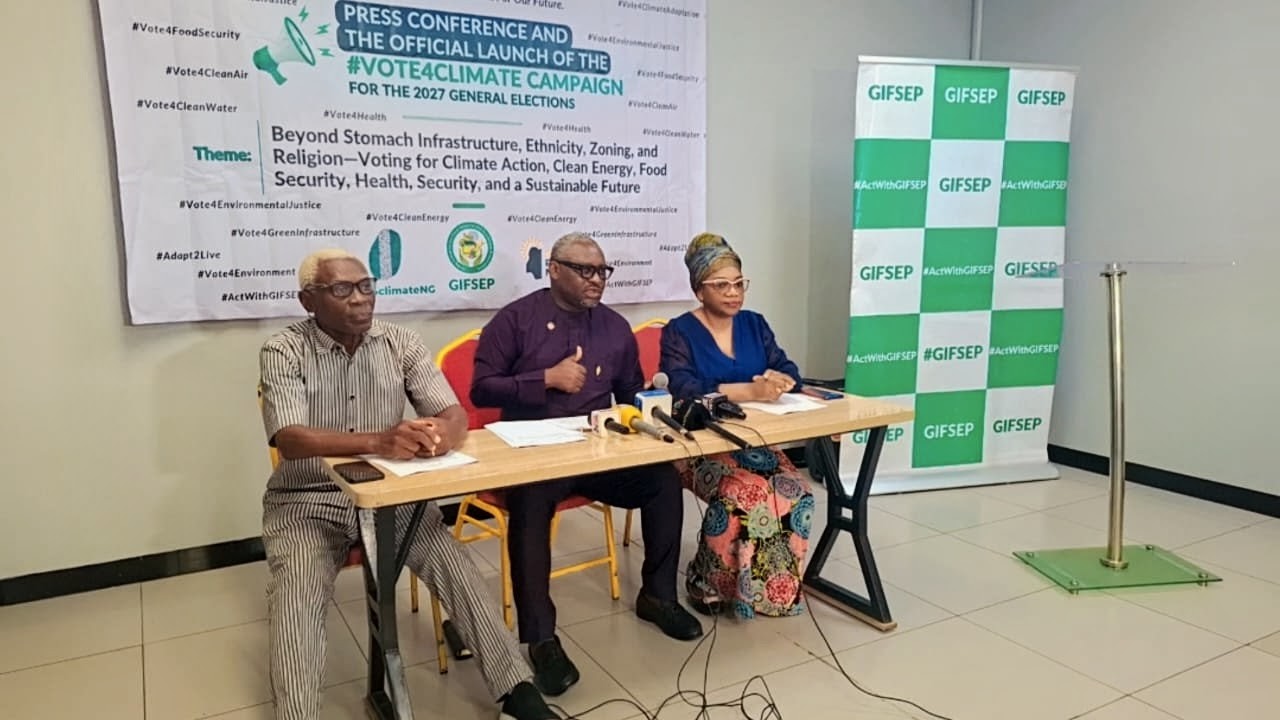
The experts made this assertioned at a press conference in Abuja to commemorate the 2026 World Environment Day and to launch the Vote4Climate 2027 campaign, urging Nigerians to prioritise environmental sustainability, clean energy, and climate action in the next general elections.
Leading the discussion, Dr. Michael Terungwa David, Executive Director of the Global Initiative for Food Security and Ecosystem Preservation (GIFSEP), described environmental degradation as an urgent national crisis already affecting millions of Nigerians.
“World Environment Day is not a ceremonial occasion; it is a call to accountability,” he said. “Climate change is no longer a future threat—it is a present reality shaping the lives of Nigerians.”
He cited shrinking arable land, coastal erosion in states such as Bayelsa, Lagos, and Delta, and the devastating 2022 floods that killed over 600 people and displaced more than 1.4 million as clear indicators of Nigeria’s growing vulnerability.
According to him, Nigeria loses about N1.1 trillion annually due to land degradation, while environmental damage costs nearly 10 per cent of the country’s Gross Domestic Product (GDP).
“The cost of inaction will be felt at the dining table, in hospitals, classrooms, and even in national security,” he warned.
Dr. David also used the platform to formally relaunch the Vote4Climate campaign ahead of the 2027 general elections, describing it as a nationwide citizens’ movement aimed at placing climate action, clean energy, food security, health, and human security at the centre of Nigeria’s democratic process.
“As Nigerians prepare for 2027, we must move beyond politics of ethnicity, religion, zoning, and stomach infrastructure. The future demands that we interrogate candidates on real issues,” he said.
He challenged journalists, civil society organisations, and voters to demand clear commitments from political candidates on climate adaptation, renewable energy, food systems, pollution control, environmental governance, and protection of vulnerable communities.
“The 2027 elections must be about choosing between a livable future and an uninhabitable one,” he stressed.
Responding to questions, Mr. Richard Nzekwu, Consultant on Land Degradation Neutrality for Nigeria under the UNCCD and Board Member of GIFSEP, raised concerns over policy gaps in key sectors, particularly mining, renewable energy, and agriculture.
He emphasised that political candidates must clearly state their plans for regulating Nigeria’s mining sector to curb environmental degradation and rising insecurity linked to extractive activities.
Nzekwu also highlighted the rapid adoption of solar energy across Nigeria, noting that while many households now depend on solar panels, the sector remains largely unregulated.
“Solar energy has become a lifeline for Nigerians, with panels visible on rooftops across communities. However, the sector is currently an all-comers affair without clear policy direction,” he said.
He cautioned against any premature move to ban the importation of solar panels, warning that Nigeria currently lacks the manufacturing capacity to sustain such a policy.
“If imports are banned without local production capacity, what happens to millions of Nigerians who rely on solar energy as their only source of power?” he queried.
On food security, Nzekwu criticised the impact of food importation on local farmers, stating that cheap imports are undermining domestic agriculture and worsening rural unemployment.
“When imported food floods the market, local farmers cannot compete. At the same time, input costs—fertilisers, pesticides, agrochemicals—remain high, making production difficult,” he said.
He also raised concerns about Nigeria’s declining seed sovereignty, warning that increasing dependence on foreign seed companies could undermine the country’s long-term food system.
“If Nigeria loses control of its indigenous seeds, what will happen to our food system in the next 20 to 30 years?” he asked.
Nzekwu called for policies that promote food sovereignty, protect local farmers, and empower youths and women to reclaim degraded lands through climate-smart and nature-based solutions.
He stressed that environmental governance must involve all tiers of government, noting that state and local governments must play active roles in addressing land degradation, food insecurity, and rural development.
“The landmass of Nigeria is fixed, yet we are losing millions of hectares annually to degradation. It is an invisible war, but a real existential threat,” he warned.
He added that better coordination among government agencies, as well as targeted engagement of youths and women in land restoration and agriculture, would help reduce migration pressures, farmer-herder conflicts, and insecurity.
Also speaking, Mrs. Gloria Agema, Board Member of GIFSEP and Executive Director of GeeFoundation for Social Justice and Development, stressed that environmental protection must be treated as a shared national responsibility.
“Environment is everybody’s business in Nigeria,” she said.
She linked rising insecurity in parts of the country to unregulated mining activities, particularly the extraction of minerals in rural communities.
“Mining of minerals, especially in local communities, has become a major driver of insecurity. What started gradually has now grown into a large-scale business involving both local and international actors,” she said.
Agema warned that without stronger regulation and accountability, extractive industries could further destabilise vulnerable regions and worsen environmental degradation.
She also reiterated that women remain disproportionately affected by climate change and must be included in decision-making processes, particularly in accessing climate financing and implementing solutions.
The experts collectively called on Nigerians, especially youths, to obtain their Permanent Voter Cards (PVCs) and actively participate in the 2027 elections, stressing that the country’s future depends on informed and issue-based choices.
READ ALSO: Ogoni Cleanup Delivering Real Climate Action — HYPREP Boss Highlights
Oyo Abduction: MURIC Urges Empowerment of Amotekun, OPC to Curb Rising Banditry
They also urged journalists to play a critical role in shaping accountability by asking political candidates tough questions on climate action, clean energy, food security, water resources, and public health.
“The future is on the ballot,” Dr. David said. “What Nigerians choose in 2027 will determine the survival, security, and prosperity of the nation.”
About The Author