By Ndudirim Sylvia Iloka
The Emir of Kano, Muhammadu Sanusi II, and the Catholic Archbishop of Abuja, Ignatius Kaigama, have called for a greater role for traditional and religious institutions in promoting national unity, peace and social cohesion across Nigeria.
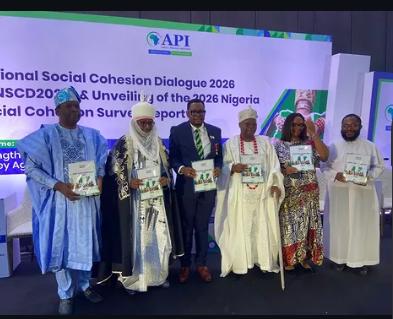
The call was made at the 2026 National Social Cohesion Dialogue held in Abuja on Thursday, June 25, where stakeholders from government, academia, civil society, development organisations, the media and traditional institutions examined strategies for strengthening social harmony and rebuilding public trust.
Organised by the Africa Polling Institute (API), the dialogue also featured the unveiling of the 2026 Nigeria Social Cohesion Survey Report, which showed the National Social Cohesion Index rising from 46.8 per cent in 2025 to 48.8 per cent in 2026, the highest score recorded since the assessment began in 2019.
Presenting the report, API Executive Director, Prof. Bell Ihua, said the improvement reflected Nigerians’ resilience and determination to remain united despite prevailing economic challenges and insecurity.
He noted that, for the first time since the survey began, a majority of respondents identified themselves first as Nigerians rather than by their ethnic, religious or regional identities.
Represented by the Falakin Kano, Mukhtar Ibrahim Bello, Sanusi said traditional and religious leaders remain among the most trusted figures within their communities and should use their influence to promote justice, tolerance and peaceful coexistence.
He urged community leaders to reject extremism, hate speech and discrimination while working closely with government and other stakeholders to strengthen national cohesion.
Delivering a keynote address titled We Bleed Red on behalf of Archbishop Kaigama, Rev. Fr. Dr. Emmanuel Unamba warned against placing ethnic or religious identities above national interest, stressing that such attitudes undermine nation-building.
He called for stronger collaboration between government and traditional institutions, greater recognition of traditional rulers, and sustained investment in conflict resolution and peacebuilding initiatives.
Kaigama also cautioned religious and traditional leaders against partisan politics, saying public confidence in their leadership depends largely on their neutrality.
Award-winning poet and spoken word artiste, Dike Chukwumerije, delivered a thought-provoking performance on social cohesion, tracing the historical origin of the name Nigeria.
He explained that Flora Shaw first proposed the name “Nigeria,” which was later adopted by Lord Lugard, adding that the name was derived from the River Niger.
Chukwumerije urged Nigerians to place the nation’s collective interest above ethnic and tribal loyalties, stressing that genuine unity can only be achieved when citizens see themselves first as one people.
READ ALSO: NUJ FCT Chairman Bags Leadership Award, Urges Media to Uphold Credibility Over Clicks
FG Targets Shift from Pilot Projects to Nationwide Digital Health Scale, Seeks N500bn Investment
The survey further revealed that while public trust in traditional and religious institutions remains relatively strong, confidence in government institutions remains low, underscoring the need for reforms aimed at rebuilding public trust.
Participants at the dialogue, including the Crown Princess of Mbutu Ngwa and other stakeholders, explored practical measures to strengthen social cohesion, deepen community engagement and enhance the role of traditional and religious institutions in national development.
The session was moderated by Nancy Iloh.
About The Author