
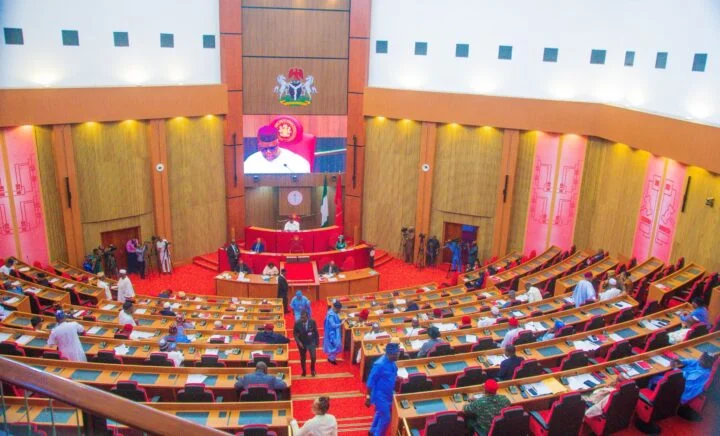
The Nigerian Senate on Wednesday rejected a motion seeking to investigate the controversial ₦1.3 billion allocation to the so-called Presidential Foreign Intervention Promotion Council (PFIPC) in the 2026 budget, opting instead to await the outcome of an ongoing probe by the Independent Corrupt Practices and Other Related Offences Commission (ICPC).
The decision followed a majority voice vote against the motion sponsored by Senator Kawu Sumaila (APC, Kano South) during plenary. Lawmakers argued that since President Bola Tinubu had already directed the ICPC to investigate the matter, initiating a parallel legislative probe would be premature.
Deputy Senate President, Barau Jibrin, who presided over the session, maintained that the upper chamber should allow the anti-graft agency to conclude its investigation before taking further action.
“I believe that what we need to do at this stage is to have the report of the ICPC, and then we can act on that report and deal with it as we feel appropriate,” Jibrin said.
The Senate’s position comes a day after its spokesperson, Senator Yemi Adaramodu, distanced the National Assembly from the controversial allocation, insisting that lawmakers neither recommended nor inserted the ₦1.3 billion provision into the budget. He further argued that the legislature is not constitutionally responsible for verifying the legitimacy of individuals heading government agencies.
However, the motion’s sponsor, Senator Sumaila, strongly disagreed, warning that the Senate could not absolve itself of responsibility since it ultimately approved the appropriation.
He described the inclusion of a “non-existent or unauthorised entity” in the national budget as a serious threat to the credibility of Nigeria’s appropriation process, noting that it exposes lapses in budget scrutiny and undermines public confidence in governance.
“Inclusion of a purported non-existent entity in the national budget undermines the credibility of the appropriation process and exposes weaknesses in fiscal oversight,” Sumaila stated.
He further urged the Senate to mandate its Committees on Ethics, Privileges and Public Petitions, as well as Appropriations, to investigate how the allocation was introduced and approved. The proposal, however, was rejected by the chamber.
The Senate’s decision contrasts sharply with that of the House of Representatives, which recently adopted a motion to probe the same ₦1.3 billion allocation.
The controversy surrounding the PFIPC stems from allegations involving Adeniyi Adeyemi, who has been declared wanted for allegedly impersonating the director-general of the council and another body, the Presidential Executive Advisory Council (PEAC)—both of which the Presidency has said do not exist.
Authorities have accused Adeyemi of forging official documents to support his claims, though he has denied the allegations, describing them as attempts to silence him. He had also accused the President’s Chief of Staff, Femi Gbajabiamila, of demanding a 48 per cent share of the budget allocation—an allegation that has been strongly denied.
In response, Gbajabiamila issued a 72-hour ultimatum demanding a retraction of the claims or face a ₦10 billion defamation lawsuit and possible criminal proceedings.
READ ALSO: Evidence, Not Media Trials, Must Drive Corruption Prosecutions — Analyst Tells EFCC
Expert Urges Nigerians to Invest for Wealth Growth
Meanwhile, former Vice President Atiku Abubakar has called for an independent investigation into the matter, citing the need to restore transparency and accountability in public financial management.
As the ICPC investigation continues, attention remains on the outcome, which is expected to shape the Senate’s next line of action on the controversial budget provision.
About The Author