

By Fatima Saka
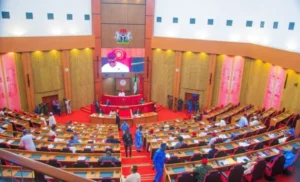
The Senate has moved to save Obogoro community in Bayelsa Central Senatorial District from extinction, urging the Federal Government to urgently provide shoreline protection following decades of erosion that have destroyed homes, school buildings and other community infrastructure, leaving about 300 residents homeless in recent times.
The upper chamber also urged the National Emergency Management Agency (NEMA) to provide relief materials to victims of the recurring flooding and erosion, while calling on the Ecological Project Office, the Federal Ministry of Environment and the Niger Delta Development Commission (NDDC) to take urgent measures to protect the threatened community.
The resolutions followed a motion titled “Urgent Need to Save Obogoro Community from Extinction,” sponsored by Senator Benson Friday Konbowei, who represents Bayelsa Central Senatorial District.
The motion highlighted the danger posed by decades of erosion to the community’s ancestral land, livelihoods, cultural identity and continued existence, warning that failure to address the situation could result in the disappearance of the community.
Presenting the motion, Konbowei noted that land was fundamental to the existence of any community or ethnic group because it provided a place for people to identify themselves, secure their livelihoods, preserve their culture and enjoy communal life.
He expressed concern that the people of Obogoro were in serious danger of losing their ancestral land as a result of persistent erosion that had continued to eat away at the community for decades.
According to the motion, the erosion has caused significant damage to different aspects of the residents’ lives, including loss of lives, destruction of property and the loss of sources of livelihood.
The senator disclosed that about 300 people had been rendered homeless in recent times, while public primary school buildings and the school field had been washed away.
Other facilities reportedly destroyed by the erosion include the National Youth Service Corps (NYSC) lodge, community playgrounds, church buildings and private residences.
The motion also noted that several people had drowned as a result of the crisis, raising concerns about the safety of residents and the future of the community.
Konbowei warned that the continued destruction of the land was threatening the survival of Obogoro as a community and endangering the cultural identity and communal relationships of its people.
Decades of Appeals Without Lasting Solution
The senator lamented that residents had repeatedly sought assistance from different levels of government and companies operating in the area without securing a lasting solution to the erosion problem.
He said the community had made several appeals, including petitions to the National Assembly, in an effort to draw attention to the destruction of their ancestral land.
Despite these efforts, the motion noted that no lasting solution had been provided to halt the erosion and protect the community.
The residents, according to the senator, felt neglected and abandoned as they continued to confront a challenge threatening their lives, property and continued existence.
The motion further observed that the erosion became more severe during the annual flood season, when rising river waters flowed at greater speed, washed away portions of the riverbank and reduced the land available to the community.
It warned that allowing the destruction to continue could ultimately result in the loss of one of Nigeria’s constituent communities.
Konbowei: Obogoro Erosion Has Persisted for Decades
Speaking with journalists after plenary, Konbowei said the erosion crisis had remained unresolved for decades despite repeated appeals to government authorities.
He recalled that Senator Abdul Ningi had referred to the problem during the Senate debate, noting that he had known about the Obogoro erosion issue since his time in the House of Representatives.
Konbowei said the continued destruction of the community had become a serious concern, adding that he had personally received recent messages from constituents drawing attention to the worsening situation.
He explained that residents had provided him with documents and correspondence showing their efforts to secure government intervention, including letters acknowledged by relevant offices.
According to him, the community had written repeatedly to authorities, including the Ecological Project Office, but had received acknowledgements without the substantive intervention needed to stop the erosion.
The senator said residents had approached him as their representative to bring their plight before the Senate and press for urgent government action.
He said he sponsored the motion in response to their appeals and to ensure that the Federal Government and relevant agencies were made aware of the threat facing the community.
Konbowei expressed satisfaction with the Senate’s deliberations, particularly the decision to establish a committee headed by the Senate President to pursue the matter and ensure that the necessary steps were taken.
He said the intervention offered an opportunity to move the issue beyond repeated appeals and towards practical measures capable of protecting the community.
The senator also expressed hope that the necessary shoreline protection projects would receive attention in the Federal Government’s budget.
He called for relevant government officials, including the Secretary to the Government of the Federation, to be engaged to ensure that the community’s situation received urgent attention before further destruction occurred.
Senator Clarifies Difference Between Flooding and Erosion
Responding to a question from journalists about annual flood warnings issued by hydrological agencies and the responsibility of the Bayelsa State Government to protect riverine communities, Konbowei said the state government had taken steps to address seasonal flooding.
He said the government, led by Governor Douye Diri, had been proactive in opening blocked canals and addressing waterways that required attention to improve water flow and reduce flooding.
According to the senator, the measures had helped prevent the widespread flooding experienced in some previous years.
However, he stressed that the situation in Obogoro was different from the temporary inundation of communities by floodwater.
He explained that the main problem was erosion caused by the force of river water flowing towards the ocean, which struck the riverbank and washed away portions of the community’s land.
Konbowei said the destruction became more severe when water levels rose during the annual flood season, as the increased speed and force of the river water accelerated the erosion.
He emphasised that the community’s challenge could not be resolved solely through measures designed to control seasonal flooding.
According to him, Obogoro requires permanent shoreline protection to prevent the river from continuously washing away its land and threatening residents’ homes.
The senator’s clarification highlighted the need for a targeted response to the erosion crisis, alongside existing efforts to manage seasonal flooding across Bayelsa State.
Senate Seeks Federal Agencies’ Intervention
In its resolutions, the Senate urged the Federal Government and its relevant agencies, particularly the Ecological Project Office, the Federal Ministry of Environment and the NDDC, to urgently address the erosion problem by providing shoreline protection for Obogoro.
The chamber also urged NEMA to provide relief materials to victims of the recurring flooding and erosion disaster.
The proposed shoreline protection is intended to address the continued loss of land along the riverbank, while the relief intervention would assist residents already affected by the destruction.
The Senate’s action also seeks to draw the attention of relevant government institutions to the community’s longstanding appeals and the need for a coordinated response.
Konbowei said he was encouraged by the deliberations on the motion and the steps taken by the chamber to pursue the matter.
He expressed hope that the intervention would ensure that the people of Obogoro could continue to live in their community without the constant threat of losing their homes and ancestral land.
Community’s Identity and Survival at Stake
The motion stressed that land was essential to the identity, livelihood, cultural preservation and communal life of any ethnic group.
It warned that allowing Obogoro to disappear would mean the loss of one of Nigeria’s constituent communities, with consequences extending beyond the destruction of buildings and other physical assets.
For residents, the continued erosion threatens their homes, educational facilities, religious institutions, economic activities and social relationships.
The destruction also raises concerns about displacement and the future of generations whose ancestral roots are in the community.
The Senate’s intervention places renewed attention on the responsibility of relevant government agencies to address both the immediate humanitarian needs of affected residents and the long-term environmental challenge threatening their community.
However, the effectiveness of the resolutions will depend on their implementation, the provision of funds, the execution of shoreline protection projects and sustained monitoring of the affected area.
CSCCN Petitions ICPC to Probe Retired AIG Ogunsakin, Oviawe Over Legal Qualifications
For the people of Obogoro, the immediate concern remains the protection of their remaining land and the prevention of further destruction, particularly during the annual flood season when rising river waters intensify erosion.
The Senate’s call for urgent intervention therefore seeks to ensure that the community’s plight receives the necessary attention before the continued loss of land makes its survival increasingly difficult.
About The Author



1 thought on “Senate Moves to Save Bayelsa Community from Extinction Over Erosion Destruction of Homes, School, Other”