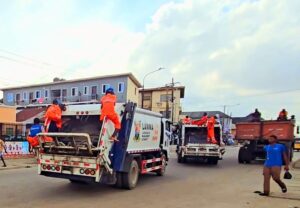
The Lagos Waste Management Authority (LAWMA) has deployed 25 trucks for an emergency waste evacuation exercise in Oshodi, Lagos State, attributing the persistent accumulation of refuse to low waste collection tariffs, inadequate waste containers and rising population density.
The Head of Private Sector Participation (PSP) Services at LAWMA, Mr Tunde Suleiman, disclosed this during an interview with the News Agency of Nigeria (NAN) on Sunday at Bolade, Oshodi, where the exercise was taking place.
Suleiman said the existing waste collection charges were no longer sufficient to cover the operational costs of Private Sector Participation operators, making it difficult for them to provide efficient services across the area.
He explained that residents still paid N750 per room for waste collection, despite increasing operational expenses and the long distances some operators travelled to evacuate refuse.
“We need to look at the rates. The people are still holding on to the old rates, which are not commensurate with the operational costs of PSPs today,” he said.
According to him, Oshodi, which has more than 350 streets, remains one of the local government areas with the lowest waste collection tariffs in Lagos State.
He said LAWMA had engaged PSP operators, Community Development Associations (CDAs), local government representatives and concerned residents to address the situation.
Suleiman, however, said the immediate priority was to clear the accumulated refuse before stakeholders resumed discussions on an appropriate tariff structure.
He added that the Lagos State Government was conducting a statewide review of waste collection tariffs to address the financial challenges facing waste management operators.
The LAWMA official said the emergency operation involved 25 trucks, supported by a working floor capable of accommodating four trucks at a time.
He noted that similar interventions had commenced in other parts of Oshodi, including Folorunsho Street and Oluwole, off Oshodi Road.
Suleiman described the exercise as a collaborative effort involving the local government, CDAs and residents who had raised concerns over the deteriorating sanitation situation.
Beyond the issue of tariffs, he identified inadequate waste containerisation as another major factor contributing to refuse accumulation in the area.
He cited a residential building with about 16 flats but only two waste bins, explaining that the containers were insufficient for the volume of refuse generated by the occupants.
According to him, such inadequacies cause bins to overflow shortly after waste collection, leaving streets and surrounding areas littered.
To address the challenge, Suleiman said LAWMA was promoting its “Adopt-a-Bin” initiative to encourage households to provide waste containers that matched their population and waste generation levels.
He also urged residents to embrace waste sorting and recycling, particularly of plastic bottles, cans and paper, to reduce the volume of refuse requiring evacuation.
The official explained that registered recyclers could purchase recyclable materials from residents, providing households with an opportunity to earn money while reducing their waste management expenses.
He added that LAWMA was implementing an incentivisation scheme through its Oshodi plant to encourage residents to participate in recycling activities.
Suleiman observed that Oshodi was previously regarded as one of the cleanest local government areas in Lagos but had experienced increasing sanitation challenges following changes in settlement patterns and population growth.
He explained that the conversion of older bungalows into multi-storey residential buildings had increased population density, creating additional pressure on existing waste management infrastructure.
On the frequency of emergency evacuation exercises across Lagos, Suleiman said such interventions were not intended to become routine but were necessary when serious waste management challenges arose.
He said LAWMA assessed the causes of waste accumulation before deploying emergency teams and also used advocacy campaigns to educate residents on proper waste disposal practices.
The LAWMA official stressed that sustained public awareness, adequate waste containers and improved compliance with waste collection arrangements were essential to preventing repeated refuse accumulation.
READ ALSO: 38% of ICU Patients Infected With Superbugs Die Within 14 Days, Study Finds
Nigeria Seeks ECOWAS-AES Agreement to Preserve West African Regional Ties
He urged residents to cooperate with LAWMA and PSP operators by paying appropriate waste collection charges, providing sufficient bins and adopting responsible waste management practices.
Suleiman added that LAWMA had a desk officer at the Oshodi local government secretariat to receive and channel complaints, while PSP operators serving the area, including Excellence, Tunap, Buckler Enterprises and Pepet, had offices residents could contact to report waste collection challenges.
About The Author