By Fatima Saka
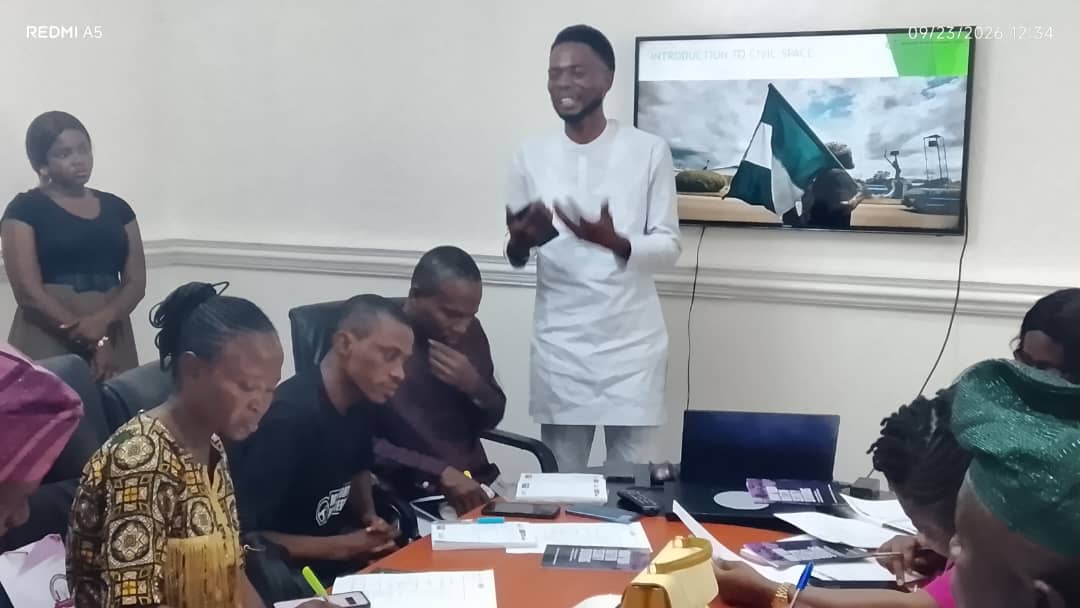
Headfort Foundation for Justice has trained teachers in Lagos on civic space and human rights, with the organisers saying the initiative is designed to help students understand and protect their civic rights.
The foundation said the training would enable teachers to transfer knowledge acquired to students through Human Rights Clubs established in participating secondary schools.
The Head of Legal Department of the foundation, Ms Olajumoke Ogunfowora, disclosed this in an interview with the News Agency of Nigeria (NAN) on Wednesday in Lagos.
She spoke during a Civic Space Train-the-Trainer programme organised for teachers as part of the foundation’s Human Rights Club project.
Ogunfowora said the training was designed to deepen teachers’ understanding of civic rights and equip them with the knowledge required to educate students.
According to her, teachers need to understand their civic rights, how to protect them and how to exercise them responsibly.
“Essentially, it is to educate the teachers on civic space and pass the knowledge to help them pass the knowledge to the students.
“They need to know about their rights, their civic rights, and how to protect it, as well as how to use it responsibly,” she said.
Ogunfowora said about 12 participants attended the training, comprising two teachers each from five secondary schools and some education district officers.
She listed the participating schools as Ayedire High School, Ojota Senior High School, Ikosi Senior and Junior Schools, and Kosofe.
She said the foundation’s legal department was responsible for delivering the legal component of the programme, particularly to help participants understand their rights.
Also speaking, the Programmes Officer of Headfort Foundation for Justice, Miss Oluwadamilola Ilori, said the organisation established its Human Rights Club in 2024 to increase students’ awareness of their rights and environment.
Ilori said the training formed part of the foundation’s continuous efforts to expose students to human rights and civic issues.
“The mission is to let students become aware, more aware of their rights and their environment, basically.
“So, it is just a continuous effort. Everything that they will gain from this is more exposure and a reminder, because students need to be reminded about things so they will not forget,” she said.
She said increased awareness would help students recognise when their rights were being violated and understand appropriate ways to respond.
Ilori recalled that while she was a secondary school student, there were instances where people attempted to trample on her rights, noting that there was no Human Rights Club to provide such awareness at the time.
According to her, the establishment of the clubs would help students recognise unacceptable conduct and understand how they should be treated.
The Programme Officer, Spaces for Change, Mr Testimony Omole, said engaging young people was essential to strengthening Nigeria’s civic space.
Omole said the training was organised by Headfort Foundation in partnership with the Action Group on Free Civic Space and supported by the Fund for Global Human Rights.
He said Spaces for Change and its partners had implemented initiatives including capacity building, advocacy, community engagement, research, knowledge building and media advocacy to advance civic space in Nigeria.
“We are at a critical point where we have realised the need to also engage the upcoming generation, the younger generation, the students and the youth,” he said.
Omole said equipping teachers with knowledge and tools on civic space protection would enable them to transfer the knowledge to students through Human Rights Clubs.
He said students and young people needed to understand the meaning of civic space and how they could legitimately participate in civic activities.
On factors affecting civic space, Omole identified securitisation and security overreach among issues that could affect civic participation.
He said research conducted by the Action Group on Free Civic Space five years ago showed that security measures could sometimes have a chilling effect when implemented disproportionately.
Omole urged civil society organisations to invest in knowledge and evidence building to support advocacy for social change and address restrictions on civic space.
Mr Gabriel Odiwe, a participant from Education District 2, Maryland, Lagos, said the training would help teachers equip students with knowledge of their civic rights.
Odiwe said many Nigerians, including students, were unaware of their rights and lacked knowledge of how to seek enforcement when their rights were violated.
“Most of our students don’t know their rights. And not just students, most of the citizens don’t know their rights,” he said.
According to him, even citizens who know their rights often lack knowledge of how to get them enforced, leaving them vulnerable to unjust treatment.
Odiwe said the training would enable teachers to understand civic space and subsequently transfer the knowledge to students.
He said the knowledge would also help students become more assertive and understand how to protect their rights in different situations.
READ ALSO: Shettima Urges Nigerians in Diaspora to Invest, Transfer Skills for National Development
UNGA 81: Nigeria Reaffirms Commitment to Multilateralism, Global Peace
Odiwe said students should be equipped to ensure that their rights were not trampled upon by adults or security personnel.
NAN reports that the project was made possible with funding provided by the Action Group on Free Civic Spaces and supported by the Fund for Global Human Rights in partnership with Spaces for Change. (NAN)
About The Author