By Fatima Saka
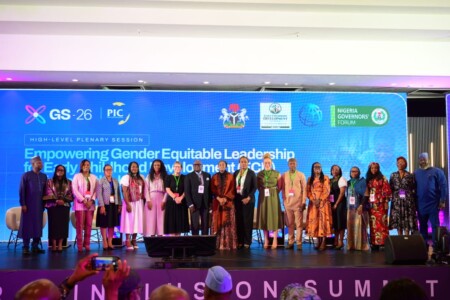
Leaders at the fifth Gender and Inclusion Summit (GS26) have called for stronger implementation of government policies and development initiatives at the community level, warning that policy commitments would have limited impact if they failed to translate into tangible improvements in the lives of citizens.
The call was made at the two-day summit organised by the Policy Innovation Centre (PIC) in Abuja on September 8 and 9, under the theme, “From Agenda to Action: Making Innovations Count for the Last Mile.”
Delivering the keynote address, Patrick Achi, President of the National Assembly of Côte d’Ivoire and former Prime Minister of Côte d’Ivoire, said inclusion must be treated as a fundamental component of development rather than an additional consideration.
“Inclusion is not a social supplement to development. Inclusion is development,” Achi said.
He described the last mile as the point where development becomes real, noting that it was where women entrepreneurs accessed capital, farmers connected to modern value chains, young people gained opportunities and citizens engaged with the State.
“The last mile is not where development ends. It is where development becomes real,” he added.
Executive Director of PIC, Dr Osasuyi Dirisu, challenged policymakers and development actors to examine whether innovative solutions were actually reaching the communities they were designed to serve.
“Do our solutions travel as far as the infrastructure goes, or do they stop?” Dirisu asked.
She identified policy, partnership, infrastructure, financing, coordination, ownership and adaptation as critical factors for moving from agenda-setting to effective implementation, particularly at the local government, ward and community levels.
Chairman of the Nigerian Economic Summit Group (NESG), Mr Niyi Yusuf, similarly urged leaders to assess the impact of years of policy commitments on ordinary Nigerians.
“The question this fifth edition of the summit places before us is a harder one: are these commitments reaching the people who need them the most?” Yusuf asked.
The summit brought together senior government officials, policymakers, development partners, private-sector leaders and other actors, including the Minister of Women Affairs and Social Development, Hon. Imaan Sulaiman-Ibrahim; Chairperson of the Nigeria Governors’ Spouses Forum and First Lady of Kwara State, Ambassador Professor Olufolake AbdulRazaq; Chairman of the PIC Board, Mr Udeme Ufot; and Director, Nigeria Office, MacArthur Foundation, Dr Kole A. Shettima.
The event also featured the pre-launch of the Gender Legislative Agenda for Africa, the launch of the Nigerian Youth Dream Charter and the SWOLE (Strengthening Women’s Leadership in Academic Economics) Policy Transformation Toolkit.
Also unveiled at the summit were findings from the Nigerian Survey on Gender Norms, Attitudes, Health and Wellbeing, providing nationally representative data on the social and gender norms shaping adolescents’ health and wellbeing.
The Minister of State for Health and Social Welfare, Dr Iziaq Adekunle Salako, who chaired the National Dialogue on Transforming Gender Norms for Adolescent Health and Wellbeing, urged participants to build on the survey findings and discussions to drive reforms towards a more equitable and inclusive health system.
“Let this dialogue be more than a conversation. Let it be a catalyst for change,” Salako said.
Chairman of the PIC Board, Mr Udeme Ufot, said the responsibility of leaders extended beyond generating ideas and making commitments to ensuring that such initiatives were implemented, scaled and experienced in the everyday lives of Nigerians.
“Our task is not only to develop good ideas and make commitments, but to ensure that they are implemented, scaled and experienced in people’s everyday lives,” Ufot said.
READ ALSO: Akande Presents Credentials To Switzerland Seek Stronger Trade, Investment Ties
Troops Arrest Terrorist Kingpin, Ammunition Courier With 300 Rounds in Kaduna
He added that the outcomes of GS26 would be documented through the Purple Book to support continued policy engagement, advocacy and accountability beyond the summit.
The summit concluded with a renewed call for stronger implementation of policies, innovations and investments at the grassroots, with participants stressing that development initiatives must move beyond agenda-setting to produce measurable improvements in the lives of people and communities.
About The Author