By Fatima Saka
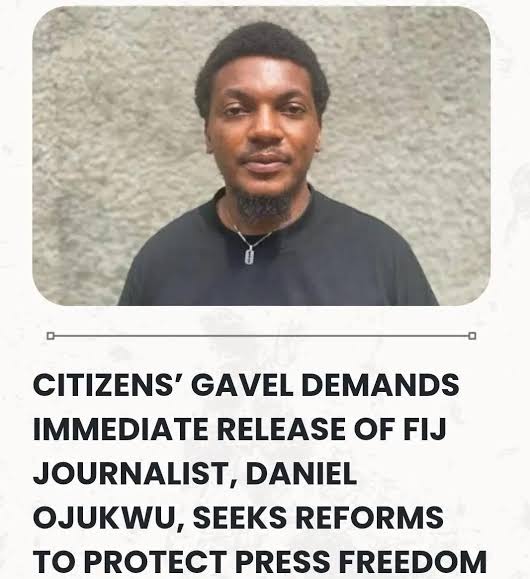
The Coalition for Whistleblowers Protection and Press Freedom (CWPPF) has called for the immediate release of investigative journalist Daniel Ojukwu on bail, describing his continued detention at the Kuje Correctional Centre as unnecessary and a threat to press freedom.
The coalition made the call in a statement issued on November 11, following Ojukwu’s remand by the Federal High Court, Abuja, on November 10, 2026, over a 12-count charge bordering on alleged cyberstalking and criminal defamation.
Ojukwu, a journalist with the Foundation for Investigative Journalism (FIJ), was arraigned over an investigative report concerning the activities and expenditure of public funds by the Office of the Senior Special Assistant to the President on Sustainable Development Goals (OSSAP-SDGs).
He pleaded not guilty to all the charges, while the court ordered his remand pending the hearing of his bail application, which was adjourned to December 1, 2026.
The coalition expressed concern that the journalist would remain in custody for weeks before his bail application is considered, insisting that pretrial detention should not be treated as punishment.
It argued that the offences against Ojukwu are bailable, adding that his established professional and residential base in Nigeria, previous administrative bail and willingness to attend court proceedings should be considered in favour of his release.
The coalition also raised concerns over the use of the Cybercrimes (Prohibition, Prevention, etc.) Act 2015, as amended, and the Criminal Code Act in cases involving investigative journalism.
According to the statement, the prosecution raises questions about the possible weaponisation of cybercrime laws against journalists reporting on matters of public interest.
It maintained that criticism of government programmes or disagreement by public officials with published reports does not automatically constitute a criminal offence.
The coalition cited Sections 39 and 22 of the 1999 Constitution, as amended, which guarantee freedom of expression and recognise the responsibility of the press to hold government accountable.
It also referenced Section 36(5) of the Constitution, which guarantees the presumption of innocence, stressing that Ojukwu should not be subjected to the consequences of a conviction before the determination of his trial.
The coalition further cited the National Human Rights Commission’s April 2025 advisory on freedom of expression, which cautioned against the arbitrary application of Section 24 of the Cybercrimes Act against journalists, activists and others exercising their constitutional rights.
It specifically questioned the reliance on Section 24(2)(a) of the Act, noting that the prosecution must establish the specific elements of cyberstalking, including communication intended to bully, threaten or harass another person and which places the person in fear of death, violence or bodily harm.
The coalition stressed that publishing an investigative report questioning the management of public funds does not, in itself, establish cyberstalking.
It called on the court to urgently hear and determine Ojukwu’s pending bail application and release him on reasonable conditions rather than keep him in custody until December 1.
The coalition also urged influential persons, the Nigeria Police Force and other law enforcement agencies to exercise restraint in applying cybercrime legislation against journalists and individuals exercising their constitutional right to freedom of expression.
It called on public officials and government institutions to respond to investigative reports through transparent, evidence-based and lawful processes rather than criminal proceedings that could intimidate journalists.
The statement was signed by the Centre for Journalism Innovation and Development (CJID) and Hope Behind Bars Africa (HBBA), on behalf of the coalition.
NCDC Confirms Recovery of Ebola Patient Evacuated to Switzerland, Hails Tinubu’s Swift Intervention
The CWPPF comprises media organisations, civil society groups and law firms committed to protecting whistleblowing, freedom of expression and press freedom.
The coalition warned that weakening investigative journalism would undermine public accountability and democratic participation, insisting that journalism must not become a criminal offence simply because it questions those in positions of power.
About The Author