
By Fatima Saka
“Power must not be exercised in darkness,” stakeholders emphasized on Thursday as the (CJID) officially unveiled the Press Attacks Tracker (PAT) for West Africa, underscoring the indispensable role of journalism in safeguarding democracy, human rights, and accountability in an increasingly complex information environment.
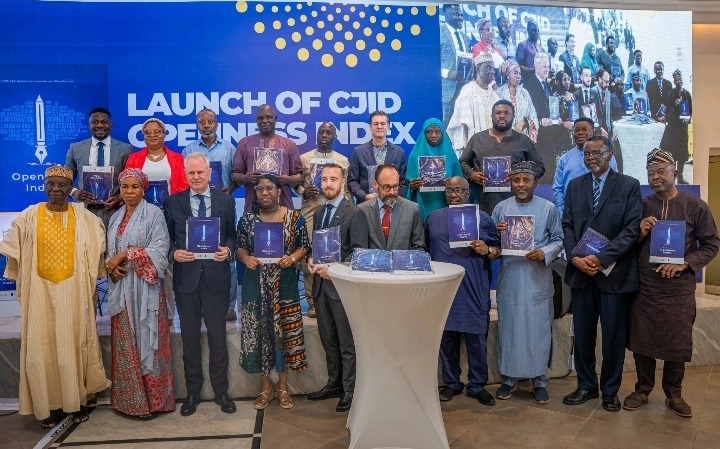
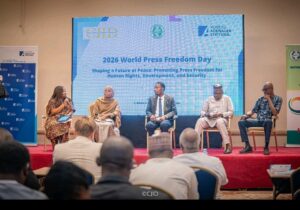
The unveiling was the centerpiece of activities marking 2026 , held in Abuja under the theme “Shaping a Future at Peace: Promoting Press Freedom for Human Rights, Development, and Security.”
The event was convened by CJID in collaboration with the (NHRC) and , bringing together Journalists, media leaders, policymakers, civil society actors, and development partners.
Speaking at the event, the Minister of Information and National Orientation, Mohammed Idris Malagi, who was represented by Dr. Dili Ezughah of the , reaffirmed the Federal Government’s commitment to press freedom and democratic governance.
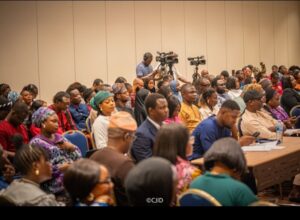
He described the theme of the event as timely, noting that journalism remains central to promoting peace, human rights, and national development amid rising global challenges such as misinformation, insecurity, and digital manipulation.
He stated that “journalism continues to serve as one of the strongest pillars for truth, transparency, and social stability, especially in a world increasingly shaped by polarization and technological disruption.”
According to him, responsible media practice builds bridges of understanding, amplifies the voices of vulnerable populations, and strengthens democratic institutions.
The Minister further emphasized that “peace and democracy cannot flourish where truth is suppressed, and development cannot be sustained without an informed citizenry,” stressing that the government remains committed to protecting freedom of expression and media independence within the bounds of professionalism and national security.
He highlighted ongoing reforms aimed at strengthening Nigeria’s information ecosystem, including investments in digital innovation, broadband expansion, cybersecurity frameworks, and youth empowerment initiatives such as the 3 Million Technical Talent (3MTT) programme. These efforts, he said, are designed to enhance transparency, expand citizen participation, and prepare Nigerians for the evolving digital landscape.
Acknowledging the difficult conditions under which journalists operate, he noted that misinformation, online harassment, economic pressures, and safety concerns require stronger institutional support and collaboration.
“The future of journalism must be anchored on truth, innovation, and public trust,” he said, urging media practitioners to uphold professionalism, accuracy, and ethical standards while adapting to emerging technologies, including artificial intelligence.
He commended CJID and its partners for their sustained contributions to fact-checking, media literacy, and the protection of journalists, calling for continued collaboration among government, civil society, and international organisations to strengthen Nigeria’s democratic space.
Delivering the keynote, the Chief Executive Officer of CJID, Dapo Olorunyomi OON, painted a stark picture of the evolving threats confronting journalism globally and within Nigeria. He highlighted how restrictive legislation, politicised regulatory frameworks, administrative intimidation, and digital manipulation are increasingly deployed to constrain the media.
“History teaches us that peace cannot thrive where truth is silenced, and development cannot flourish where accountability is weakened,” Olorunyomi said. “Even as obstacles evolve, journalism must remain defiant. When state power seeks to constrain, we must respond with courage; when truth is buried, we must dig deeper.”
He stressed that defending press freedom goes beyond protecting journalists, describing it as a broader societal obligation.
According to him, “press freedom is ultimately about safeguarding society’s ability to know, to question, and to demand accountability,” warning that without this, democratic institutions risk collapse.
Olorunyomi further called for comprehensive reforms, including stronger legal protections for journalists, sustainable and independent media financing models, and coordinated efforts to counter disinformation across newsrooms, civil society, and the judiciary.
In his welcome address, Moritz Sprenker, Resident Representative of Konrad Adenauer Stiftung, reinforced the centrality of journalism to democratic governance. He noted that journalism plays a watchdog role that ensures transparency and accountability in public institutions.
“Journalism ensures that power is not exercised in the dark. It exposes wrongdoing, strengthens public debate, and gives voice to those who might otherwise remain unheard,” Sprenker said. “Where journalists can work freely, societies are better equipped to manage crises, resolve conflicts, and build trust.”
Dr. Tony Ojukwu, Executive Secretary of the NHRC, Represented by Hilary Ogbonna described press freedom as a constitutional and democratic necessity. He cited Section 39 of Nigeria’s Constitution, which guarantees freedom of expression, and warned against increasing attacks on journalists.
“Press freedom is not an abstract ideal; it is a practical necessity for national development and sustainable peace,” he said. “A society where journalists are intimidated, attacked, or silenced cannot truly be democratic or secure.”
He revealed that the Commission continues to receive reports of arbitrary arrests, threats, and harassment targeting journalists, stressing that misuse of laws undermines public trust and weakens democratic institutions.
In a defining moment of the event, Akintunde Babatunde, Executive Director of CJID, officially unveiled the Press Attacks Tracker (PAT) for West Africa, describing it as a critical tool for documenting and responding to violations against journalists.
“The Press Attacks Tracker is not just a platform; it is a response to the growing need for accountability,” Babatunde said. “It will provide real-time data, strengthen advocacy, and support efforts to protect journalists across the region.”
The event also featured a panel discussion moderated by Busola Abijola, Deputy Director, Journalism Programme at CJID, which examined the impact of investigative journalism on human rights protection and nation-building.
In addition, specialised training sessions were held, including one on legal first aid for journalists facilitated by Christiana Longe, Project Manager, Media Freedom at CJID, and another on strategic approaches and dignity-centred conduct in human rights reporting led by Hauwa Shaffi Nuhu, Managing Editor at HumAngle.
READ ALSO: Onigbinde Emerges New MARAN president
AI-Driven Disinformation Threatens Nigeria’s 2027 Elections, Media Experts Warns
Stakeholders collectively raised concerns over rising misinformation, shrinking civic space, and increasing threats to media independence, calling for stronger collaboration and reforms to safeguard press freedom.
The event ended with renewed commitment to uphold journalism as a pillar of democracy, peace, and development, with participants stressing that a free and independent press remains essential to building an informed, accountable, and just society.
About The Author