FG Strengthens Zero-Waste Policy Drive, Targets Food Loss Across Value Chain — Balarabe Reveals

The Federal Government has reaffirmed its commitment to reducing food waste and promoting sustainable consumption as part of broader efforts to secure Nigeria’s environmental and economic future.
Speaking at the International Day of Zero Waste 2026 in Abuja, Minister of Environment, Balarabe Abbas Lawal, said Nigeria is intensifying policies aimed at achieving a zero-waste future, with a strong focus on tackling food loss across the value chain.
The 2026 event, themed “Food Waste—Towards Sustainable Consumption and Production,” brought together policymakers, development partners, and industry stakeholders to explore practical solutions to food inefficiencies.
Nigeria Targets Food Waste Reduction to Drive Sustainable Growth: Lawal stressed that reducing food waste is critical to Nigeria’s food security and environmental sustainability, noting that waste undermines investments in production, transportation, and processing, while also contributing to pollution and greenhouse gas emissions.
“The choices we make today will determine the sustainability of our food systems, the health of our environment, and the wellbeing of our communities,” he said.
He called for coordinated action across the food value chain, urging farmers to adopt improved storage and processing technologies, while encouraging businesses and retailers to enhance inventory and distribution systems. He also emphasized the importance of public awareness and behavioural change in achieving lasting results.
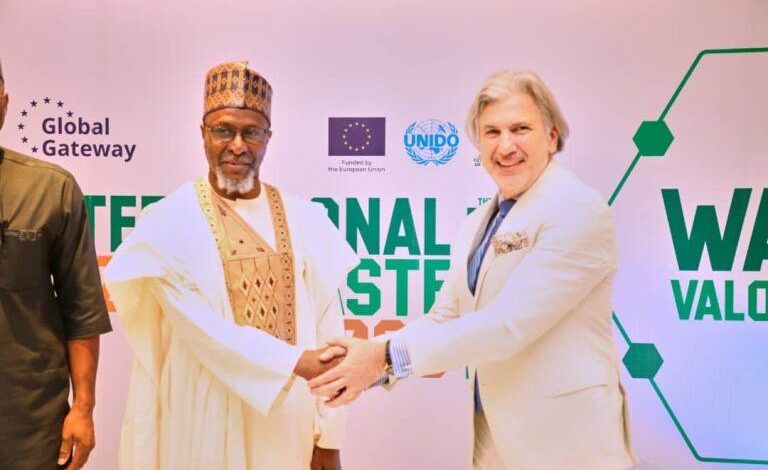
The minister highlighted ongoing collaboration between the Federal Ministry of Environment, the European Union Delegation to Nigeria and ECOWAS, and the United Nations Industrial Development Organization, describing international partnerships as vital to addressing global environmental challenges.
Also speaking, Deputy Ambassador of the EU Delegation, Zissimos Vergos, said tackling food waste can strengthen economic resilience, protect vulnerable populations, and stimulate growth.
He underscored the need for increased investments in infrastructure, cold chain systems, and modern technologies to improve food preservation and distribution.
“By approaching food waste through the lens of industrial transformation, we can create jobs, improve food security, and build a more sustainable and inclusive future,” Vergos said.
Similarly, UNIDO representative, Phibert Johnson, described food waste as a sign of inefficiency within agro-industrial systems, warning that losses across harvesting, storage, processing, and distribution reduce productivity and competitiveness.
READ ALSO: Artemis II Crew Launches to Moon After 50 Years, Marks Historic Return to Deep Space
ADC Accuses Tinubu of Undermining Opposition, Call for INEC Leadership Resignation
“Food is more than a commodity; it is a foundation of wealth, a driver of health, and a pillar of security,” he said, adding that efficient food systems are essential for economic stability and community wellbeing.
The event served as a platform for stakeholders, including academia, civil society, and youth groups—to discuss scalable solutions to food waste, with a shared goal of building a more sustainable and resilient food system in Nigeria.
About The Author