
Tension is mounting in Mboke community, Umuoye Imerienwe, in Ngor/Okpala Local Government Area of Imo State, following allegations of an attempted takeover of ancestral land without the consent of its original custodians.
The disputed land, known as Okohia-Alaukwu, is a vast expanse historically regarded as sacred heritage belonging exclusively to the Umu Okere and Amadi families of Mboke. Community sources say ownership boundaries and lineage rights over the land have long been established and recognized within the traditional framework of the area.
However, controversy erupted in recent days after videos surfaced showing extensive clearing activities on the land. Indigenes allege that the operation is being coordinated by individuals linked to the leadership of the Imerienwe Peoples Assembly, reportedly in collaboration with armed miscreants, under the pretext of developing a market.
The development has triggered widespread outrage, with residents questioning how a project said to span over 700 plots could commence without the knowledge or approval of the landholding families.
Community elders also recalled previous attempts by Ndiokwu village to lay claim to parts of the land—efforts they say were resisted and settled through traditional intervention. Many now fear that those ambitions may have resurfaced through indirect means involving external interests.
The situation has further revived memories of an earlier land dispute involving a private claimant, which was eventually resolved by the Eze-in-Council. The traditional ruling, reportedly documented and endorsed by all parties, affirmed that the Okohia-Alaukwu land belongs to the Umu Okere and Amadi families. Residents argue that the current development appears to disregard that binding decision.
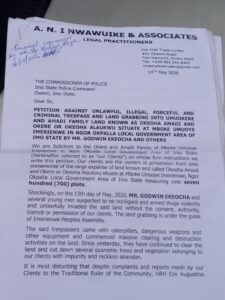
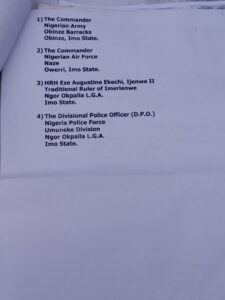
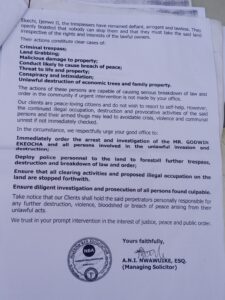
Sources disclosed that a formal petition has been submitted to the Imo State Commissioner of Police, warning of rising tension and the potential for a breakdown of law and order if urgent action is not taken.
Legal practitioner and indigene, Barrister Iyke Nwawuike, condemned the alleged action, describing it as a violation of due process and community rights. He stressed that development initiatives must be transparent and inclusive, not imposed through secrecy.
Environmental concerns have also been raised, with claims that parts of the land may fall within a protected forest reserve. Stakeholders insist that any such project should undergo proper environmental impact assessment and regulatory approval.
Residents further questioned the viability of establishing a market in the area, citing its remote location and lack of basic infrastructure such as roads, electricity, and water. They contrasted the project with the long-neglected Ulakwo–Imerienwe–Umuekwune–Etche road, a critical economic route that has remained in poor condition for decades.
The controversy has sparked broader concerns about governance, accountability, and transparency within the community. Questions are being asked about who authorized the project, whether due process was followed, and who stands to benefit.
READ ALSO: Oyo School Abduction: MURIC Demands Urgent Rescue Action
FRSC Launches “Operation Guduma” in Anambra to Tackle Fake Diplomatic Plates, Overloading
Community members are now calling for an immediate halt to all clearing activities, full disclosure of the project details, and an emergency stakeholders’ meeting involving affected families, traditional authorities, and government agencies.
For many residents, the dispute has gone beyond land ownership, evolving into a test of justice, environmental responsibility, and respect for ancestral heritage in the face of modern development pressures.
About The Author