
By Fatima Saka
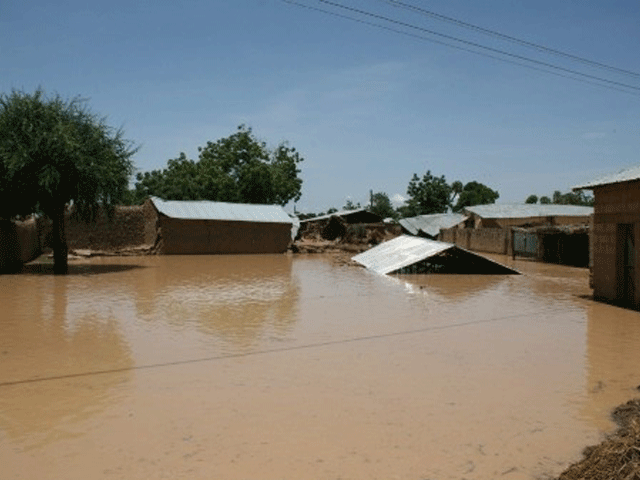
Abuja — The Federal Government has warned that no fewer than 14,118 communities across 266 Local Government Areas in 33 states and the Federal Capital Territory (FCT) fall within high flood risk zones ahead of the 2026 rainy season.
Minister of Water Resources and Sanitation, Joseph Utsev, disclosed this during the presentation of the 2026 Annual Flood Outlook (AFO) in Abuja, raising concerns over the scale of potential devastation if proactive measures are not taken.
The report, themed “Smart Water Resources Management – Moving from Oil to Water-Based Economy,” identified Abia, Adamawa, Anambra, Bauchi, Bayelsa, Benue, Borno, Cross River, Delta, Ebonyi, Edo, Enugu, Gombe, Imo, Jigawa, Kaduna, Kano, Kebbi, Kogi, Kwara, Lagos, Nasarawa, Niger, Ogun, Ondo, Osun, Oyo, Plateau, Rivers, Sokoto, Taraba, Yobe, Zamfara, and the FCT as high-risk areas.
Beyond the high-risk zones, the Minister revealed that 15,597 communities in 405 LGAs across 35 states fall under moderate flood risk, with Ekiti State identified as the only state not affected in that category. Additionally, 923 communities in 77 LGAs across 24 states are projected to experience minimal flooding.
The outlook further warned that major urban centres such as Abuja, Lagos, Port Harcourt, Ibadan, Kano, Kaduna, Enugu, Calabar, Makurdi, Yola, and Abeokuta are likely to experience flash and urban flooding due to heavy rainfall, poor drainage systems, and inadequate flood control infrastructure.
Coastal and riverine flooding is also expected in states such as Bayelsa, Cross River, Delta, Lagos, Ogun, Rivers, and Ondo, driven by rising sea levels and tidal surges, with potential disruptions to fishing, transportation, and ecosystems.
Utsev stressed that addressing the looming flood threat requires coordinated action at all levels, urging state governments, local authorities, and communities to integrate flood risk management into development planning, improve drainage systems, and strengthen resilience measures.
He emphasized that preparedness remains critical to safeguarding lives, infrastructure, and economic activities.
In his remarks, Director-General of the Nigeria Hydrological Services Agency, Umar Ibrahim Mohammed, described the Annual Flood Outlook as a vital tool for early warning, policy formulation, and emergency response coordination.
He noted that the 2026 forecast leverages a hybrid AI-integrated modelling system to improve prediction accuracy and reduce false alarms. According to him, the agency has also upgraded its Flood Dashboard to a real-time geo-intelligence platform, supported by a mobile application and trained flood marshals to enhance early warning dissemination.
Mohammed urged Nigerians to heed official advisories and actively support community-level preparedness efforts to mitigate the impact of flooding.
Also speaking, Minister of Livestock Development, Idi Mukhtar Maiha, warned that water remains central to Nigeria’s economic survival, particularly amid growing competition for land and water resources.
READ ALSO: Drug Resistance Threat: Nigeria to Host Landmark Global AMR Summit in Abuja
Senate Raises Alarm Over ₦210 Trillion Discrepancies in NNPCL Accounts
He stressed the need for science-driven development planning anchored on water availability, sustainability, and efficient resource management to support long-term economic growth.
Describing water as indispensable to life and productivity, Maiha noted that key sectors such as agriculture and industry depend heavily on reliable water supply, urging stakeholders to embrace data, innovation, and modern technology in managing the nation’s water resources.
About The Author