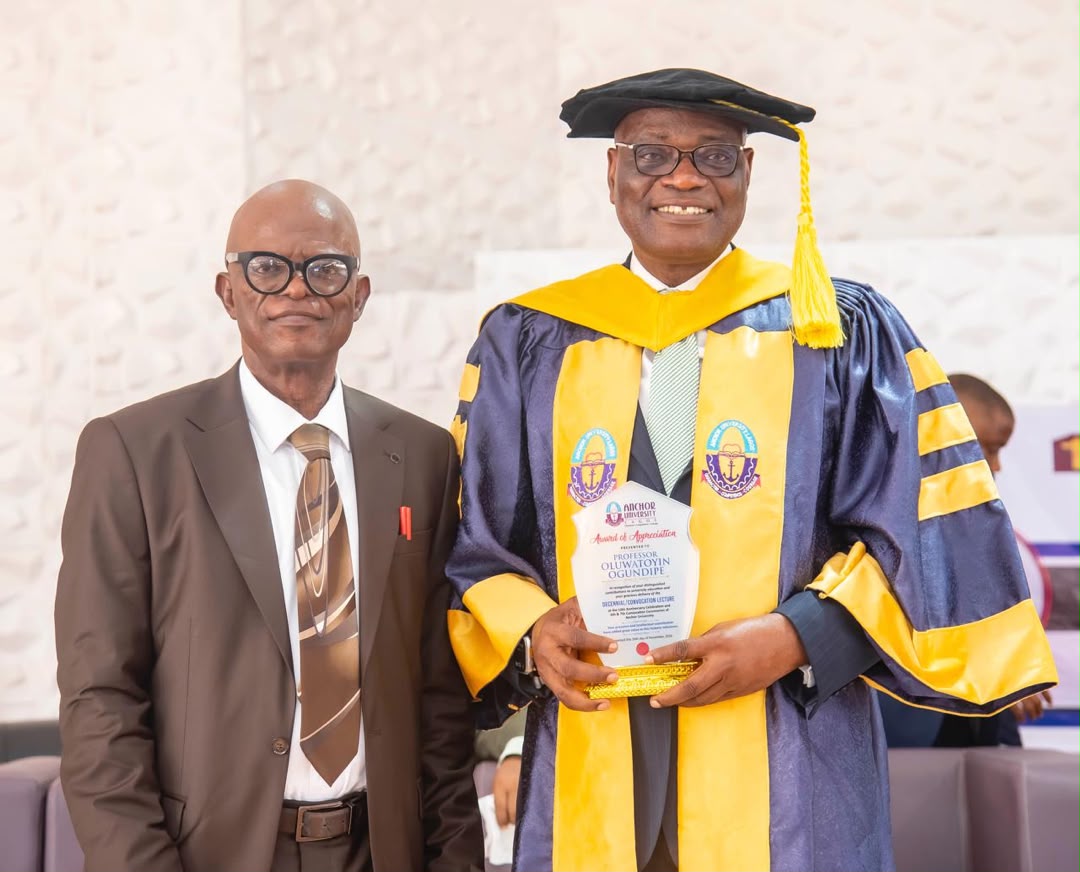
The Chairman, Governing Board of the National Universities Commission (NUC), Prof. Oluwatoyin Ogundipe, has challenged African universities to transform research findings into practical solutions, marketable products and sustainable livelihoods to accelerate the continent’s development.
Ogundipe said universities must move beyond traditional classroom teaching and become centres of innovation, enterprise and technological advancement capable of addressing Africa’s pressing social and economic challenges.
He made the call on Friday while delivering the 2026 Convocation Lecture of Anchor University, Ayobo, Lagos, titled, “ANCHOR@10: University Education, Transformational Leadership and the Future of Africa.”
The former Vice-Chancellor of the University of Lagos said the relevance of universities in the 21st century would depend increasingly on their ability to generate original knowledge, promote innovation and produce graduates equipped to respond to changing global realities.
“We can no longer be content merely to transmit inherited knowledge. A graduate who knows only what was taught in the lecture theatre will soon find that knowledge outdated.
“Universities must become hubs of innovation, enterprise and technological adaptation, places where research becomes solutions, solutions become products and products become livelihoods,” he said.
Ogundipe identified research excellence, digital transformation, industry partnerships and international academic collaboration as critical priorities for universities seeking to remain relevant.
He also called for stronger connections between academic institutions and the marketplace through internships, innovation incubators and curricula jointly developed with industries.
According to him, universities must be locally responsive by ensuring that their research and academic programmes address the needs, cultures and aspirations of their immediate communities.
He maintained that Africa’s development challenges were rooted largely in institutional weaknesses and leadership gaps, stressing that institutions could only be as strong as the people who built and sustained them.
The NUC chairman noted that despite the continent’s enormous natural and human resources, Africa continued to struggle with poverty, unemployment, infrastructure deficits and weak governance.
He said the continent’s limited contribution to global manufacturing and knowledge production reflected the urgent need to prioritise human capital development.
“Our prosperity will not rest on crude oil, cobalt or cocoa. It will rest on our capacity to generate knowledge, nurture innovation and raise ethical, courageous leaders, equal to the demands of an increasingly complex world.
“That task belongs, in no small measure, to universities such as Anchor,” he stated.
Ogundipe further emphasised the importance of ethical and transformational leadership, saying leaders must demonstrate integrity, moral courage and personal accountability.
He added that universities must deliberately cultivate moral reasoning, civic responsibility and public service values in their graduates to prepare them for leadership roles.
On Anchor University’s 10th anniversary, he urged the institution to move from promise to pre-eminence by positioning itself as a regional centre of excellence in teaching, research, innovation and leadership development.
He also challenged the university to establish stronger partnerships with leading institutions across Africa and beyond while ensuring that its presence delivered tangible benefits to Ayobo, Lagos State and Nigeria.
Addressing the graduating students, Ogundipe urged them to see themselves as agents of transformation rather than job-seekers alone.
READ ALSO: Anambra Monarchs Urged to Secure PWDs’ Inclusion in Oil Community Benefits
CoSPAL Adopts Nigeria’s Legislative Mentorship Model for African Parliaments
“Today is not the end of your story. It is the end of your preparation and the beginning of a new chapter.
“The world does not reward those who are merely qualified; it rewards those who are indispensable,” he said.
About The Author