By Distinct News Editorial Board
For the two weeks leading to presidential assent, Nigeria’s political space was charged with protests, sharp parliamentary divisions and mounting public scrutiny over one central issue, compulsory electronic transmission of election results. Opposition lawmakers warned against dilution. Civil society groups demanded clarity. The streets echoed a familiar democratic anxiety: can Nigeria finally secure the integrity of its vote transmission process?
In the midst of the debate, the Independent National Electoral Commission (INEC) sought to steady public confidence, announcing that 93 per cent of polling units nationwide have mobile network coverage. The figure, according to the commission, followed a joint technical assessment with the Nigerian Communications Commission (NCC) and major telecom operators. The declaration was strategic, aimed at addressing fears that infrastructure limitations could frustrate electronic transmission.
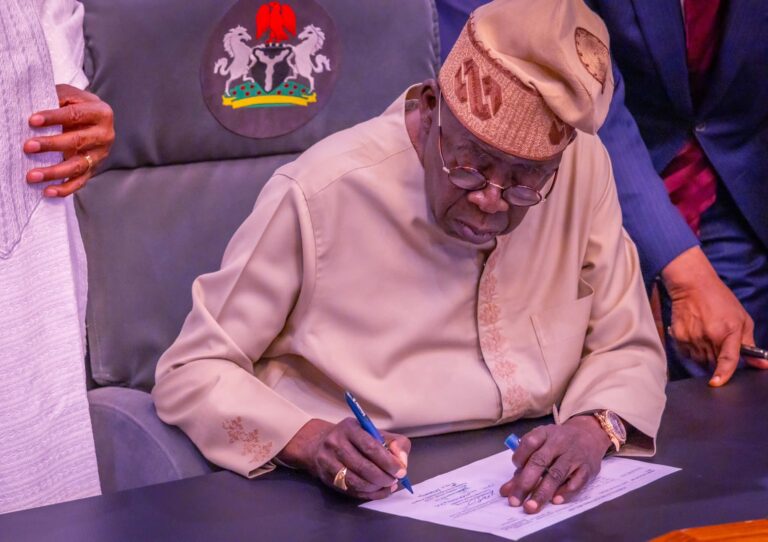
It was against this tense national backdrop that President Bola Ahmed Tinubu signed the amended 2022 Electoral Act into law, commending the National Assembly for managing the legislative process without confusion or disenfranchisement. The President framed the amendment as an outcome of democratic brainstorming and collective nation-building.
Yet beneath the ceremony lies a deeper national test.
President Tinubu’s remarks reflected caution as much as optimism. He reminded Nigerians that voting itself remains largely manual, ballot papers are issued manually, votes cast manually, and counted manually at polling units. The innovation, he emphasised, concerns the transmission of those results. And it is precisely this stage that has historically attracted disputes, litigation and allegations of manipulation.
The controversy, therefore, is not about abandoning manual voting. It is about safeguarding the journey of results from polling units to collation centres.
The President’s reference to Nigeria’s broadband capacity and vulnerability to cyber interference introduces a pragmatic concern. Technology promises speed and transparency, but it also demands resilience, cybersecurity protection and stable connectivity. Electronic transmission cannot afford widespread glitches or selective failures, particularly in a politically polarised environment.
For opposition lawmakers, however, compulsory transmission is a democratic safeguard. It is seen as a buffer against human interference in the collation chain. Their agitation reflects a broader erosion of public trust that has trailed previous elections. In their view, anything short of guaranteed digital transmission leaves room for suspicion.
Senate President Godswill Akpabio described the amendment as historic, noting that the National Assembly worked for two years to conclude the process in time for electoral preparations. He underscored provisions enabling electronic transmission and strengthening INEC’s Results Viewing Portal (IReV), which allows public access to polling unit results, even where synchronization occurs after connectivity is restored.
These assurances are significant. But credibility will not be built on assurances alone.
The 93 per cent coverage figure, while encouraging, leaves a seven per cent gap, a margin that could become contentious in tightly contested constituencies. More importantly, coverage does not equal capacity. Network presence must translate into stable, high-speed data transmission under nationwide election-day pressure.
Nigeria’s electoral history teaches a consistent lesson: reforms succeed only when implementation matches ambition. The amended Act provides a framework. The integrity of the process will depend on INEC’s preparedness, transparent procurement, robust stress-testing of technology, and airtight cybersecurity protocols.
READ ALSO: LAWMA records 1,023 illegal dumping cases in 2025
Waste pickers commit to zero waste initiative
The protests of recent weeks were not merely partisan expressions; they were indicators of a citizenry unwilling to accept opaque outcomes. That vigilance is healthy for democracy.
With the amendment now signed, debate must give way to delivery. The true verdict will not emerge from the signing ceremony but from the next general election, when ballots are cast, counted and transmitted under the watchful eyes of Nigerians and the international community.
The amended Electoral Act stands as a promise. Its execution must provide the proof.
About The Author