
Glaucoma remains a major public health challenge in Nigeria, with nearly one in every 20 Nigerians above the age of 40 living with the disease, while about 90 per cent of those affected are unaware of their condition until significant and permanent vision loss has occurred.
The alarming statistics were highlighted on Monday in Abuja during activities marking the 2026 edition of World Glaucoma Week, where health experts called for urgent action to tackle the growing burden of the disease.
Glaucoma, often described by experts as the “silent thief of sight,” progresses gradually without noticeable symptoms in its early stages, making early detection through routine eye examinations critical to preventing irreversible blindness.
Specialists at the event warned that many Nigerians only seek medical attention after substantial vision loss has already occurred, underscoring the need for sustained public awareness campaigns and improved access to eye care services.
Risk factors associated with the disease include advancing age, family history, high blood pressure and African ancestry, all of which increase the likelihood of developing glaucoma.
Experts also cautioned against the unsupervised use of steroid-based eye drops and reliance on unverified traditional remedies, noting that such practices can worsen eye complications and accelerate vision loss.
Signs that may indicate glaucoma include rainbow-like halos around lights, frequent changes in eyeglasses and difficulty with peripheral vision, symptoms which require prompt medical evaluation.
Stakeholders at the event stressed that regular eye examinations, particularly for individuals aged 40 years and above, remain one of the most effective ways to detect the disease early and prevent severe visual impairment.
Health officials also emphasised the need for stronger collaboration among government institutions, healthcare professionals, civil society organisations and the media to reduce the burden of avoidable blindness in the country.
The Federal Government, through the Minister of State for Health and Social Welfare, Iziaq Adekunle Salako, reaffirmed its commitment to strengthening early detection, treatment and awareness programmes to combat glaucoma nationwide.
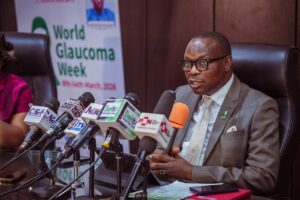
Salako made the pledge during a press briefing in Abuja to commemorate World Glaucoma Week, noting that the government is prioritising integrated eye care services across primary, secondary and tertiary healthcare levels under the National Eye Health Strategic Development Plan 2024–2028.
According to him, the ministry has launched the Nigeria Glaucoma Guidelines and Toolkit to standardise diagnosis, treatment and referral protocols, empowering healthcare workers across the country to deliver high-quality eye care services.
He said ophthalmologists from the 36 states and the Federal Capital Territory have already been trained on the guidelines to enable them cascade the training in their respective states.
The minister added that through the JigiBola 2.0 Effective Spectacle Coverage Initiative, more than 2,220 primary healthcare workers across 16 states have been trained and equipped with screening kits to conduct vision tests and refer patients for further care when necessary.
Salako also recalled that during the 2025 commemoration of World Glaucoma Week, the ministry provided free eye examinations and free glaucoma medication for diagnosed patients in the Federal Capital Territory while coordinating similar exercises with state commissioners for health nationwide.
He further disclosed that activities marking this year’s commemoration include free glaucoma examinations at 38 health facilities across 11 states and the FCT, as well as intensified public awareness campaigns through traditional and social media platforms.
Salako urged Nigerians, particularly those aged 40 and above, to prioritise regular eye examinations at least once every two years and adopt preventive health measures to protect their vision.
He noted that the vision of the administration of Bola Ahmed Tinubu to build a one-trillion-dollar economy by 2030 depends on the optimal productivity of healthy citizens, stressing that avoidable blindness could undermine national development.
“Together, we can reduce the burden of this disease, protect the vision of our people and build the Nigeria of our dream,” the minister said.
In her welcome remarks, the Permanent Secretary of the Federal Ministry of Health and Social Welfare, Daju Kachollom, reiterated the ministry’s commitment to reducing the burden of avoidable blindness through the National Eye Health Programme.
READ ALSO: unresolved leadership Crisis: Four Senators Dump PDP for APC
“Our goal is simple: no Nigerian should go blind from a condition that can be managed if detected early,” she said.
Also speaking, glaucoma specialist and Permanent Secretary at the Ministry of Interior, Magdaline Ajani, warned that glaucoma often progresses silently without noticeable symptoms, urging Nigerians to avoid self-medication and seek professional eye care promptly.
About The Author