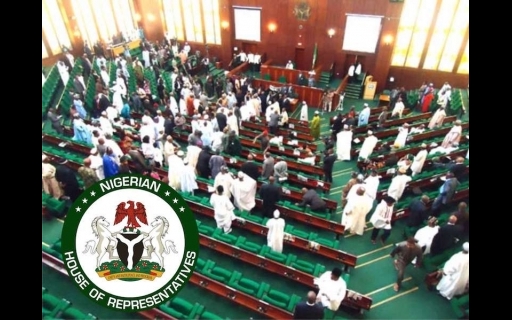
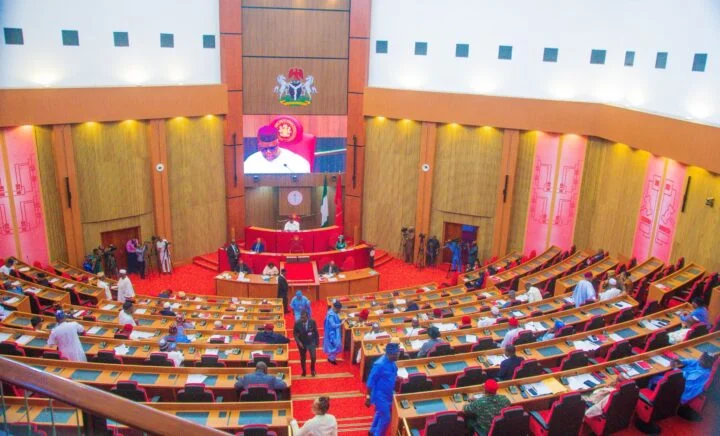
The Senate on Thursday raised serious concerns over the deteriorating state of Nigeria’s railway system, particularly the Abuja–Kaduna–Kano rail corridor, following a motion sponsored by Senator Abdul Ningi (Bauchi Central).
Leading the debate, Senator Ningi told lawmakers that what was once a flagship rail project had degenerated into what he described as a “tragic Nigerian story,” marked by declining passenger numbers, reduced trips, slow speeds and suspected mismanagement of resources.
He recalled that the Abuja–Kaduna rail line, initiated under former President Goodluck Jonathan and commissioned in 2015, initially operated up to 10 trips daily, conveying an estimated 10,000 passengers per day. According to him, the service generated about ₦1.8 billion monthly when it operated at near-full capacity.
However, Senator Ningi disclosed that during a recent visit to Kaduna, he discovered that daily passenger traffic had dropped drastically to between 800 and 900, while train trips had been reduced to just one trip from Abuja to Kaduna and one return trip the following morning.
He attributed the sharp decline to worsening service delivery, insecurity, vandalism of coaches, and the slow speed of trains, noting that a journey that once took about one and a half hours now lasts over three hours. He warned that the situation had forced commuters back onto the unsafe Abuja–Kaduna highway.
“This is disturbing and unacceptable. We cannot continue to waste scarce national resources and allow such critical infrastructure to decay while Nigerians suffer,” Ningi said, calling the situation a national emergency requiring immediate Senate intervention.
Contributing to the debate, other senators confirmed that the Nigerian Railway Corporation (NRC) is facing severe financial constraints, worsened by vandalism and damage to coaches, which has limited operations on the corridor. Lawmakers also raised concerns over the quality of rail equipment procured, alleging that some coaches and components were substandard or second-hand despite massive investments, including loans from China Exim Bank.
The Senate questioned how revenues generated during peak operations were managed and demanded accountability over procurement processes, contract execution and maintenance arrangements.
In response, the Senate leadership inaugurated a special ad-hoc committee to conduct a comprehensive investigation into the rail system, with a focus on the Abuja–Kaduna–Kano line. The committee was mandated to examine funding, execution, procurement quality, revenue utilization and overall management of the rail project.
READ ALSO: MURIC Backs SCSN, Insists INEC Chair Amupitan Must Be Sacked Over Alleged Bias
Anambra Group Launches Grassroots Structure for Tinubu’s 2027 Re-election Drive
The committee was given six weeks to report back to the Senate with findings and recommendations for corrective action, including measures to recover losses and restore efficient rail services.
Lawmakers stressed that the Senate, as a corrective parliament, would ensure accountability and push for urgent reforms to revive what was once considered the pride of Nigeria’s modern transport infrastructure.
About The Author