
By Fatima Saka
The North East Development Commission (NEDC) has said its success in securing five international management system certifications will only matter if the standards translate into stronger accountability, efficient project delivery and tangible improvements in the lives of people across the North-East.
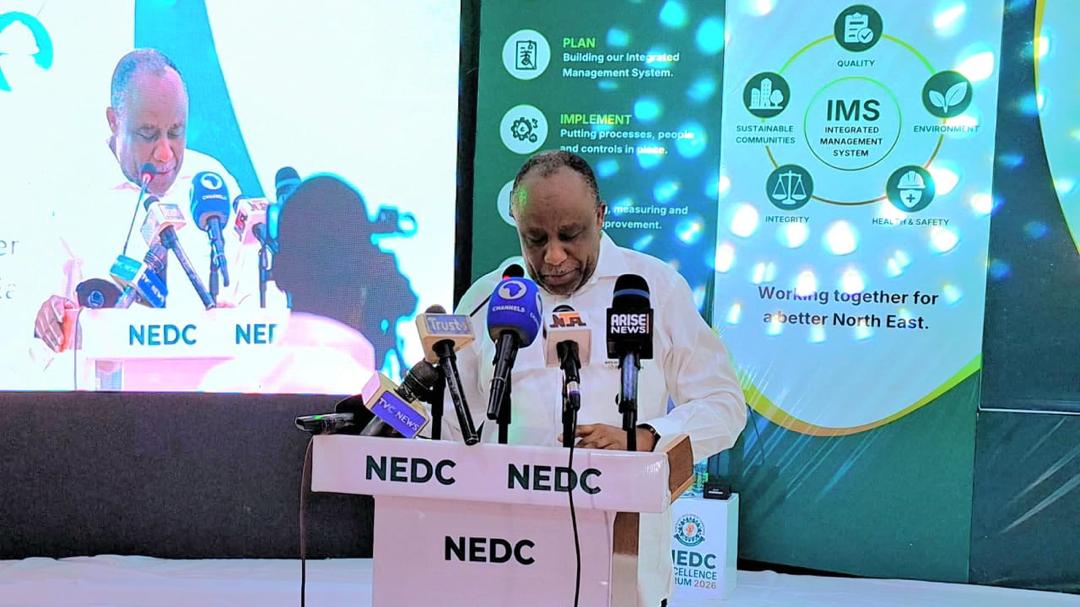
The Commission stated this as it commenced its three-day NEDC Excellence Forum 2026 in Maiduguri, Borno State, on Monday, with staff from its headquarters and state offices participating in practical sessions designed to strengthen institutional performance.
The forum, holding from Sept. 14 to 16 at the Multi-Purpose Hall of Borno State Hotel, is themed “Sustaining Excellence through NEDC’s ISO-Certified Integrated Management System (IMS).”

The Managing Director and Chief Executive Officer of NEDC, Mohammed Goni Alkali, said the certifications were only the beginning, stressing that the real test was how effectively the standards would shape the Commission’s daily operations and development interventions.
“For us, excellence must ultimately be measured by the quality of development we deliver to the people of the North-East. Our ISO certifications established important standards, but the real work is ensuring that those standards are reflected in how we work, how we serve and how we deliver,” Alkali said.
NEDC recently secured certification to five ISO management system standards covering Quality Management, Environmental Management, Occupational Health and Safety, Anti-Bribery Management and Sustainable Development in Communities.
The Commission said the Excellence Forum was therefore designed not as a ceremonial celebration of the certifications but as an avenue to move the standards from documentation into practical workplace behaviour.
Participants are expected to engage in practical exercises, simulations and real-life workplace situations aimed at improving collaboration, problem-solving, accountability and service delivery.
The emphasis on implementation is particularly significant given the scale of NEDC’s mandate, which includes interventions in roads, education, healthcare, water, livelihoods and other sectors across the six states of the North-East.
While certification provides an institutional framework for improving processes, it does not automatically guarantee efficient execution, sustainability or value for money in development projects.
The Commission acknowledged that the effectiveness and sustainability of physical interventions depend significantly on the quality of the institution responsible for planning, resource management, accountability and implementation.
Consequently, the success of the 2026 Excellence Forum will ultimately be determined less by the number of staff trained or certificates obtained than by whether the standards result in clearer responsibilities, stronger internal controls, improved teamwork and more reliable programme delivery.
NEDC also cautioned against viewing the certifications as proof that its systems were perfect, maintaining that institutional excellence requires continuous implementation, monitoring, review and improvement.
The Commission said its approach was to embed the principles of quality, integrity, environmental responsibility, occupational safety and sustainable development into everyday operations.
READ ALSO: Lagos AG: Proposed Magistrates’ Retirement Age Bill Not Executive Bill
BRICON @10: Cancer Survivors Urged to Reject Stigma, Embrace Life Beyond Diagnosis
It added that sustained implementation of the Integrated Management System could strengthen NEDC’s capacity to manage development interventions across the North-East while ensuring that institutional reforms produce visible improvements in the quality and reliability of services delivered to communities.
NEDC stressed that the ultimate beneficiary of the process remained the people of the North-East, whose development needs, it said, must remain at the centre of its pursuit of institutional excellence.
About The Author