By Fatima Saka
In efforts to end open defecation in Nigeria by 2030, the Federal Government has announced plans to convene the 2026 Annual Retreat for States on the Clean Nigeria Campaign from Nov. 17 to Nov. 18 to accelerate implementation and strengthen sanitation financing across the country.
The retreat, themed, “Accelerating and Sustaining Progress: Financing, Data, and Systems for a Fully ODF Nigeria,” will bring together government officials, development partners and other sanitation stakeholders to review performance, share experiences and develop practical strategies for achieving nationwide Open Defecation Free (ODF) status.
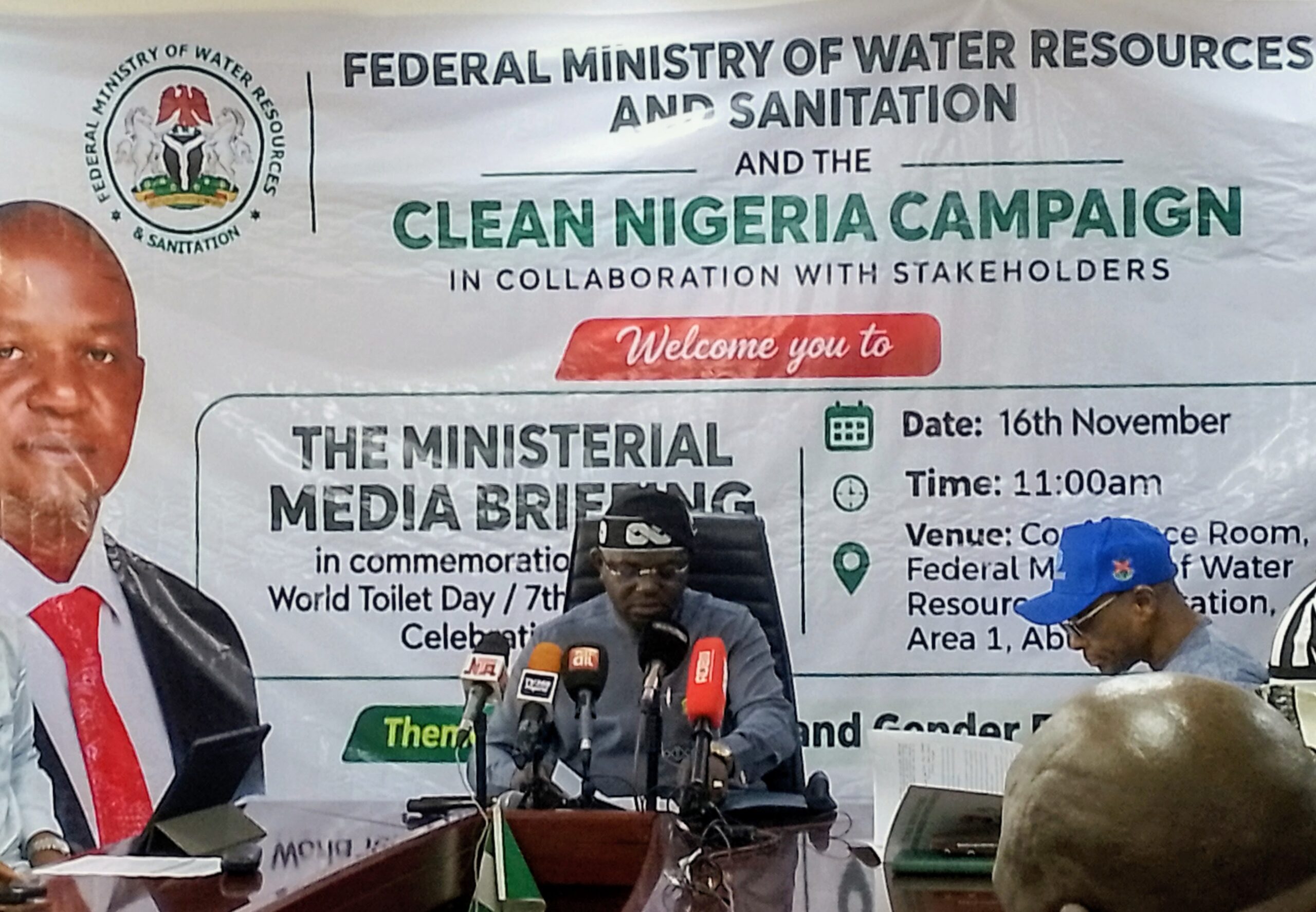
The Minister of Water Resources and Sanitation, Engr. Prof. Joseph Terlumun Utsev, announced this on Monday in Abuja during a ministerial press briefing on the Clean Nigeria: Use the Toilet Campaign ahead of the 2026 World Toilet Day celebration.
Utsev disclosed that 185 Local Government Areas (LGAs) had attained ODF status, while Jigawa and Katsina had achieved state-wide ODF status.
He described the achievements as the outcome of collaboration among federal, state and local governments, development partners, civil society organisations, private sector actors and communities.
The minister, however, said more efforts were required to extend the campaign to LGAs yet to attain ODF status and sustain existing achievements to prevent a return to open defecation.
He disclosed that President Bola Tinubu had signed the Executive Order on Open Defecation Free Nigeria by 2030 and Other Related Matters, 2025, to strengthen coordination, define institutional responsibilities and promote accountability across all levels of government.
According to him, Vice-President Kashim Shettima would formally unveil the Executive Order during the World Toilet Day celebration and seventh anniversary of the Clean Nigeria Campaign on Nov. 19.
Utsev identified sustainable financing, reliable data and monitoring, as well as institutional strengthening and sustainability as major priorities for accelerating the campaign.
He urged governments at all levels to make adequate budgetary provisions for sanitation, ensure effective utilisation of available resources and encourage private sector participation through innovative financing options.
He also called on states to strengthen sanitation data collection and reporting systems to monitor progress, identify implementation gaps and support evidence-based decisions.
Earlier, the Acting Permanent Secretary of the ministry, Engr. Ali I. Dallah, said the Clean Nigeria Campaign, launched in November 2019, had remained a strategic national intervention for promoting safe, inclusive and dignified sanitation practices.
Dallah commended the Clean Nigeria Secretariat, under the leadership of its National Coordinator, Mrs. Chizoma Obara, for its commitment and sustained efforts in driving the campaign.
He said achieving an entirely ODF Nigeria by 2030 would require sustained political commitment, increased investment in sanitation infrastructure, reliable monitoring and evaluation systems, stronger institutional coordination and continuous behavioural change interventions.
The Acting Permanent Secretary said the 2026 World Toilet Day celebration, with the theme, “Sanitation and Gender Equality,” would reinforce the importance of equitable access to safe sanitation facilities, particularly for women, girls and other vulnerable groups.
He urged journalists to sustain public education, investigative reporting and advocacy on sanitation, noting that the media had an important role in influencing behavioural changes required to end open defecation.
During the question-and-answer session, Utsev said the Federal Government was strengthening engagement with state governments through the Nigeria Governors’ Forum to secure greater political commitment towards achieving the 2030 target.
He disclosed that the ministry had held a plenary meeting with the governors’ forum about three months earlier and was planning another meeting involving all state governors to discuss strategies for ending open defecation.
On funding, the minister said the government was encouraging state and local governments, as well as ministries, departments and agencies, to create dedicated budget lines for sanitation and the Clean Nigeria Campaign.
He explained that such provisions would support the construction and maintenance of toilets, washing facilities and other essential sanitation infrastructure, reducing dependence on federal government funding alone.
Utsev also identified development partners, national task groups, civil society organisations and Nigerians as important stakeholders, stressing that government efforts would not succeed without changes in citizens’ attitudes and sanitation practices.
Speaking during the vote of thanks, the Director of Water Quality Control and Sanitation, Habu Jamilu, appreciated the minister for his leadership and the Acting Permanent Secretary for his support in organising the briefing.
READ ALSO: Two Nigerian Emerge Lieutenant Governors in US
NiDCOM Hails Akande’s Election to International Court of Justice
Jamilu commended journalists for their contributions through public education, investigative reporting and sustained advocacy, urging them to give the forthcoming national retreat and World Toilet Day celebration adequate coverage.
He described the Clean Nigeria Campaign as a practical contribution to President Tinubu’s Renewed Hope Agenda, particularly in improving public health, protecting the environment and promoting human dignity, and called for collective efforts to achieve an open defecation-free Nigeria by 2030.
About The Author