
By Fatima Saka
The Senate Committee on Banking, Insurance and Other Financial Institutions on Wednesday intensified legislative scrutiny of Nigeria’s financial system after the Economic and Financial Crimes Commission (EFCC) disclosed that transactions associated with the failed Crypto Bullion Exchange (CBEX) scheme were valued at about N1.3 trillion.
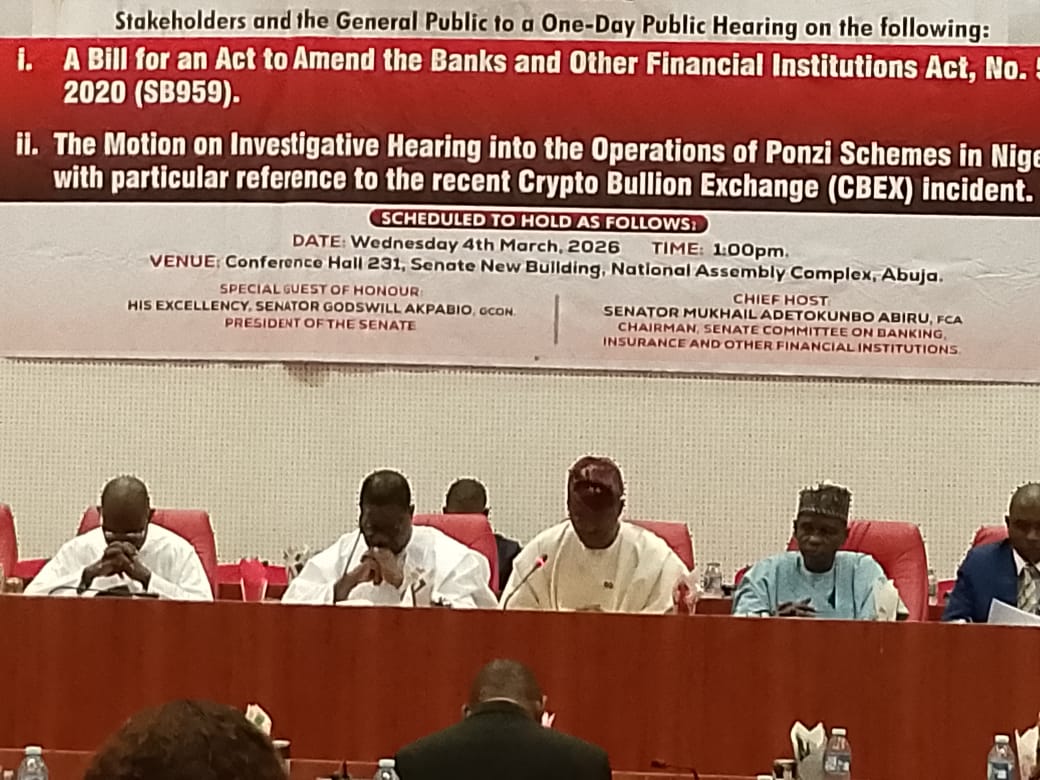
The revelation came during a public hearing on a motion to investigate the proliferation of Ponzi schemes in Nigeria, particularly the CBEX incident, alongside consideration of a bill seeking to amend the Banks and Other Financial Institutions Act (BOFIA 2020).
Addressing lawmakers, the Executive Chairman of the EFCC, Olanipekun Olukoyede, was represented by Dein Whyte, Cybercrime Section Supervisor of the commission, who presented findings from the agency’s ongoing investigation into the crypto-based investment platform.
Whyte explained that CBEX began operations in mid-2024, promising investors 100 per cent returns through what it described as artificial intelligence-driven cryptocurrency trading. He said the promoters persuaded victims to convert their naira holdings into stablecoins before transferring funds into designated digital wallets.
According to him, while the estimated exposure within Nigeria was put at N1.3 trillion, forensic analysis of blockchain records traced more than $46 million in USDT inflows into wallets linked to the scheme.
Investigations revealed that the operators aggressively promoted the platform through social media, physical events and broadcast channels, and registered a company with the Corporate Affairs Commission under a different name to lend credibility to their operations.
The EFCC representative said some Nigerian promoters had been identified and were currently facing prosecution for operating an unlicensed investment exchange. He added that certain digital assets had been frozen, and relevant infrastructure traced to foreign collaborators in Southeast Asia had been shut down.
Whyte further clarified that although the promoters obtained an onboarding certificate from the EFCC’s Special Control Unit Against Money Laundering, they misrepresented it to the public as regulatory approval.
Lawmakers expressed concern over the rising trend of digital fraud and the use of fintech platforms to facilitate criminal transactions. Some senators questioned representatives of payment service providers on why their systems appeared attractive to fraudsters and kidnappers.
Responding, a Moniepoint representative said the platform’s rapid growth was driven by ease of access, affordability and real-time transaction confirmation. He, however, acknowledged challenges arising from identity misuse, particularly in cases where individuals sell or surrender their account details to third parties.
The committee also examined possible regulatory overlaps in the proposed BOFIA amendment, with stakeholders urging harmonisation of new compliance requirements with existing Central Bank of Nigeria frameworks.
Chairman of the Committee, Senator Mukhail Adetokunbo Abiru, said a technical team comprising legal and financial experts would be constituted to review submissions and address grey areas identified during the hearing.
READ ALSO: Fadeyi Flags Off 1km Access Road to Boost Healthcare Delivery at Ila-Orangun Teaching Hospital
Nigeria Targets $10bn Steel Market in EU
He stressed that the Senate’s objective was to strengthen oversight of financial institutions, close regulatory loopholes and protect Nigerians from predatory investment schemes that continue to thrive despite repeated warnings from regulators.
The hearing underscored growing legislative concern over digital investment fraud, with lawmakers vowing to pursue stricter safeguards to prevent a recurrence of large-scale losses in Nigeria’s evolving financial ecosystem.
About The Author