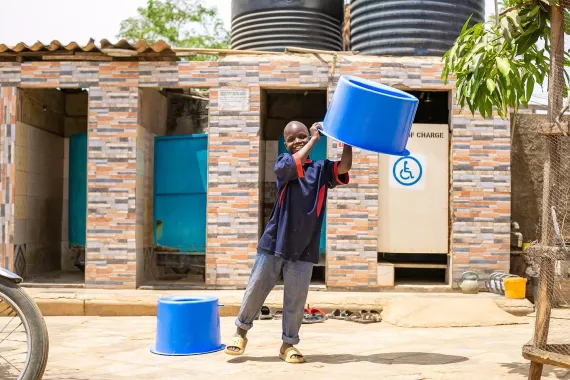
The Federal Government has announced plans to restore water supply and rehabilitate locked toilet facilities at LEA School in Kpadna Community, Jabi District of the Federal Capital Territory, following concerns that pupils have been forced to practise open defecation.
The Minister of Environment, Mallam Balarabe Abbas Lawal, disclosed this on Thursday during the 2026 World Toilet Day commemoration held in Kpadna Community, Abuja.
Lawal described the situation as unacceptable, noting that the absence of reliable water supply had rendered existing toilet facilities in the school unusable, exposing pupils, particularly girls, to health risks and indignity.
He said the development demonstrated that providing toilet infrastructure without adequate water supply, maintenance arrangements and sustainable management systems did not guarantee access to safe sanitation.
“A toilet that cannot be used is effectively no toilet at all,” the minister stated.
He announced that the Federal Ministry of Environment, through the Inter-Ministerial Committee for the 2026 World Toilet Day commemoration, would work with relevant authorities to address the challenges at the school.
The proposed interventions include immediate assessment and restoration of the toilets, restoration of reliable water supply, rehabilitation of the facilities, establishment of sustainable school sanitation management arrangements, as well as environmental health education and continuous monitoring.
The minister stressed that the interventions must go beyond the World Toilet Day celebration, insisting that every child should have access to functional toilet facilities whenever the need arises.
He called on the Inter-Ministerial Committee and the Department of Pollution Control and Environmental Health to collaborate with the Federal Capital Territory Administration, Area Council authorities, education authorities, water supply agencies and development partners to ensure the identified challenges were addressed.
Lawal also directed that the situation at LEA School be documented as a case study to guide similar interventions in other schools and public institutions where toilet facilities remain unusable due to inadequate water supply, poor maintenance and other operational challenges.
Speaking on the broader sanitation challenge, the minister disclosed that findings from the 2024 Nigeria Demographic and Health Survey indicated that approximately 20 per cent of Nigeria’s household population still practised open defecation.
He warned that inadequate sanitation contributed to the spread of diseases such as cholera, typhoid and other faecal-oral infections, while also contaminating surface and groundwater and degrading the environment.
According to him, the Federal Government, under the Renewed Hope Agenda, remains committed to strengthening environmental sanitation, responsible waste management, public health protection and sustainable sanitation solutions.
He said the ministry was strengthening collaboration with stakeholders through sanitation advocacy, capacity building for Environmental Health Officers, community-based waste management, open defecation control programmes and private-sector partnerships.
The minister further emphasised that this year’s theme, “Sanitation and Gender Equality,” with the tagline, “Safe Toilets. Equal Futures,” highlighted the connection between access to safe toilets, human rights, public health, dignity and social justice.
He noted that inadequate sanitation disproportionately affected women and girls, particularly in schools, markets, workplaces and public spaces, where the absence of safe, private and accessible toilets exposed them to health risks, insecurity and indignity.
Lawal added that the lack of appropriate toilet and menstrual hygiene facilities could also affect schoolgirls’ attendance, participation and academic performance.
He called for a whole-of-government and whole-of-society approach involving federal and state governments, local authorities, development partners, civil society organisations and community-based organisations to achieve universal access to safe sanitation.
The minister also urged stakeholders to strengthen the management of faecal sludge and wastewater, warning that untreated wastewater and poorly managed faecal sludge could contaminate water sources and contribute to infectious diseases and antimicrobial-resistant microorganisms.
Earlier, the Permanent Secretary of the Federal Ministry of Environment, in her opening remarks, said the commemoration provided an opportunity to renew collective commitment to safe sanitation, public health protection and access to functional toilet facilities.
She stressed that sanitation went beyond the provision of toilets, describing it as a matter of human dignity, personal safety, environmental protection and community well-being.
The Permanent Secretary also identified inadequate water supply at LEA School as a major challenge, stressing that toilet facilities must be functional, accessible and properly maintained to ensure effective utilisation.
She expressed confidence that the engagement would strengthen collaboration between the Federal Ministry of Environment, FCT authorities, development partners and the community towards addressing sanitation challenges, particularly in schools and public institutions.
The 2026 World Toilet Day commemoration brought together government officials, development partners, traditional institutions, community leaders, Environmental Health Officers, teachers, students and other stakeholders.
READ ALSO: MURIC Hails Sultan for Honouring Akintola with Special Recognition Award
FG Urges Stronger Accountability From States, Warns Against Derating Policy’s Commitment
The minister commended UNICEF, SATO, the Inter-Ministerial Committee and other partners for their contributions, urging Nigerians to take ownership of sanitation improvements in their homes, schools, workplaces and communities.
He maintained that ending open defecation required functional infrastructure, reliable water supply, effective maintenance, behavioural change, sustained investment and active community participation.
About The Author