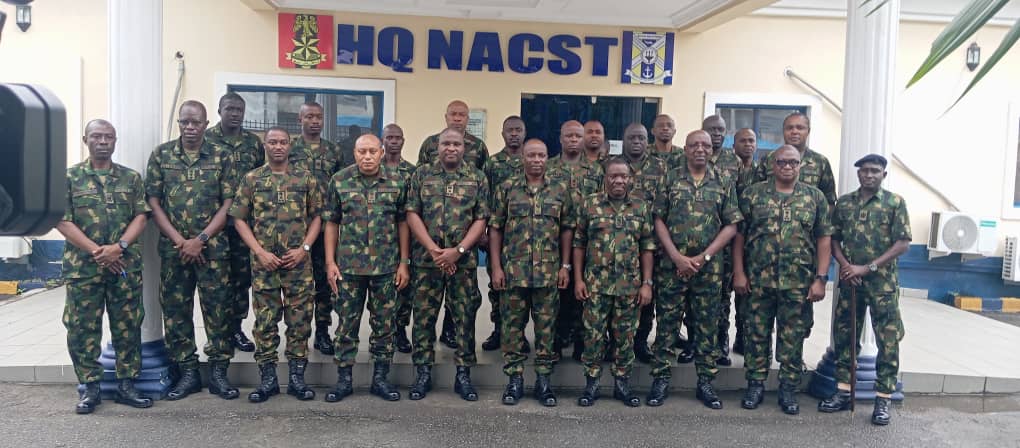
LAGOS, Nigeria — The Nigerian Army Corps of Supply and Transport (NACST) has commenced a two-day conference aimed at strengthening logistics, mobility and operational support for the Army’s expanding formations and theatres of operation.
The conference, themed “Repositioning Supply and Transport Sustainment to Enhance Operational Effectiveness of an Expanding Nigerian Army,” is holding from Sept. 29 to Sept. 30 at the Headquarters of the Nigerian Army Supply and Transport Corps (NASTC), Bonny Cantonment, Victoria Island, Lagos.
The Corps Commander Supply and Transport, Maj.-Gen. Nansak Shagaya, said the conference was designed to enable commanders and senior officers to exchange experiences and develop practical strategies for improving logistics delivery across the Army.
Shagaya said the expansion of the Nigerian Army’s formations, capabilities and operational commitments had increased the demand for reliable supply, effective mobility, maintenance and responsive logistic support.
He described the Supply and Transport Corps as a critical enabler of combat power, noting that its responsibilities in supply, transportation, firefighting, petroleum product distribution, catering and other sustainment functions directly affected the mobility, endurance and effectiveness of troops.
According to him, the Corps must strengthen its systems and ensure that logistic support remains timely, dependable and focused on operational requirements.
He said his command philosophy was centred on developing a highly proficient Supply and Transport Corps capable of efficiently supporting the Nigerian Army in fulfilling its constitutional responsibilities.
Shagaya said the philosophy required professionalism, discipline, innovation and operational responsiveness, as well as continuous improvement in personnel, equipment and processes.
He said the approach was also aligned with the command philosophy of the Chief of Army Staff, Lt.-Gen. Waidi Shaibu, which seeks to transform the Nigerian Army into a more professional, adaptable, combat-ready and resilient force capable of discharging its constitutional responsibilities within a joint and multi-agency environment.
He identified the repositioning of the Army’s supply and transport distribution system as a major priority, stressing the need to improve demand forecasting, inventory control, stock visibility, warehousing and delivery timelines.
Shagaya also called for improved vehicle availability, safety and reliability through preventive maintenance, driver training, recovery capability and effective life-cycle management.
He advocated the adoption of digital logistics, asset tracking, automation, data analytics and responsible artificial intelligence to strengthen planning, accountability and decision-making.
The Corps Commander further called for greater indigenous capacity through collaboration with the Defence Industries Corporation of Nigeria, research institutes and local technology providers.
He said practical local solutions in maintenance, vehicle support and logistics systems should be encouraged where they could improve reliability, reduce dependence and promote long-term sustainability.
Shagaya said the effectiveness of the Corps would ultimately depend on the competence, discipline and commitment of its personnel, noting that logistics remained a foundation of operational effectiveness.
He urged participants to ensure that deliberations at the conference produced practical recommendations capable of strengthening the responsiveness, readiness and resilience of the Army’s supply chain and sustainment system.
The Chief of Logistics, Nigerian Army, Maj.-Gen. Adekunle Adeyinka, said operational effectiveness required personnel to perform their responsibilities better, faster and more economically while optimising resources, reducing errors and eliminating risks.
Adeyinka charged senior officers to continue to guide, monitor and provide sound counsel to officers serving in the field.
He also urged them to pay particular attention to female officers and create an environment that would enable them to contribute effectively to the development of the Corps.
The logistics chief called on officers to dedicate their time, knowledge and energy to ensuring that the Corps attained a higher level of professional performance.
The Chief of Staff, NACST, Brig.-Gen. Philip Ebuk, said the expansion of the Nigerian Army from eight to 12 divisions presented an opportunity for the Corps to broaden its contribution to quality and efficient service delivery.
Ebuk said the ability to adapt to changing operational demands without compromising logistic support to troops remained a key measure of professionalism among logistics officers.
He said logistics support would continue to evolve rapidly, adding that the success of the Corps would depend not only on technology and infrastructure but also on the ability of its personnel to collaborate, innovate and adapt.
READ ALSO: Cross River Honey Venture Links Agriculture, Tourism — Filmmaker
Senate Extends 2025 Capital Budget Implementation to December 31
According to him, the conference provides an avenue for the exchange of ideas and development of strategies that would strengthen the Corps and sustain its relevance within the Nigerian Army.
He said the forum would also enable commanders to draw lessons from operational challenges and develop practical approaches to improving logistics support to troops.
About The Author