By Fatima Saka
Abuja, Nigeria — Nigeria has taken a frontline position in the global fight against information warfare, as policymakers, diplomats, security experts, and media stakeholders converged on Wednesday in Abuja to confront the escalating threat of disinformation, warning that Foreign Information Manipulation and Interference (FIMI) now accounts for an estimated $100 billion in annual global losses.
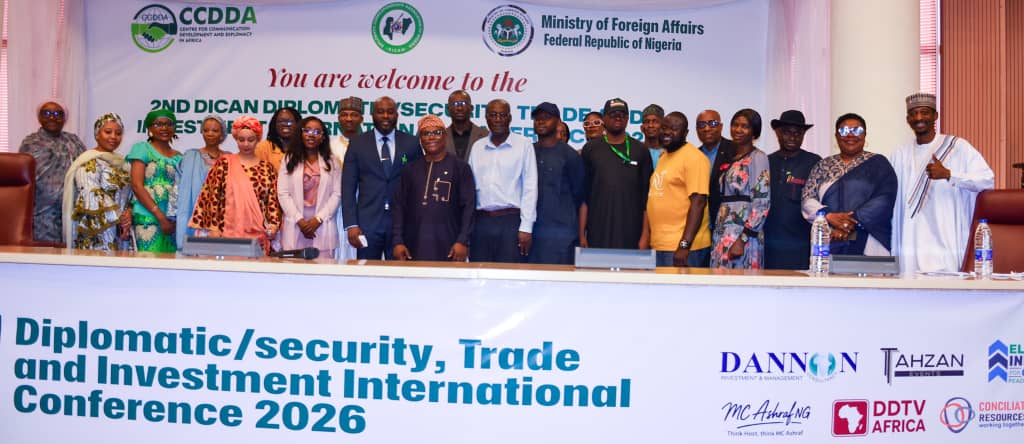
The high-level discussions formed the centrepiece of the 2nd Diplomatic, Security, Trade and Investment International Conference organised by the Diplomatic Correspondents’ Association of Nigeria (DICAN) at the Rotunda Hall of the Ministry of Foreign Affairs.
Declaring the conference open, Chairman of DICAN, Idehai Frederick, described the gathering as a “landmark convergence” and a turning point in global efforts to tackle disinformation. He said information warfare had evolved from “amateur fake news” into the “industrialisation of deception,” driven by sophisticated technologies and coordinated international actors.
According to data presented at the conference, over 70 per cent of FIMI campaigns now deploy advanced generative artificial intelligence to produce deepfakes, manipulate markets, and inflame diplomatic tensions—often faster than traditional verification systems can respond.
Frederick warned that with more than 40 countries conducting major elections between 2024 and 2026, disinformation has become a strategic geopolitical tool used to undermine electoral systems in what experts termed “competitive sovereignty theft.”
Representing former President Goodluck Jonathan, the Executive Director of the Goodluck Jonathan Foundation, Ann Iyonu, described information warfare as a new form of conflict capable of destabilising societies without physical weapons.
“False narratives, fake news, and manipulated content have become powerful tools that create division, weaken public trust, and threaten democratic stability,” she said, noting that Nigeria has witnessed how unverified information can inflame ethnic and religious tensions and fuel insecurity.
Iyonu emphasised that safeguarding truth through collaboration between the media, intelligence agencies, and diplomatic institutions is critical to strengthening democracy, particularly during elections when misinformation can distort public perception and discourage civic participation.
Also speaking, the Permanent Secretary of the Ministry of Foreign Affairs, Ambassador Dunoma Umar Ahmed, highlighted the strategic importance of diplomatic journalism in shaping global understanding and promoting transparency.
He reaffirmed Nigeria’s commitment to strengthening foreign policy objectives anchored on economic diplomacy, regional stability, and the protection of Nigerians abroad, while underscoring the media’s role in projecting a positive national image and fostering constructive international engagement.
In her goodwill message, the Executive Director/CEO of the Nigerian Export Promotion Council (NEPC), Nonye Ayeni, linked information integrity directly to economic growth. She warned that misinformation can distort markets, erode investor confidence, and hinder trade partnerships.
Ayeni disclosed that Nigeria recorded over $6.1 billion in non-oil exports in 2025, representing an 11.5 per cent increase from the previous year, with value-added products accounting for 51 per cent of exports. She stressed that credible information systems are essential to sustaining this growth and expanding Nigeria’s global market access.
Adding an international perspective, Zhou Hongyou, Minister at the Embassy of the People’s Republic of China in Nigeria, underscored the critical role of the media in strengthening bilateral relations and fostering mutual understanding.
He commended Nigerian journalists for promoting China-Nigeria relations and urged continued commitment to objectivity, fairness, and factual reporting, particularly on sensitive global issues.
He also highlighted ongoing media cooperation initiatives, including training programmes and exchange visits aimed at enhancing capacity in digital and international reporting.
A major outcome of the conference was the launch of the Nigeria Fact-Check and Information Integrity Network (NFIIN)—a national platform designed to coordinate efforts among government agencies, media organisations, and civil society to combat misinformation.
The initiative, driven by the Centre for Communication Development and Diplomacy in Africa (CCDA) in partnership with DICAN and PR Nigeria, has mobilised 69 civil society organisations across Nigeria’s 36 states.
As part of its operational framework, six regional situation rooms have been established nationwide to monitor, verify, and analyse misleading content in real time, enabling rapid responses to emerging disinformation threats.
The network is supported by nationwide public awareness campaigns including “Verify Before You Share,” “Truth Matters: Build a Stronger, Safer Society,” and “Think Before You Share,” all translated into English, Hausa, Yoruba, and Igbo to ensure broad accessibility.
Stakeholders at the conference stressed that disinformation is no longer merely a communication challenge but a “life-and-death issue,” increasingly linked to insurgency, social unrest, economic disruption, and strained diplomatic relations.
They noted that the economic toll of information manipulation—estimated at $100 billion annually—stems from reduced foreign investment, market instability, and increased national security spending.
The conference marked a clear shift from dialogue to action, with the launch of a coordinated national and international campaign to dismantle disinformation networks and strengthen collaboration among intelligence agencies, diplomats, and the media.
Participants called on development partners, foreign missions, and international organisations to provide technical and financial support to bolster Nigeria’s capacity to detect and counter sophisticated information warfare strategies.
Looking ahead, organisers announced that the 2027 edition of the conference will focus on the intersection of disinformation with security, migration, and human trafficking, highlighting how false narratives exacerbate vulnerability and global instability.
READ ALSO: Previewing the Recurring Camp Tent Headaches During Hajj Rites in Mina
Dabiri-Erewa Advocates Strategic Diaspora Engagement as Catalyst for Africa’s Development
The event also featured the presentation of awards to individuals and institutions recognised for their commitment to truth, integrity, and public service.
As deliberations concluded, participants unanimously agreed that protecting information integrity is essential to safeguarding national sovereignty, strengthening democratic institutions, and ensuring sustainable economic development across Nigeria and the African continent.
About The Author