Budget Defence: Zero Capital Releases, NASS Move to Grant Solid Minerals Ministry First-Line Charge Status

By Fatima Saka
The Federal Ministry of Solid Minerals Development faced intense scrutiny at the National Assembly on Monday as lawmakers advocated placing the Ministry on first-line charge, warning that zero capital releases threaten Nigeria’s ₦1 trillion mining reform agenda.
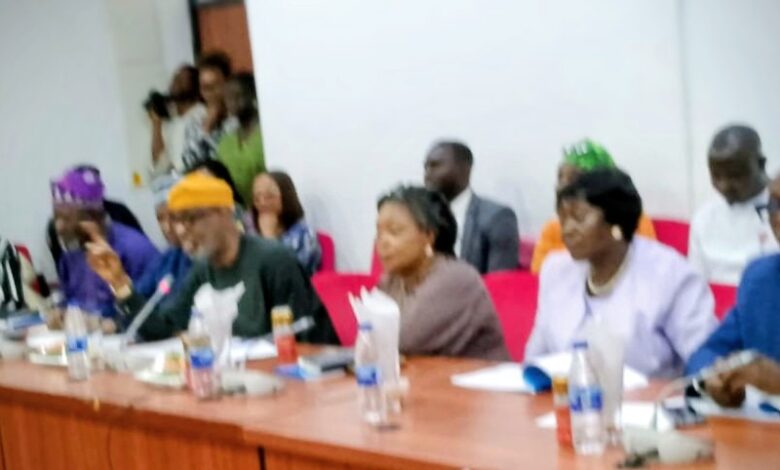
Minister of Solid Minerals Development, Henry Dele Alake, appeared before the Joint Committee on Solid Minerals Development to present the Ministry’s 2024 budget performance and 2026 projections.
The session was jointly chaired by Senator Ekong Sampson, Chairman of the Senate Committee on Solid Minerals Development, and Hon. Jonathan Gaza Gbefwi, Chairman of the House Committee on Solid Minerals Development.
Sampson, while welcoming the Minister, commended Alake for his consistent responsiveness to legislative invitations and praised the professionalism of the Ministry’s leadership, particularly the Permanent Secretary and technical team. He noted that the Ministry’s staff demonstrated strong commitment both locally and internationally, citing their recent engagement at a global mining event.
However, deliberations shifted to concerns over funding gaps. Lawmakers questioned how the Ministry could deliver on its mandate despite a ₦1 trillion intervention framework if capital releases remain at zero.
Hon. Gaza Gbefwi strongly canvassed the idea of placing the Solid Minerals Ministry on first-line charge, arguing that the sector is too strategic to suffer funding uncertainties.
“If there is a way we can make it a first-line charge, maybe it will help us. It is a very sensitive ministry, just like the oil sector,” he said, suggesting that guaranteed funding would fast-track sectoral development.
Responding, Alake welcomed the proposal, describing it as highly encouraging and emphasizing that legislative backing would make it feasible. He stressed that achieving Nigeria’s mining ambitions requires sustained funding, particularly for internationally certified geological data acquisition.
According to him, credible geological data is the foundation for attracting serious investors and positioning Nigeria among leading mining destinations globally. He added that investor interest in Nigeria’s mineral assets has grown significantly following reforms and global promotion efforts.
Presenting performance figures, Alake disclosed that out of the ₦31.24 billion appropriated in 2024, approximately 81 per cent was released and utilized. On revenue, the Ministry exceeded its ₦11.8 billion target by generating over ₦28 billion—representing a 139 per cent increase above projections.
He attributed the improved revenue to strengthened enforcement through the Mine Marshals initiative, which has led to the arrest of over 350 illegal miners, with more than 150 already prosecuted. The Ministry also formalized artisanal miners into cooperatives, improving compliance, royalty collection, and access to financing.
In addition, the Ministry expanded its digitization programme, earning national recognition as one of the most digitized ministries, a move that has enhanced transparency and operational efficiency.
Despite these gains, Sampson expressed concern that the absence of capital releases undermines implementation.
“How do you drive the harvest with zero percent release?” he queried, emphasizing that budget frameworks must be matched with actual funding to inspire investor confidence.
He described the proposal to prioritize the sector as logical and compelling, noting that solid minerals hold immense potential for economic diversification and revenue expansion.
READ ALSO: Suspension: Don says he won’t examine ineligible students – Prof. Osegbue Emphasizied
Lagos Govt Probes Ambulance Incident in 11th Access Bank Lagos City Marathon, Victim Stable
With the 2026 budget largely a rollover of 2025 figures, Alake appealed for legislative support to secure predictable releases and unlock the sector’s full potential.
The debate over granting the Solid Minerals Ministry first-line charge status now signals a growing consensus within the National Assembly that funding certainty may be the critical missing link in Nigeria’s quest to transform its vast mineral wealth into sustainable economic growth.
About The Author