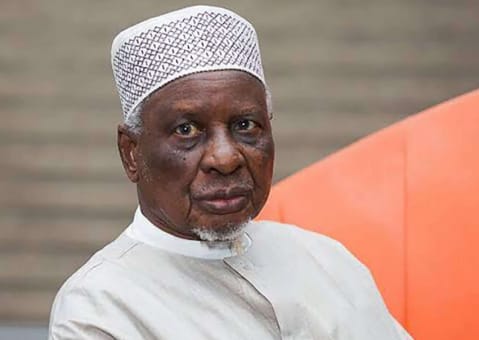
Without doubt, Alhaji Salihu Abubakar Tanko Yakasai (OFR) is presently the last man standing, amongst the class of Nigeria’s most-daring and most-visible “freedom fighters and political prisoners”, who fiercely fought against colonialism, until Nigeria gained independence in 1960. Based on this salient fact, l make bold, to state without fear or favour, that Alhaji Tanko Yakasai is today, eminently qualified to be addressed as “THE FATHER OF THE NATION”; going by his unwavering patriotic fervour and his attainment of 100 years of age (on 5th December, 2025). More so, there has been “no prominent political leader” in the annals of Nigeria’s history who has been so privileged to become a centenarian. I stand to be challenged on this assertion. It is also very incisive, as Mr. President respectfully addressed him as “Baba” in the special birthday message sent to him from the Presidency. Interestingly too, he is still very relevant in the scheme of things, till today.
He was born in Kofar-Mata, Kano on 5th December, 1925. But he grew up in Yakasai Quarters, Kano. Thus, he became popularly known as “Tanko Yakasai.” He received his early education at various Quranic schools, both in Kano and Hadarwa (a village in the present-day Bauchi State), between 1933 and 1942.
Thereafter, he was enrolled into Shahuchi Elementary School in Kano, between 1941 and 1946. At a point, he was withdrawn from the school, as a result of the scorn and bully, meted on children who were seen going to conventional schools, due to the stern antipathy for western education, in most parts of the old northern region. The menace is popularly known today, as “boko haram.” Infact, he had a fair share of the “almajiranci” (“almajiri”) experience. Later, he acquired some vocational skills in tailoring, from his father. Thus, he eventually became the master-tailor for Kano Middle School, from 1944 to 1952. He also ventured into the business of groundnut, as an agent.
He began his political activism in 1948, when he registered as a member of Kano Youth Association (Jam’iyyar Samarin Kano), which later fused with other socio-cultural organisations to form the Jami’yyar Mutanen Arewa (a socio-political pressure group) in 1949. Thereafter, he joined the Northern Elements Progressive Union (NEPU) in 1951, as one of the founding-fathers of the party. His immediate political leaders and mentors were late Mallams Sa’adu Zungur, Isa Wali, Aminu Kano and Habibu Raji Abdallah.
What stands him out from the crowd is his courage and audacity, to defend what he believes in, even if he’s standing alone. He does not pander to primordial, ethnic, religious or political sentiments in his relationship with people, across whatever divides. His self-confidence comes with conviction; his courage comes with the strength of his character; and his voice has remained very constant “for or against” many socio-political issues in Nigeria, for over seven decades. Therefore, his political career is not only replete with many trials, it is also impregnated with various inspirational experiences that will continue to guide both the present and upcoming politicians and public servants in general.
He is a man of many parts, with so many dynamic strides. Thus, etching his footprints in every path he follows; and he has ever been in the forefront on any course he takes up. He is very patriotic, very brave, very resilient and immensely endowed with native intelligence. These rare attributes must have inspired him to write his autobiography, titled – “TANKO YAKASAI : The Story of a Humble Life” (vols. 1 & 2). Both books contains over 1,000 pages; and published in 2012. He carefully narrated so many intriguing stories about himself, the Hausa/Fulani culture, and a wide range of empirical information on Nigeria’s democratic projects, from the colonial era to the current democratic dispensation. He chronicled his captivating stories with clarity; giving details of various events and exact names of key actors, who played one role or the other for different events at different times (both in Nigeria and overseas). Infact, he is a great repository of Nigeria’s history and general knowledge.
As a self-made man, he zealously acquired western education on his own, outside the regimented classroom. As a human rights activist, a freedom fighter and nationalist, he became a political prisoner (who was arbitrarily arrested and jailed several times, under both colonial and military regimes). He is a consummate patriot, a journalist, an astute public administrator, a quintessential leader and a well-respected elderstatesman. Alhaji Tanko Yakasai is also a Pan-Africanist in his own right. His pre/post-Nigeria’s independence political activism earned him special recognition outside Nigeria, particularly, by some political leaders like Dr. Felix Mumie of the Cameroons People’s Union (CPU), Djibo Bakary and Amadu Diop of Sawaba Party in the Republic of Niger. In addition, his mission and roles in Ghana, during the First All-African People’s Congress in 1958, with the likes of late Alhaji Abdul-Gafar Dabiri and Sheikh Abdul-Hafeez Abou (immediate past Baba-Adini of Lagos, who died at the age 101 on 9th January, 2023), among others, remains indelible.
Being an intelligent, creative-minded and forward-looking young man, his courage and academic brilliance paved the way for him to be appointed as an Hausa editor of the Comet Newspapers, Kano, between 1954 and 1960. Later in 1966, he was employed as the sales manager for Agip Nigeria Ltd, after serving the company diligently for about a year. But as he was very passionate to learn and further develop himself, he took the bold step to enrol for a non-formal evening classes. He also attended the British Council English Tutorial Classes in Kano, between 1952 and 1955. Thereafter, he proceeded to the University College, Ibadan (extra-mural department), where he obtained certificates in “comparative federalism” and the “problem of independence and development” in 1956 and 1959, respectively. Later in 1963, he was offered a scholarship by the German-African Society, to study at Wilhelm Pieck Youths Higher Institute, Bogansee, East Germany, where he obtained a diploma in political economy. Thus, he warmly embraced the Lenin-Marxist political ideology of socialism.
Eventually, he joined a Marxist group, having other activists like Sidi Kayam, S.U. Bassey, Alao Aka Bashorun, Wahab Goodluck, Eskor Tokyo, S.G. Ikoku, R.B.K. Okafor, I.O. Dafe, Adewole Fashanu, Chike Ekwuyase, among others in the fold. Thereafter, he was elected as the national president of NEPU/NCNC Youth Association, with D.C. Ugwu, Mokwugo Okoye, and Adeniran Ogunsanya, as deputy president, secretary and treasurer, respectively, after the two parties formed an alliance ahead of the 1959 general election. Subsequently, the association had a national spread and it metamorphosed into the Nigerian Youths Congress (NYC), with Dr. Tunji Otegbeye and Alhaji Tanko Yakasai, as national president and deputy, respectively. Other prominent members of the congress were Bola Ige, Bisi Onabanjo, Femi Okunnu, Sobo Sowemimo, Stephen Giwa Amu, Nduka Eze, Yusufu Dantsoho, Alin Kote, Muhammadu Kwambo, among others. At the long run, both the British and Nigerian government began to feel uneasy as the congress waxed stronger and adopted a militant anti-imperialist/anti-colonialist approach. Infact, the congress successfully organized a mass demonstration, which forced the federal government to drop the Anglo-Nigerian Defence Pact of 1962. As a result of this feat and the popularity it gained, the congress immediately transmuted into the Socialist Workers and Farmers Party (SWFP) with Wahab Goodluck, as president and Tunji Otegbeye, as secretary, respectively. Following the collapse of Nigeria’s first republic on 15th January, 1966, the party was listed among the proscribed political parties in the schedule to Decree No. 34 of 1966.
Ahead of Nigeria’s attainment of political independence, he led a delegation of the Nigerian Youths Congress to China, German Democratic Republic (GDR) and the defunct Soviet Union on scholarship, as well as for political exchange programs and conferences. These adventures further emboldened him and his fellow comrades like Alao Aka Bashorun, Wahab Goodluck, Gogo Chu Nzeribe, Tunji Otegbeye, Shehu Satatima, Uba Na-Alkassim, Achimalo Garba, among others, in the fierce struggle for Nigeria’s independence. Infact, his activism put him and his fellow freedom fighters, under security watch because the Nigerian government became uncomfortable as they were interfacing with communist countries, most especially after he delivered a very powerful (revolutionary-like speech at a conference in China), few days to Nigeria’s independence in 1960. His speech attracted the attention of some international media organizations like the BBC, VOA, Associated Press, among others. Some compatriots and nationalists, who fought the colonialists through the “power of the pen” and persecuted like him, were the likes of M.C.K. Ajuluchukwu, Anthony Enahoro, Lateef Jakande, Bisi Onabanjo, A. K. Blackson, Ebun Adesioye, Babatunde Jose, Magaji Dambatta, Smart Ebi, among others.
Some of the “first generation” ’freedom fighters and nationalists, who boldly dared the colonialists in Southern Nigeria, were James Johnson, J. K. Randle, Sapara Williams, John Payne Jackson, Felix Oladipo Solanke, Mojolaoluwa Agbebi, Stella Jane Thomas, Orisadipe Obasa, Oyinkan Abayomi, Charlotte Obasa, Kola Balogun, Ernest Ikoli, Eni Njoku, Louis Ojukwu, Adelakun Howells, Margaret Ekpo, Eyo Ita, Okoi Arikpo, Jaja Wachukwu, Karimu Kotun, Alvan Ikoku, Ozumba Mbadiwe, Michael Imodu, Curtis Adeniyi-Jones, Akinola Maja, Eric Moore, Kitoyi Ajasa, Israel Oludotun Ransome-Kuti, Funmilayo Ransome-Kuti, Ojike Mbonu, Mbazulike Amechi, Ayo Adebanjo, Osita Agwuna, among others.
Among those who boldly challenged colonial oppression in Northern Nigeria were the likes of Ibrahim Imam, Yusuf Hadejia, Babba Dan’agundi, Bello Ijumu, Abba Maikwaru, Abdulrahman Bida, Aminu Kano, Maitama Sule, J. S. Tarka, Isaac Kpum, Gambo Sawaba, M. D. Yusuf, Magaji Dambatta, Abba Habib, Ali Konte, Abubakar Zukogi, Abdulrahman Howeidy, Mudi Sipikin, Lawan Dambazau, Mustapha Dambatta, Hamisu Hitla, Sabo Bakin Zuwo, Ibrahim Heebah, Shehu Dantata, Bashari Gezawa, Baballiya Manaja, Abubakar Tambuwal, Girinya Lokoja, Sa’adu Jega, Moses Rwang, Jonah Assadugu, among others.
As a diehard in both the nationalist movement, and his primary consistency, he was fully committed to the cause of promoting the ideals of NEPU, as a party for the masses (“talakawas”) and all its affiliate organizations. This resulted into his being assaulted, arbitrarily arrested and jailed at different times, together with other party loyalists, who courageously stood very firm to challenge the persistence oppression and exploitation of the colonialists and their surrogates, among the political class, government officials and traditional rulers in northern Nigeria. As NEPU’s national publicity secretary, he was responsible for holding public lectures, membership mobilisation drive and the establishment of the party’s branches in places like Hadejia, Gusau, Sokoto, Minna, Bida, Funtua, Gombe, Jos, Bauchi, Kafancha, Makurdi, Kontagora, Maiduguri, Wukari, among others. He went through the trenches with enormous hardship and threats to his life, whilst carrying out various political assignments; luckily, he escaped being assassinated by his political opponents at two different times.
He served as the pioneer commissioner for information in Kano State in 1967, under the late police commissioner, Audu Bako, who was then the state’s military governor. He was also on the saddle in the ministries of cooperatives and community development, as well as finance, till he left office in 1975, following the overthrow of Gen Yakubu Gowon on 29th July, 1975.
Being an indefatigable political strategist, he was involved in numerous political think-tanks, which paved way for the birth of Nigeria’s second, third and fourth republics. He was appointed as Nigeria’s first special assistant on National Assembly Matters by Nigeria’s first executive President, late Alhaji Shehu Usman Aliyu Shagari, from 1979 to 1983, under the National Party of Nigeria (NPN). He earlier played some strategic roles in the National Movement, which eventually metamorphosed into the NPN in 1982. In addition, he has been playing various strategic roles in both the formation and activities of many pressure groups and political parties, like the Northern Progressive Front (NPF), Committee of Patriots (COP), Northern Elders Assembly (NEA), Northern Patriotic Front (NPF), Social Democratic Party (SDP), Committee for National Consensus (CNC), Democratic Party of Nigeria (DPN) and All People’s Party (APP), until he quit partisan politics on 22nd October, 2002. However, as a very versatile elderstatesman, he continue to serve as mentor to many political actors and public office-holders. Moreover, he has always been addressing several national issues in his personal capacity, and mobilizing stakeholders for joint action, when necessary. As a businessman, he is the chairman/MD of Satco Nigeria Ltd (a building and construction company).
He served as a delegate to the 1994/95 Constitutional Conference and the Nigerian National Conference (2014).
He was : a founding-member, Arewa Consultative Forum (ACF); founder/chairman, Northern Elders Council (NEC); member of the Governing Council, Nigerian Institute of International Affairs (2010-2014); national chairman, Nigerian National Summit Group (NNSG), which pioneered the 2014 National Conference, among others. Therefore, I make bold to say that Alhaji Tanko Yakasai, has fully paid his dues to Nigeria, Africa and humanity, as a whole.
He served as a delegate to the 1994/95 Constitutional Conference and the Nigerian National Conference (2014). He was : a founding-member, Arewa Consultative Forum (ACF); founder/chairman, Northern Elders Council (NEC); member of the Governing Council, Nigerian Institute of International Affairs (2010-2014); national chairman, Nigerian National Summit Group (NNSG), which pioneered the 2014 National Conference, among others. Therefore, I make bold to say that Alhaji Tanko Yakasai, has fully paid his dues to Nigeria, Africa and humanity, as a whole.
He was conferred with the rank of Officer of the Order of the Federal Republic (OFR), by the Nigerian government on 20th December, 2005.
Alhaji Tanko Yakasai is happily married with 4 wives; 23 children (lost 4 among them); 64 grandchildren (lost 3 among them); and 4 great-grandchildren, as at now.
Comrade Ganiyu Abdullahi is a researcher and public affairs analyst (08055048925)
About The Author