By Fatima Saka
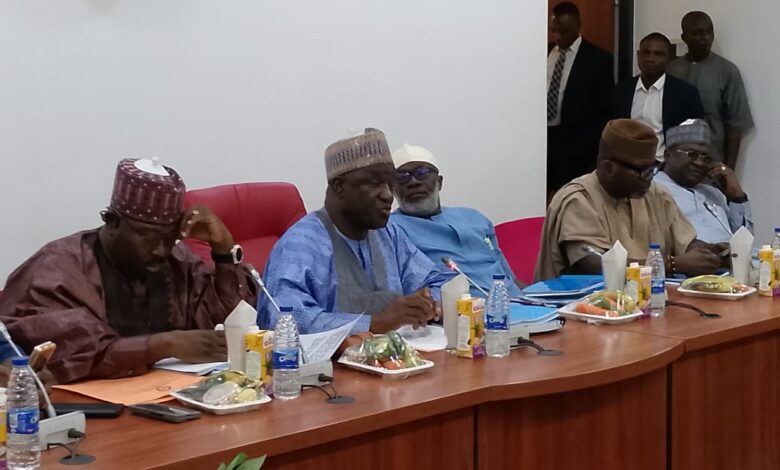
The Senate Committee on Labour, Employment and Productivity on Thursday raised serious concerns over the poor capital funding of the Federal Ministry of Labour and Employment, as it reviewed the ministry’s 2025 budget performance and examined its 2026 projections.
Chairman of the Committee, Senator Diket Plang (Plateau Central), said the panel was particularly disturbed that only 7.9 per cent of the ministry’s N5.103 billion capital allocation for 2025 had been warranted, with no cash-backing yet effected.
“I have seen the content of your capital budget, and if there are deficiencies, you will alert us,” Plang said during the budget defence session. “For today’s screening, we want to hear a summary of your 2025 performance, especially given that only a limited amount of capital release is guaranteed.”
He assured the minister that the Senate was committed to ensuring that funds appropriated to the ministry are released and properly utilised.
“We will work with you and also carry out oversight to ensure that projects are executed in line with what was approved in the budget,” he added.
Minister of Labour and Employment, Muhammad Maigari Dingyadi, in his presentation, confirmed that funding challenges had severely affected the ministry’s operations in 2025.
According to him, out of the N5.103 billion capital allocation, only N403 million, representing 7.9 per cent, had been warranted, and the amount was yet to be cash-backed. The ministry’s overhead budget of N1.323 billion recorded a 58.15 per cent performance, with N769.5 million released.
The minister said the shortfall had led to delays in employment and skills development programmes, limited factory inspections, inability to rehabilitate state and zonal offices, and reduced participation in international labour engagements.
He further warned that Nigeria risks suspension from the African Regional Labour Administration Centre (ARLAC) due to unpaid statutory contributions, while outstanding dues to the International Labour Organization (ILO) have restricted the country’s participation in key global labour meetings.
“Our standing arrears to the ILO have become a source of embarrassment,” Dingyadi said, noting that several international commitments remain unsettled due to funding limitations.
The minister disclosed that the ministry recently signed a Memorandum of Understanding with Saudi Arabia on labour migration, with the potential to create thousands of regulated overseas job opportunities for Nigerians. He added that Germany, China, Japan and the Republic of Korea have also expressed interest in similar arrangements.
However, he stressed that financial constraints remain a major barrier to implementing such bilateral agreements.
On the 2026 budget, Dingyadi said the ministry’s capital projection stands at N3.57 billion, about 70 per cent of the 2025 allocation, describing it as inadequate to sustain nationwide labour administration and international obligations.
Responding, Senator Plang said the committee would scrutinise the ministry’s submissions and ensure that grey areas are clarified. He also referenced a pending bill aimed at strengthening the regulation and certification of labour personnel for export, noting that its passage would support structured labour migration and revenue generation.
The committee pledged to engage relevant authorities to improve funding releases, warning that underfunding the labour sector could worsen industrial unrest and undermine national stability.
About The Author