
By Fatima Saka
Nigeria on Thursday marked the official close-out of the Commonwealth Partnerships for Antimicrobial Stewardship (CwPAMS) Programme, with health leaders, technical partners and frontline experts calling for stronger national commitment to sustain the country’s progress in combating antimicrobial resistance (AMR).
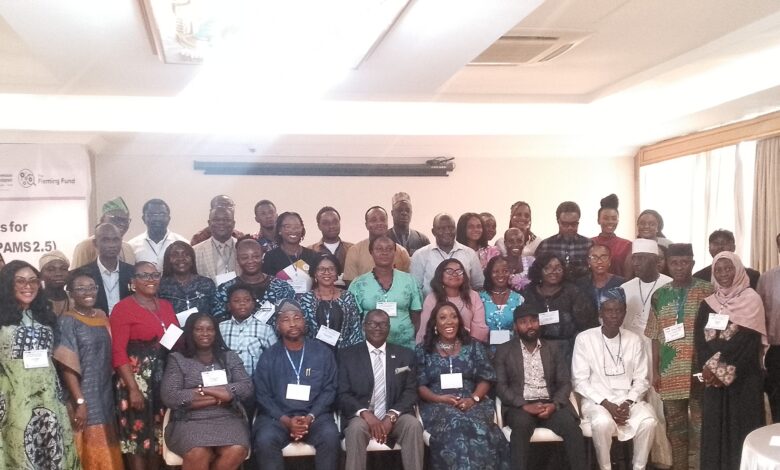
The one-day event, organised in conjunction with the Federal Ministry of Health and Social Welfare and coordinated by Ducit Blue Solutions, brought together key stakeholders from hospitals, regulatory agencies, academia and the international health community to review achievements made since the programme began in Nigeria in 2021, second phase in 2023 to December 2025.
Speaking at the event, Pharm. Estelle Mbadiwe, Founding Partner of Ducit Blue Solutions and the local coordinating partner for CwPAMS, described the close-out as a critical sustainability moment for Nigeria. She noted that the programme has supported 17 facilities across the country and delivered major gains in leadership, governance, antimicrobial use guidelines, community engagement and capacity building.
According to her, the priority going forward is to integrate these achievements into Nigeria’s national AMR mechanism and ensure long-term sustainability beyond donor funding.
Mbadiwe explained that the UK-funded initiative, supported by the Fleming Fund, Global Health Partnerships and the Commonwealth Pharmacists Association, has strengthened health workforce capacity, advanced bilateral learning between Nigerian and UK institutions, and improved medicines quality monitoring. She stressed that Nigeria has demonstrated that national and community-level collaboration can significantly drive progress in AMR mitigation, but sustaining momentum is essential.
Former Minister of Health and member of the UN One Health Global Leaders Group on AMR, Prof. Onyebuchi Chukwu, warned that antimicrobial resistance remains a silent but deadly pandemic, emphasized that West Africa records one of the highest AMR-related mortality rates globally, with Nigeria alone recording 65,000 deaths in 2021 attributable to AMR.
Chukwu further stressed that sustainability must extend beyond financial support, requiring commitment, motivation and national ownership. He added that Nigeria’s hosting of the 2026 High-Level Global Ministerial Meeting on AMR in Abuja demonstrates strong national intent, but urged the country to match intent with action, including domestic financing, innovation and continued collaboration with international partners.
Representing the Director-General of the Nigeria Centre for Disease Control and Prevention (NCDC), Dr. Ridwan Yahaya, the National AMR Focal Point, stressed that antimicrobial stewardship cannot be effective if limited to tertiary hospitals, noting that the community is where most antibiotics are consumed.
He commended CwPAMS for expanding efforts into community pharmacy engagement, which he described as a major gap in Nigeria’s response. Yahaya urged the Federal Ministry of Health to ensure tertiary hospitals establish and institutionalize AMS programmes, while calling on state governments to set up One Health AMR governance structures to drive equitable national progress.
In a presentation on UCH Ibadan’s progress, Dr. Babatunde Ogunbosi, Reader/Consultant in Paediatric Infectious Diseases at the University of Ibadan and University College Hospital (UCH), highlighted key milestones achieved through the institution’s AMS interventions. These include training over 600 health workers, expanding stewardship activities to state-owned health facilities, integrating behavioral and organizational change models into training, conducting point prevalence surveys supported by new diagnostic technology, generating context-specific AMR data, developing in-house treatment guidelines and engaging community pharmacists to curb over-the-counter antibiotic misuse. UCH also supported the establishment of an AMR student club to strengthen AMR education among young health professionals.
Pharmacist Moshood Olukulawal, one of Nigeria’s in-country consultants for the programme, described CwPAMS as a landmark opportunity that fostered strong inter-professional collaboration between microbiologists, doctors, nurses and pharmacists. He noted that despite the programme’s close-out, the work of combating AMR must continue and expand.
READ ALSO: Glo Mobile, NCC, Megatech Sued Over Alleged Breach of Contract, Unpaid $9.5m Consultancy Fee
Across presentations, stakeholders emphasized that AMR cannot be addressed as a donor-driven agenda. They called on the Federal Government, state authorities and the private sector to scale up domestic funding, institutionalize AMS programmes nationwide and strengthen the hub-and-spoke model proven under CwPAMS.
With Nigeria preparing to host the 2026 High-Level Ministerial Meeting on AMR, experts say this is the moment for the country to demonstrate leadership, deepen accountability and ensure that the gains made under CwPAMS translate into long-term national capacity, stronger health systems and safer antibiotic use for all Nigerians.
.
About The Author