
By Fatima Saka
Abuja — The Federal Government of Nigeria and the People’s Republic of China have strengthened collaboration on public health security, declaring it a critical pillar for national and economic stability, with far-reaching implications for Nigeria, Africa, and the global community.
Speaking at a high-level symposium on Monday in Abuja, the Coordinating Minister of Health and Social Welfare, Muhammad Ali Pate, underscored that recurring outbreaks—from Ebola to COVID-19—have exposed vulnerabilities in global health systems and reinforced the urgency of collective preparedness.
Pate explained that the engagement with China and other international partners provided a platform to reflect on past lessons and translate them into actionable strategies. He emphasized: “Nigeria is adopting a multi-sectoral “One Health” approach, bringing together the ministries of health, agriculture, livestock, and environment to address the complex drivers of infectious diseases.’

According to him, the collaboration is expected to yield concrete outcomes, including improved disease surveillance systems, stronger laboratory networks, enhanced emergency response capacity, and expanded use of genomics and data science.
He noted that investments in clinical research, clinical trials, and community engagement will also play a key role in building trust and ensuring effective outbreak response.
Pate further highlighted Nigeria’s openness to global partnerships, stressing that health security depends on sustained international cooperation. He described the engagement as a relationship built on trust, solidarity, and shared responsibility, rather than a transactional arrangement, adding that Nigeria is ready to both contribute to and benefit from global scientific knowledge.
Providing further insight, the Minister of State for Health and Social Welfare, Iziaq Adekunle Salako, focused on the importance of diagnostic capacity as a cornerstone of effective healthcare delivery.
Salako noted that without accurate and timely diagnosis, disease control efforts are significantly weakened. He said the Nigeria-China partnership will help strengthen laboratory systems, improve access to modern diagnostic tools, and enhance the ability of health workers to detect and respond to outbreaks early.
He also referenced China’s COVID-19 experience, describing it as a model of coordinated response, where strong public health infrastructure, disciplined implementation, and rapid decision-making contributed to relatively lower fatality rates despite large case numbers.
Salako added: “Nigeria’s strategic position in West Africa—accounting for nearly half of the sub-region’s population—means that strengthening its health system will have a ripple effect across neighbouring countries, significantly improving regional health security.”
From the Chinese delegation, renowned virologist and academician, George Gao, stressed the critical role of data sharing and global cooperation in combating infectious diseases.
Gao warned that pathogens evolve and spread rapidly, often outpacing national responses, and stressed that withholding data only worsens global vulnerability. He pointed to the emergence of multiple COVID-19 variants as evidence of how quickly viruses adapt when surveillance and information sharing are inadequate.
He called for a unified global system where countries share epidemiological and genomic data transparently and in real time. Gao also emphasized the importance of resilient public health systems, commending Nigeria’s efforts while encouraging further improvements.
In addition, he highlighted basic public health infrastructure—particularly water supply and sanitation—as fundamental to disease prevention. Drawing from China’s experience, he advocated for what he termed a “toilet revolution,” stressing that improved sanitation systems are essential for reducing disease burden in rapidly growing economies.
In his goodwill message, the Chinese Ambassador to Nigeria, Yu Dunhai, placed the partnership within the broader context of strengthened bilateral relations between Nigeria and China.
He noted that the elevation of diplomatic ties to a comprehensive strategic partnership following President Bola Ahmed Tinubu’s 2024 visit to China has created new opportunities for cooperation in health, science, and technology.
Yu emphasized that the global public health landscape is becoming increasingly complex, with rising risks of emerging and re-emerging diseases, as well as constraints in international health assistance.
He said: “China is committed to supporting Nigeria through South-South cooperation, focusing on capacity building, access to medical resources, and joint scientific innovation.”
He reaffirmed that the Chinese government and its institutions, including the Chinese Academy of Sciences, will continue to serve as key partners in advancing public health collaboration.
Also speaking, the Country Representative of the World Health Organization in Nigeria, Pavel Ursu, emphasized that global health security depends on solidarity, science, and equity.
“The COVID-19 pandemic exposed the reality that no country—regardless of its level of development—can independently manage global health threats”, Ursu noted. Stressing that pathogens move faster than policies, making early detection, rapid response, and transparent data sharing essential.
He highlighted key lessons from the pandemic, including the importance of strong surveillance systems, functional laboratories, and resilient primary healthcare systems capable of sustaining essential services during crises.
Ursu also referenced ongoing global efforts to strengthen international health regulations and negotiate a pandemic treaty aimed at ensuring equitable access to vaccines, diagnostics, and treatments.
He commended Nigeria and China for their leadership in advancing frameworks for pathogen data sharing and benefit distribution.
Foreign Affairs Minister Tuggar Resigns to Pursue Bauchi Governorship Bid
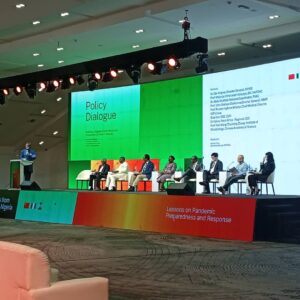
The symposium featured extensive technical discussions on critical pillars of health security, including surveillance and laboratory systems, emergency response coordination, community engagement, and policy development.

The event also featured the presentation of an Award of Excellence to George F. Gao.


Participants agreed that the Nigeria-China partnership represents a significant step toward building a robust public health system anchored on science, innovation, and international cooperation.
They stressed that with the uncertainty surrounding future pandemics, sustained collaboration and preparedness remain essential, as global health security is only as strong as its weakest link.
About The Author