By Fatima Saka
The Federal Government has intensified efforts to fully integrate oral health into Nigeria’s primary healthcare system, mandating Primary Health Centres (PHCs) to provide oral hygiene education, counselling, essential diagnostics, fluoride application, basic restorative services and referrals where necessary.
This will be further strengthened through the reorganisation and expansion of the Basic Health Care Provision Fund (BHCPF), which is expected to unlock additional funding to improve access to oral healthcare services, particularly for vulnerable and underserved populations.
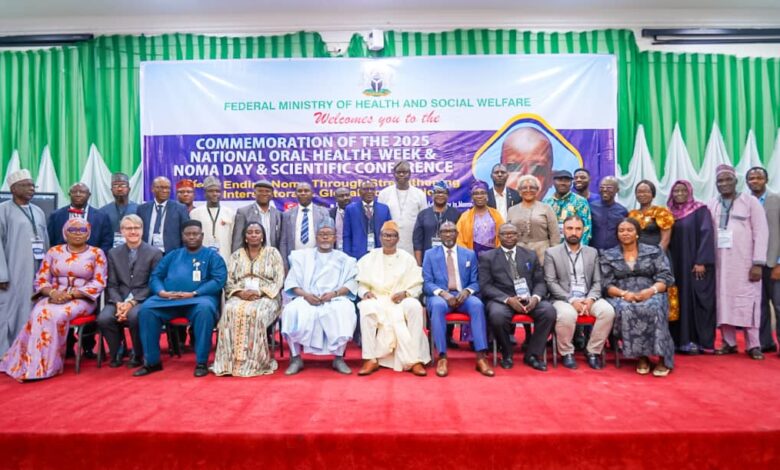
These commitments formed the focus of the keynote address delivered by the Honourable Minister of State for Health and Social Welfare, Dr. Iziaq Adekunle Salako, at the commemoration of the 2025 National Oral Health Week, Noma Awareness Day and Scientific Workshop, held on Tuesday in Abuja.
Speaking on the theme, “Ending Noma through Strengthening Intersectoral and Global Collaboration,” Dr. Salako underscored that oral health is an integral part of overall wellbeing, quoting the World Health Organization (WHO) that “there is no health without oral health.” He noted that millions of Nigerians, particularly children and the elderly, continue to live with preventable conditions such as dental caries, periodontal disease and oral cancers, which erode dignity, productivity and quality of life.
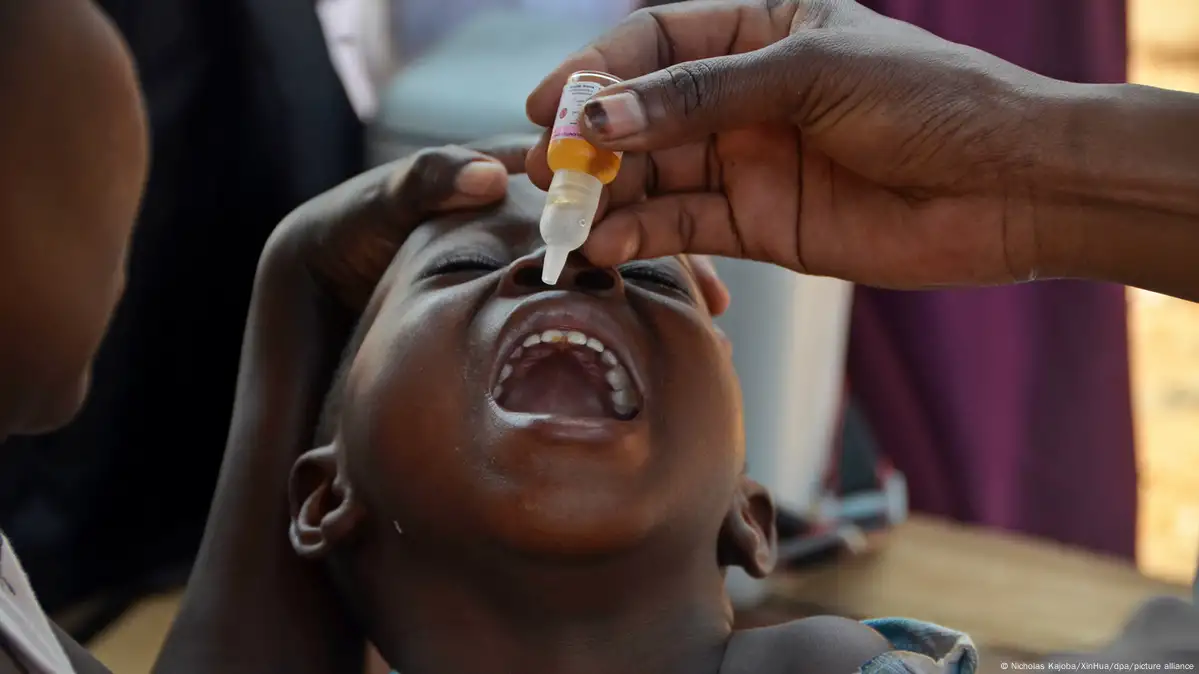
He drew attention to the devastating impact of noma — a rapidly progressing gangrenous disease that primarily affects malnourished children living in extreme poverty and poor sanitary conditions.
According to him, Nigeria remains within the noma belt in sub-Saharan Africa, with the North-West region carrying a disproportionate burden due to poverty, malnutrition, poor oral hygiene and weak surveillance systems that result in late diagnosis and avoidable deaths.
To address the challenge, the Minister announced plans to upgrade and equip dental facilities nationwide and employ more dental professionals at the primary healthcare level. He added that community health workers, PHC personnel and traditional birth attendants are being trained to identify and refer cases of oral diseases, including noma, cleft lip and cleft palate, for comprehensive and, in many cases, free treatment.
Dr. Salako also highlighted the Federal Government’s commitment under President Bola Ahmed Tinubu, referencing the establishment of the Noma Centre in Abuja and the Noma Children’s Hospital in Sokoto State, where patients receive free treatment and rehabilitation. He called for a whole-of-society response, involving investments in nutrition, water and sanitation, housing, immunisation, and maternal and child health, stressing that “noma is not just a medical failure, but a societal inadequacy.”
In her welcome address, the Permanent Secretary, Federal Ministry of Health and Social Welfare, Daju Kachollom, mni, described noma as one of the most devastating yet preventable diseases. She said the 2025 theme underscores the critical need for coordinated action across key sectors such as nutrition, WASH, education, social protection and community development.
Mrs. Kachollom noted that Nigeria played a pivotal role in securing the recognition of noma as a Neglected Tropical Disease (NTD) by the WHO in 2023 — a landmark that has since helped to galvanise global attention, funding and research. She reaffirmed the Ministry’s commitment to integrating oral health into primary healthcare, expanding workforce capacity and ensuring that services remain accessible, affordable and sustainable for all Nigerians.
Speaking on behalf of the Noma Aid Nigeria Initiative (NANI), its Chairman, Mr. Mathis Winklers, reiterated the organisation’s continued commitment to supporting Nigeria in the fight against the disease. He disclosed that over 200 noma survivors have received treatment at the Noma Treatment Centre in Abuja, many of whom required complex microvascular surgeries due to severe facial disfigurement.
He paid tribute to his late mother, a long-time advocate in the fight against noma, and praised Nigeria for being at the forefront of global awareness and prevention efforts, noting that Nigeria’s National Noma Day remains the only one of its kind in the world. He pledged NANI’s sustained partnership in research, prevention, advocacy and surgical interventions.
Representing Médecins Sans Frontières (MSF) and Frontier Medicine, Dr. Ahmed Adhikari highlighted MSF’s longstanding collaboration with the Federal Ministry of Health, particularly at the Noma Hospital in Sokoto. He revealed that since 2014, more than 1,600 reconstructive surgeries have been performed on over 1,000 patients through multiple surgical missions, with 99 surgeries carried out on 89 patients in 2025 alone.
Dr. Adhikari added that MSF has also trained 28 Nigerian surgeons and 14 anesthetists, helping to build sustainable local capacity to manage noma cases. He emphasised the need to scale up community awareness, early screening, frontline worker training and the integration of noma surveillance into both public and private healthcare systems, while calling for increased domestic and international funding.
Also speaking, the President of the Nigerian Dental Association (NDA), Dr. Elias Emedom, reaffirmed the association’s commitment to oral health promotion, prevention and professional development. He noted that the NDA has remained at the forefront of community sensitization, early diagnosis and advocacy for the eradication of noma, particularly in underserved areas.
He highlighted the participation of Nigerian oral health professionals in international engagements such as the World Dental Conference in Shanghai, China, which has strengthened global partnerships and knowledge exchange.
Dr. Emedom further called for the full implementation of the National Oral Health Policy and improved working conditions for dental professionals to curb brain drain in the sector.
READ ALSO: Diaspora Committee Maps Advocacy Visits, Reassures Nigerians Abroad of Senate’s Support
Utsev Marks Birthday with Prayers, Reaffirms Commitment to Water Security, National Development
The event brought together government officials, development partners, healthcare professionals, civil society organisations and international agencies, all united in a renewed determination to eliminate noma and strengthen oral healthcare services across Nigeria.
As the week-long commemoration continues, stakeholders reiterated that no Nigerian child should suffer or die from a disease that is entirely preventable, pledging to intensify collaboration, research, awareness campaigns and service delivery to protect the smiles, dignity and future of every Nigerian.
About The Author