By Fatima Saka
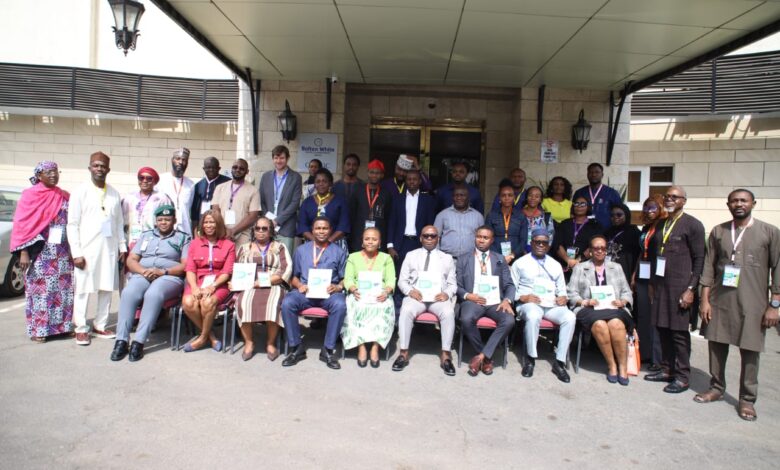
The Federal Government, working with development partners, has inaugurated the National Cosmetics Safety Management Technical Working Group (NCSM-TWG) as part of efforts to curb the rising health risks associated with unsafe cosmetic products in Nigeria.
The inauguration, held on Tuesday in Abuja, signals the commencement of full implementation of the National Policy on Cosmetics Safety and Health, aimed at protecting Nigerians from the silent but widespread dangers posed by substandard and unregulated cosmetic products.
Representing the Permanent Secretary of the Federal Ministry of Health and Social Welfare, Mrs. Daju Kachollom, mni, the Senior Technical Assistant, Dr. Dogara Okara, said cosmetic safety has become an urgent public health concern requiring coordinated national action.
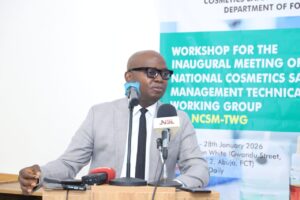
The Permanent Secretary Federal Ministry of Health Social Welfare, ably represented by Dr. Dogara Okara, Senior Technical Assistant to the P.S.; delivering the keynote address during the Workshop For The Inaugural Meeting Of The National Cosmetics Safety Management Technical Working Group NCSM-TWG, held today 27 January 2026 in Abuja.
The Permanent Secretary Federal Ministry of Health Social Welfare, ably represented by Dr. Dogara Okara, Senior Technical Assistant to the P.S.; delivering the keynote address during the Workshop For The Inaugural Meeting Of The National Cosmetics Safety Management Technical Working Group NCSM-TWG, held today 27 January 2026 in Abuja. />
He noted that unsafe cosmetics—often containing harmful chemicals such as heavy metals and formaldehyde—are linked to a wide range of health conditions, including skin disorders, hormonal imbalance, kidney damage and cancer.
“For many Nigerians, cosmetics are used daily and over long periods. When these products are poorly formulated, the health consequences can be severe and long-lasting,” Dr. Okara said, adding that the government could no longer afford regulatory gaps in the sector.
He explained that the National Policy on Cosmetics Safety and Health, approved at the 66th National Council on Health meeting in Calabar in November 2025, laid the foundation for the establishment of the Technical Working Group.
According to him, the NCSM-TWG will provide technical leadership for policy implementation, strengthen inter-agency coordination, support enforcement of safety standards and ensure that directives from the National Multi-Sectoral Ministerial Advisory Committee on Cosmetics are translated into action.
“The composition of this group reflects the seriousness of the task ahead. With experts drawn from government, regulatory agencies, academia, civil society and development partners, the expectation is that cosmetic safety regulation in Nigeria will become more effective and evidence-based,” he said.
In his remarks, Dr. Paul Okhakhu, Chairman of the Technical Working Group and Director of the Cosmetics Safety Management Programme, said years of fragmented regulation had allowed unsafe cosmetic products to flood the market, resulting in widespread adverse cosmetic events.
“Improperly formulated cosmetics do not only affect the skin; they can interfere with the endocrine system, damage internal organs and pose risks to unborn children,” he said.
Dr. Okhakhu disclosed that the policy implementation period from 2026 to 2030 would focus on stricter regulation, improved product labelling, enhanced consumer awareness and safer cosmetic formulations aligned with international standards.
Delivering a goodwill message, the World Health Organization (WHO), represented by Dr. Edwin Isotu Edeh, described the policy as a forward-looking intervention that balances public health protection with industry growth.
He warned that unregulated cosmetic production, particularly within the informal sector, poses long-term risks to population health and undermines consumer safety.
On enforcement, the National Agency for Food and Drug Administration and Control (NAFDAC) said regulatory action is already underway. Prince Ikenna Usofor, Director in charge of Imported and Locally Manufactured Cosmetics, stressed that all cosmetic products entering the Nigerian market must meet established safety and quality standards.
“Cosmetics are not occasional-use products; they are applied repeatedly, and the skin readily absorbs many substances. This makes safety regulation non-negotiable,” he said.
Usofor warned that toxic substances such as mercury, lead and excessive fluoride—commonly found in poorly regulated cosmetics—can accumulate in the body and lead to serious health complications over time.
He added that the establishment of the Technical Working Group strengthens NAFDAC’s enforcement capacity by providing a technical framework for surveillance, regulation and inter-agency collaboration.
Addressing the broader public health implications, the Country Representative of Resolve to Save Lives, Nanlop Ogbureke, described the cosmetics safety policy as a critical governance reform that protects consumers while strengthening Nigeria’s cosmetics industry.
“Cosmetics safety lies at the intersection of health, consumer rights and economic development. This policy ensures that public health is not sacrificed in the pursuit of profit,” the organisation said.
Resolve to Save Lives noted that Nigeria’s structured approach to cosmetics safety could serve as a reference point for other African countries confronting similar regulatory challenges.
The Technical Working Group comprises representatives from the Ministries of Health, Environment, Industry, Trade and Investment, regulatory and law enforcement agencies, academic institutions and development partners, including WHO and Resolve to Save Lives.
With the formal launch of the NCSM-TWG, the Federal Government says Nigeria is now better equipped to prevent the circulation of harmful cosmetic products and ensure safer options for consumers through coordinated, sustained and science-driven regulation.
About The Author