Democracy Must Deliver to Earn Trust, Tuggar Tells AU Forum, Highlights Nigeria’s Preventive Democracy Initiative

By Fatima Saka
Nigeria’s Minister of Foreign Affairs, Yusuf Maitama Tuggar, has declared that democracy in Africa must “command trust through delivery,” warning that governance deficits and unmet socio-economic expectations are eroding public confidence in democratic institutions across the continent.
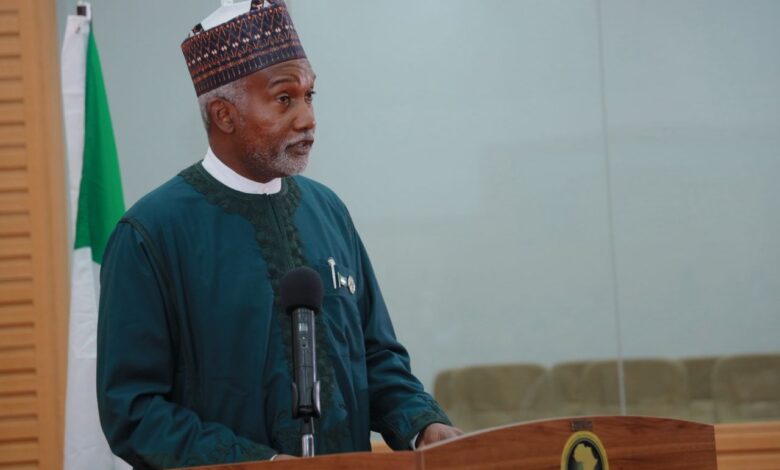
Speaking at the High-Level Ministerial Forum on Regional Partnership for Democracy held on the margins of the 39th Ordinary Session of the Assembly of Heads of State and Government of the African Union in Addis Ababa, Ethiopia, Tuggar said democracy in Africa, though widely affirmed in principle, is increasingly tested in practice.
He noted that while citizens remain committed to democratic ideals, declining institutional performance and weak accountability structures have created a trust gap that must be urgently addressed.
“We meet at a moment when democracy in Africa, though widely affirmed in principle, is increasingly tested in practice,” the minister said. “Democracy on the continent must do more than survive; it must command trust through delivery.”
Tuggar used the forum to spotlight Nigeria’s launch of the Regional Partnership for Democracy (RPD) in November 2025, an initiative developed in collaboration with the United Nations Development Programme.
According to him, the RPD is designed as a preventive mechanism aimed at strengthening democratic systems before breakdowns occur, rather than responding after unconstitutional changes of government have taken place.
“The RPD is conceived as a preventive rather than a curative measure,” he said, explaining that the initiative seeks to enhance the capacity, independence, and credibility of democratic institutions in order to reinforce public trust and institutional legitimacy.
He stressed that recent democratic challenges in West Africa are not limited to military interventions, but also stem from internal weaknesses such as erosion of accountability, exclusionary politics, and widening disconnect between political leadership and citizens.
“In such environments, democracy becomes vulnerable not only to internal decay, but also to external actors who seek to impose uniform governance templates that fail to reflect national realities,” Tuggar cautioned.
The minister outlined three key priorities for strengthening democratic governance across the region: building independent and credible institutions; aligning democracy with tangible socio-economic outcomes; and promoting inclusive participation, especially among youth and women.
He emphasized that electoral bodies, judiciaries, legislatures, and oversight institutions must operate free from undue influence and in strict adherence to constitutional mandates. He also underscored the need for democracy to translate into improved service delivery, job creation, social protection, and equitable development.
“Citizens must experience democracy not only at the ballot box, but also through improved service delivery,” he stated, warning that public trust inevitably wanes when democratic systems fail to address everyday realities.
On inclusion, Tuggar called for sustained investment in civic education, leadership development, and responsible digital engagement to ensure participation is constructive and rooted in democratic values.
NSCDC takes its community engagement to Agege
He further urged stronger coordination between the RPD, Regional Economic Communities, and relevant African Union organs to promote coherence and long-term sustainability in democratic support efforts.
Reaffirming Nigeria’s commitment to democratic governance and multilateral cooperation, Tuggar maintained that Africa’s democratic future would be best secured through partnership and prevention rather than prescription and reaction.
“It is by strengthening democracy before it falters that we secure its future,” he concluded.
About The Author