
By Fatima Saka
The Federal Government has renewed its commitment to reducing preventable deaths among newborns and children, identifying pneumonia and complications arising from premature births as major contributors to Nigeria’s child mortality burden.

The government said pneumonia accounts for approximately 20 per cent of under-five deaths in the country, while complications of prematurity contribute nearly 35 per cent of neonatal mortality, underscoring the need for increased investment in newborn care, early diagnosis and effective treatment.
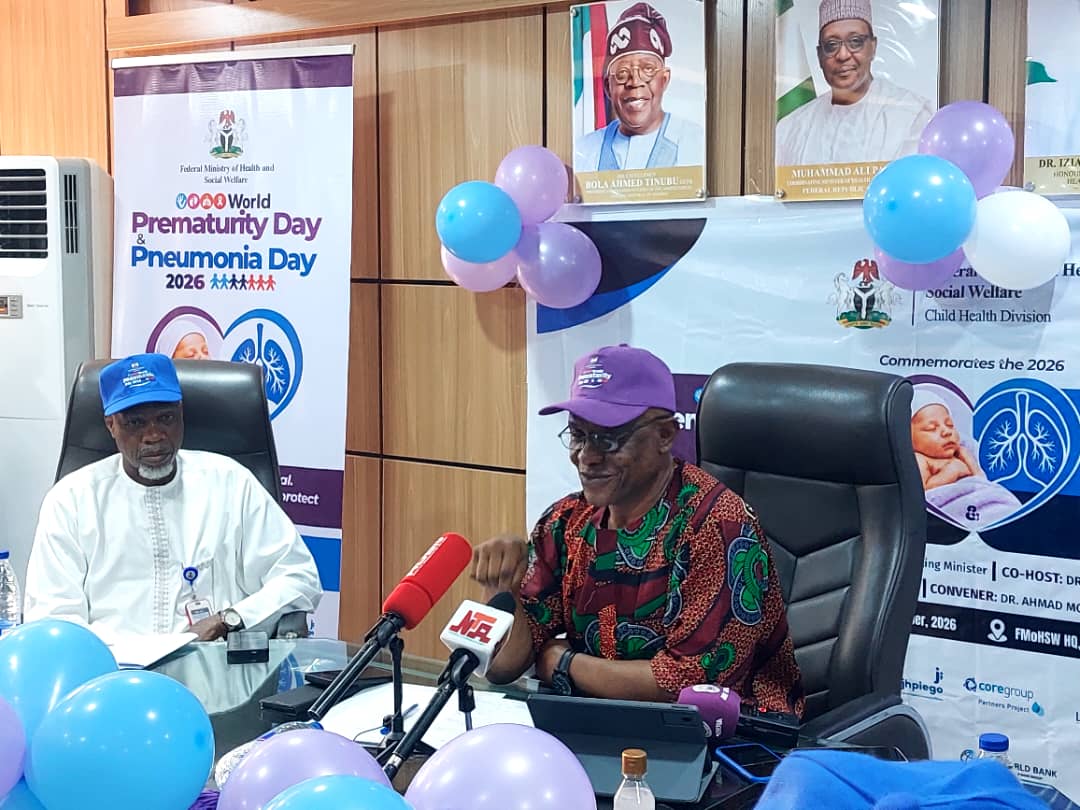
The Coordinating Minister of Health and Social Welfare, Professor Muhammad Ali Pate, represented by the Director and Head of the Department of Health Planning, Research and Statistics, Dr John Ajiwohwodoma Ovuoraye, stated this on Tuesday during a press briefing to commemorate the 2026 World Pneumonia Day and World Prematurity Day.
Pate disclosed that the 2024 National Demographic and Health Survey put Nigeria’s under-five mortality rate at 110 deaths per 1,000 live births, representing an improvement from 138 deaths per 1,000 live births recorded in 2018.
He, however, noted that the figure remained significantly above the Sustainable Development Goal target of reducing under-five mortality to 25 deaths per 1,000 live births.
According to him, the statistics highlight the urgent need for sustained and coordinated interventions to protect newborns and children from preventable deaths.
He explained that premature and low-birth-weight babies were particularly vulnerable to health complications requiring timely and quality medical attention.
The minister noted that although pneumonia was preventable and treatable, it continued to claim children’s lives, particularly in communities where access to early diagnosis and appropriate treatment remained limited.
He identified strengthened essential newborn care, immunisation, improved nutrition, early recognition of danger signs, access to oxygen and quality treatment as critical interventions for improving child survival.
Pate said the 2026 World Prematurity Day theme, *”Small Babies, Big Potential: Invest in Follow-up Care to Protect Their Future,”* highlighted the importance of sustained medical attention for babies born prematurely.
He added that the World Pneumonia Day theme, *”A New Era of Pneumonia Control,”* provided an opportunity to strengthen public awareness, mobilise communities and promote evidence-based interventions against the disease.
The minister called on governments at all levels, development partners, professional bodies, civil society organisations, the media, communities and families to strengthen collaboration and translate advocacy into practical actions.
He particularly urged the media to provide accurate information, highlight the preventability of newborn and child deaths and keep the welfare of newborns and their families on the national agenda.
He said the Federal Government remained committed to ensuring that families accessed healthcare without delay and that health facilities were adequately equipped to provide appropriate treatment and follow-up care.
The Permanent Secretary of the Federal Ministry of Health and Social Welfare, Daju Kachollom mni, represented by the Director of Family Health, Dr Ahmad Mohammad Ozi, also reaffirmed the ministry’s commitment to improving maternal, newborn and child health outcomes.
The ministry acknowledged the importance of collective action among government institutions, development partners, healthcare professionals and communities in addressing preventable deaths among newborns and children.
Speaking at the event, the World Health Organisation’s Team Lead, Health Systems and Services, Dr Mary Brantuo, stressed the need for continued medical attention for premature babies, noting that their care should not end when they are discharged from neonatal intensive care units.
Brantuo said an estimated 15 million babies were born prematurely worldwide every year, representing approximately one in 10 births.
According to her, premature babies require continuous monitoring, developmental assessments, specialised support and timely medical interventions to address possible complications.
She explained that families also needed adequate guidance and support to care for premature babies after returning home.
On pneumonia, Brantuo said despite improvements in vaccines, diagnostic tools and treatment options, the disease remained one of the deadliest infections, particularly among young children, older adults and vulnerable populations.
She noted that premature babies were especially susceptible to infections, including pneumonia, because of their immature immune systems and fragile health conditions.
The WHO representative called for renewed commitment and increased investment in primary healthcare systems, expanded access to quality health services and comprehensive interventions to prevent avoidable deaths.
She reaffirmed the organisation’s commitment to working with the Federal Government and other stakeholders to improve newborn survival, strengthen follow-up care and eliminate preventable pneumonia deaths.
Also speaking, UNICEF Maternal and Newborn Health Specialist, Victoria Jsiramen, reaffirmed the organisation’s commitment to supporting the Federal Ministry of Health and Social Welfare in improving maternal, newborn and child health outcomes.
Jsiramen said UNICEF was committed to ensuring that every newborn had access to affordable, high-quality and evidence-based healthcare before, during and after birth.
She identified early breastfeeding, warmth, hygiene and skilled community care as essential life-saving interventions for newborns.
She noted that prematurity and pneumonia remained major causes of newborn and child deaths globally, adding that Nigeria contributed significantly to the global burden.
While acknowledging the efforts of the Federal Ministry of Health and other stakeholders, Jsiramen expressed concern that newborn health indicators had regressed despite some improvements in other reproductive, maternal, newborn and child health indicators.
She commended the Federal Ministry of Health for its MAMI initiative and ongoing efforts to reduce maternal and newborn mortality.
She also highlighted UNICEF’s collaboration with the ministry and professional organisations to improve training, strengthen guidelines and upgrade newborn care services, including Level Two newborn care units.
The organisation pledged to continue working with federal and state governments, communities, parents, professional bodies and development partners to ensure that premature babies survived and reached their full potential.
In a separate remark, a representative of the National Child Health Technical Working Group reaffirmed the group’s commitment to supporting the Federal Ministry of Health in developing and implementing strategies to improve child survival.
The representative explained that the group comprised experts brought together by the ministry to provide technical support on policies and interventions aimed at reducing child mortality.
READ ALSO: Senate Approves $20.5bn External Borrowing Plan, Says $7.7bn Loan Not Additional
Customs Reforms: Adeniyi Urges Public Institutions to Put Communication in Heart of Policy Decisions
The group pledged to work with the ministry and other stakeholders to ensure that essential interventions targeting premature births and pneumonia were effectively implemented across the country.
The joint commemoration brought together officials of the Federal Ministry of Health and Social Welfare, development partners, professional bodies, health experts and other stakeholders to renew commitments towards reducing preventable newborn and childhood deaths in Nigeria.
About The Author