By Fatima Saka
The World Health Organization (WHO) and a Member of the European Parliament have called for stronger action against antimicrobial resistance (AMR), warning that the growing misuse of antibiotics and other antimicrobial medicines in humans and animals is threatening lives, livelihoods and modern medicine.
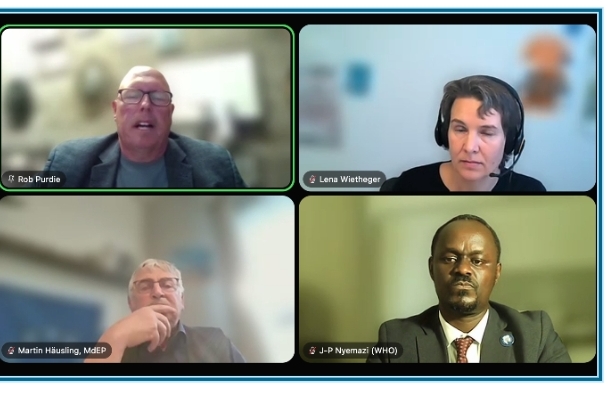
The call was made at a press conference organised by the WHO and Hon. Martin Häusling, Member of the European Parliament on Wednesday, to mark the exhibition “AMR: The Human Stories Behind a Silent Pandemic,” taking place at the European Parliament from Sept. 28 to Oct. 2, 2026.
Häusling said the misuse of antibiotics in animal husbandry remained a major concern, particularly the routine treatment of entire groups of animals when only some show signs of infection.
He said the practice of giving antibiotics to thousands of animals in response to a single infection could contribute to drug resistance, stressing the need to move away from mass and prophylactic treatment.
According to him, the problem also extends to the environment, as resistant pathogens can enter water systems through wastewater from slaughterhouses and other agricultural facilities.
He called for more targeted use of antimicrobials, saying treatment should be based on proper diagnosis and the specific medicine required rather than the generalised use of broad-spectrum drugs.
Häusling also raised concern over the use of last-resort antibiotics in food-producing animals, stressing that such medicines should be preserved for situations where other treatment options fail.
He said the challenge was global and required stronger public awareness and political attention, noting that the exhibition was organised to help Members of the European Parliament understand that AMR could affect anyone.
“AMR can destroy families and livelihoods,” he said, adding that he would continue to push the issue on the parliamentary agenda.
The Acting Director, AMR Department, WHO Headquarters, Dr Jean-Pierre Nyemazi, said AMR affects humans, animals, plants, food systems, economies and the environment, with resistant pathogens capable of moving across borders and between sectors.
He stressed that the One Health approach was essential because antimicrobial resistance could not be effectively addressed by the human health sector alone.
Nyemazi said bacterial AMR was associated with more than 4.7 million deaths globally in 2021, while about 1.14 million deaths were directly attributable to it. WHO’s latest figures also show that one in six laboratory-confirmed bacterial infections causing common infections globally was resistant to antibiotics in 2023.
He said AMR also imposes economic costs through prolonged hospital stays, additional healthcare expenses, loss of productivity and the impact on families who may have to leave employment to care for sick relatives.
Nyemazi urged parliamentarians to ensure that national AMR commitments were supported by legislation, financing and accountability, while also highlighting the role of the media in taking AMR beyond scientific circles and into public debate.
He said WHO was working with the Food and Agriculture Organization of the United Nations, United Nations Environment Programme and World Organisation for Animal Health under the Quadripartite framework to strengthen the global One Health response.
Nyemazi noted that the updated Global Action Plan on AMR 2026–2036 provides a 10-year framework focused on prevention, surveillance, responsible antimicrobial use, access to quality medicines and diagnostics, environmental protection, research and innovation, and stronger governance.
He also recalled the 2024 UN commitment to reduce deaths associated with bacterial AMR by 10 per cent by 2030. WHO says the target is part of the global response agreed by countries at the UN General Assembly High-Level Meeting on AMR.
Sharing his personal experience, Rob Purdie, an AMR survivor and member of the WHO Task Force of AMR Survivors, said his battle involved an antifungal-resistant infection that began with what was initially diagnosed as a sinus infection.
Purdie said delayed diagnosis resulted in his fungal infection progressing to meningitis, after which he underwent prolonged treatment involving several antifungal medicines and severe side effects.
He said the illness eventually affected his ability to work for about five years and placed a significant financial burden on his family.
Purdie said his experience demonstrated how delayed diagnosis, limited treatment options and antimicrobial resistance could affect not only patients but also families, health systems and economies.
He urged stakeholders to stop treating AMR as a “silent pandemic”, arguing that survivors and affected families should have a stronger voice in public discussions about the crisis.
During the question-and-answer session, Nyemazi said tackling the sale and use of antibiotics without appropriate prescriptions would require simultaneous action by governments, healthcare providers, pharmacies and the public.
He said governments needed to strengthen primary healthcare so that people could obtain timely diagnosis and appropriate treatment, while pharmacies should comply with regulations restricting the dispensing of certain antibiotics without prescriptions.
He also advocated the use of technology to track medicines dispensed by pharmacies and enable authorities to determine whether they were provided for appropriate clinical reasons.
On Nigeria, Nyemazi said the challenges facing human health systems were mirrored in animal health, where access to veterinary services remained limited in many places.
He identified prevention as the most effective and least costly approach, including vaccination, infection prevention and control, water, sanitation and hygiene, improved animal husbandry and responsible antimicrobial use.
Nyemazi further called for stronger coordination among government, civil society, the private sector and individuals, noting that AMR’s multisectoral nature made coordination critical to an effective response.
He said the updated global action plan places greater emphasis on governance, behavioural change and measurable targets, while also strengthening the One Health component by bringing human, animal, food and environmental sectors together.
Purdie said journalists had an important role in changing public understanding of AMR by focusing not only on prescriptions but also on prevention, vaccination, diagnostics, WASH and the experiences of people affected by resistant infections.
Nyemazi also called for increased investment in new antibiotics, antifungals, phage therapy and other innovations, while warning that new medicines alone would not solve the problem if existing treatments were not properly preserved.
He stressed the need to combine research and development with antimicrobial stewardship, diagnostics, training and appropriate use of medicines.
READ ALSO: FG Targets 50,000 North-Central Youths for Free Digital, Employability Training
SON Warns Manufacturers Against Compromising Certifies Standards
Purdie said developing a novel antifungal medicine could take decades, making responsible use of existing medicines essential while new treatments were being developed.
WHO says the misuse and overuse of antimicrobials are major drivers of resistance, while inadequate access to vaccines, diagnostics, medicines, clean water, sanitation and infection prevention also contribute to the crisis.
The exhibition at the European Parliament is using personal stories from across Europe to illustrate the human consequences of AMR and to encourage greater political and public attention to the growing global health challenge.
About The Author