
By Fatima Saka
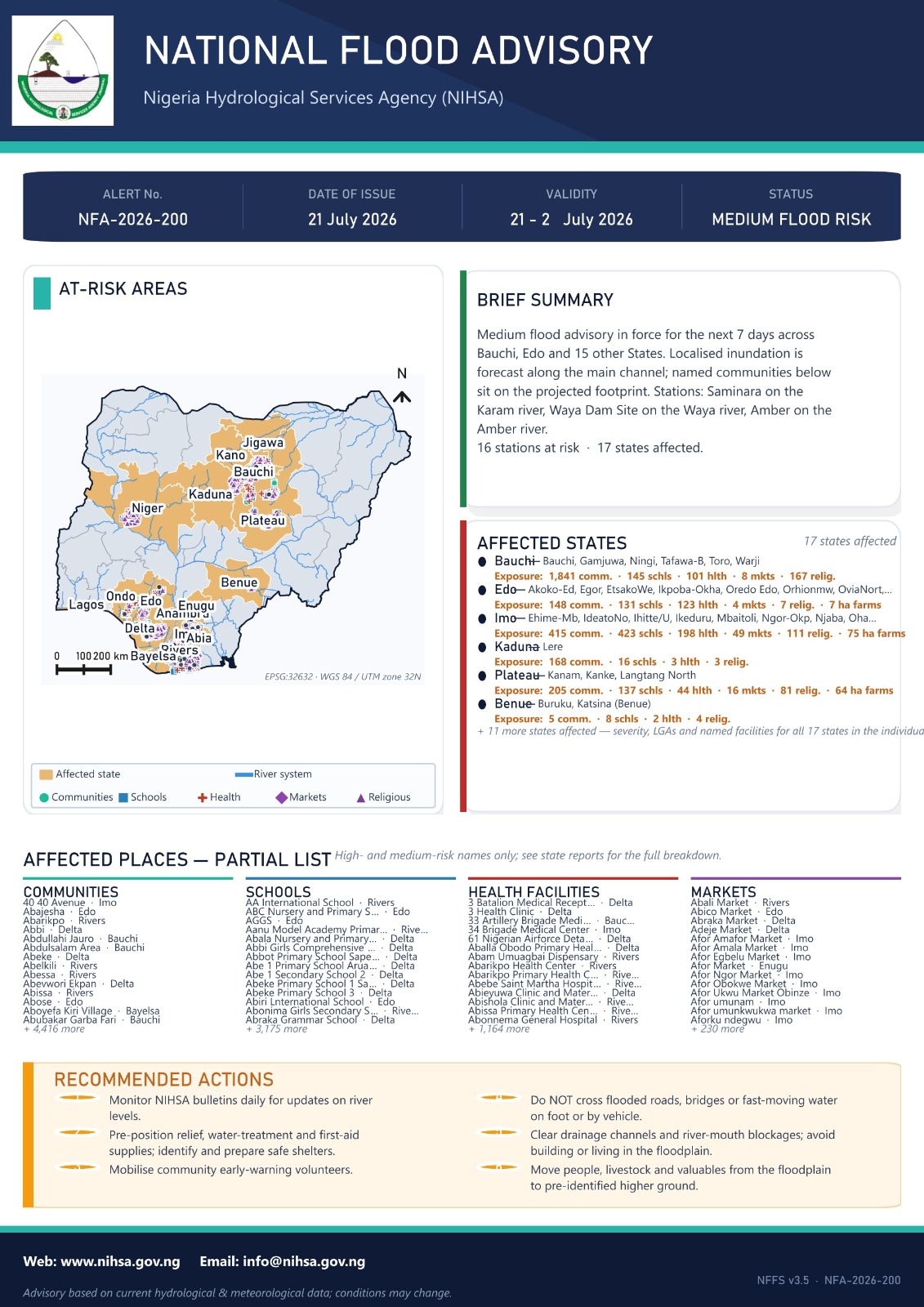
The Nigeria Hydrological Services Agency (NIHSA) has issued a Medium Flood Risk Advisory across 17 states, warning that thousands of communities and critical infrastructure could be affected between July 21 and July 27, 2026.
In the advisory released on Tuesday, NIHSA listed the affected states as Abia, Anambra, Bauchi, Benue, Bayelsa, Edo, Enugu, Delta, Plateau, Imo, Jigawa, Kaduna, Niger, Kano, Lagos, Ondo and Rivers.
The agency said localized flooding is expected along major river channels, with at least 16 monitoring stations identified as high-risk points. Among the key vulnerable locations are Saminara on the Karam River, Waya Dam Site on the Waya River, and Amber on the Amber River.
NIHSA warned that the projected flood footprint could impact thousands of communities, schools, health facilities, markets, religious centres and farmlands, raising concerns over livelihoods and public safety.
Data provided by the agency shows that Bauchi State is among the hardest hit, with 1,841 communities, 145 schools and 101 health facilities at risk across several local government areas, including Bauchi, Gamawa, Ningi, Tafawa Balewa, Toro and Warji.
In Edo State, about 148 communities, 131 schools and 123 health facilities are exposed to possible flooding, particularly in Akoko-Edo, Egor, Etsako West, Ikpoba-Okha and Oredo LGAs.
Imo State also faces significant exposure, with 415 communities, 423 schools and 198 health facilities at risk across LGAs such as Ideato North, Ihitte/Uboma, Ikeduru, Mbaitoli, Ngor Okpala and Njaba.
Similarly, Kaduna State has 168 communities and 16 schools at risk in Lere LGA, while Plateau State could see impacts on 205 communities, 137 schools and 44 health facilities in Kanam, Kanke and Langtang North LGAs. In Benue, five communities and eight schools in Buruku and Katsina-Ala LGAs are listed as vulnerable.
The agency noted that detailed exposure levels for other states are contained in individual state reports.
To mitigate the potential impact, NIHSA advised authorities and residents to closely monitor flood updates, pre-position emergency supplies, and activate community-based early warning systems.
Residents were also warned not to cross flooded roads or fast-moving water, and to relocate people, livestock and valuables from flood-prone areas to safer, elevated grounds.
READ ALSO: Outrage over Nurse Assault in Ibadan Hospital Sparks Calls for Justice, Better Staffing
Afriland Seeks Partnerships for Affordable Housing
“Citizens are advised to remain vigilant and adhere strictly to safety guidelines to reduce risks associated with flooding,” the agency stated.
NIHSA further urged communities to avoid building or residing on floodplains, emphasizing the importance of preparedness as the rainy season intensifies.
About The Author